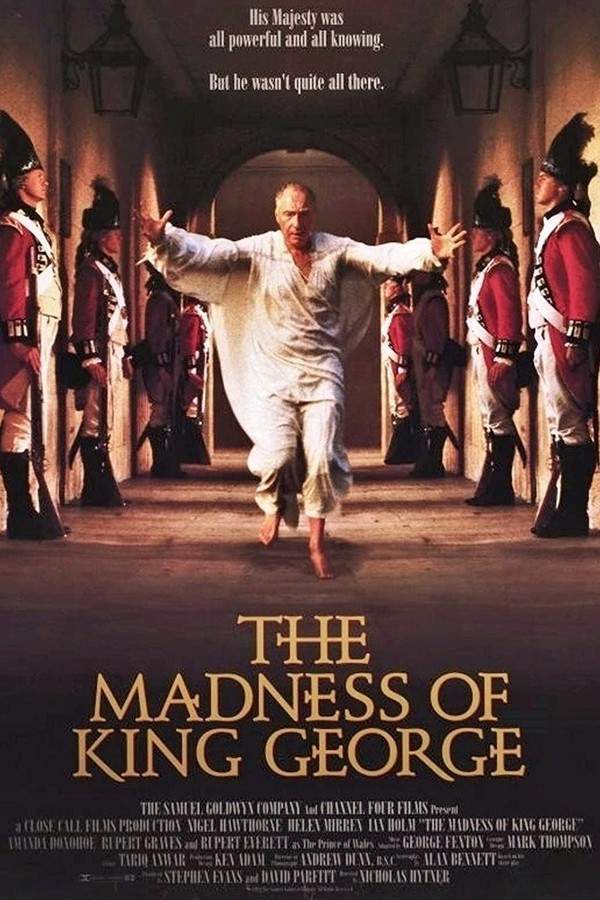
The Madness of King George

The Madness of King George

Year: 1994

Runtime: 104 min

Language: English

Director: Nicholas Hytner

BiographyDramaHistoryComedy

In 1788, King George III of England suffers a mysterious illness that increasingly impairs his mental state, leading to erratic behavior and bewildering episodes. His doctors struggle to understand the cause of his condition as the king’s episodes become more frequent and severe. Queen Charlotte and Prime Minister William Pitt the Younger must work together to manage the escalating crisis and protect the monarchy from those who seek to exploit the king’s vulnerability and destabilize the nation.

Warning: spoilers below!

Haven’t seen The Madness of King George yet? This summary contains major spoilers. Bookmark the page, watch the movie, and come back for the full breakdown. If you're ready, scroll on and relive the story!

Timeline – The Madness of King George (1994)

Trace every key event in The Madness of King George (1994) with our detailed, chronological timeline. Perfect for unpacking nonlinear stories, spotting hidden connections, and understanding how each scene builds toward the film’s climax. Whether you're revisiting or decoding for the first time, this timeline gives you the full picture.

1

King George III's Decline

In 1788, King George III begins to struggle with madness, which sparks the Regency Crisis. This period sees intense power struggles within the British Parliament, as various factions vie for control amidst the King's deteriorating condition.

1788
2

The Prime Minister's Position

Tory Prime Minister William Pitt the Younger finds himself in a precarious situation as King's mental state worsens. He faces challenges from reform-minded opposition leader Charles James Fox, who has different visions for Britain's future.

British Parliament
3

The King's Love for His Family

Despite his madness, King George III shows unwavering dedication to his wife, Queen Charlotte, and their 15 children. His affection for his family remains constant, even as he copes with his internal struggles.

4

Prince of Wales Seizes Opportunity

George, Prince of Wales, sees the King's decline as an opportunity to pursue greater power. Resentful of his father, he secretly marries Mrs. Fitzherbert in 1785, a move he understands is illegal without royal approval.

1785
5

Provocative Concert

Aligning himself with Fox, the Prince arranges a concert featuring Handel's music to provoke his father. The event takes a chaotic turn when King George, distracted and erratic, engages in inappropriate behavior with Lady Pembroke and attacks his son.

6

King George's Moment of Clarity

In a touching moment with Queen Charlotte, King George acknowledges his mental decline. Their conversation is cut short by his physician’s advice, revealing the toll that mental illness takes on personal connections.

7

Archaic Treatments Begin

Under Dr. Warren's care, King George undergoes painful and outdated treatments focused solely on his bodily functions. This approach, marked by harsh methods like cupping and laxatives, highlights the brutal realities of medical care at the time.

8

Introduction of Dr. Francis Willis

Lady Pembroke introduces Dr. Francis Willis, who is known for his innovative treatment methods. He offers a more compassionate approach that emphasizes understanding the patient’s perception of their condition, setting the stage for the King's potential recovery.

Lincolnshire
9

The King's Anger and Restraint

As Dr. Willis attempts to treat King George, the King struggles with anger. This leads to incidents where he must be physically restrained to prevent inappropriate behavior, reflecting the complexities of treating mental illness during the Regency era.

Willis's Estate
10

Emotional Move to Kew

The Prince of Wales decides to move King George to Kew, prompting an emotional farewell with Queen Charlotte. This moment underscores the King's internal conflict and struggle as he fights against the restraints imposed on him.

Kew
11

Signs of Improvement

Despite ongoing delusions, King George begins to show signs of improvement thanks to Willis's care. One notable moment occurs when he successfully feeds himself, representing a small victory against the ravages of his illness.

12

Political Maneuvering in Parliament

With the King's condition unstable, the Whig opposition pushes for the Prince to gain regency powers. This political maneuvering is heightened by Baron Thurlow's efforts to suppress news of the Prince's secret marriage.

British Parliament
13

A Moment of Clarity

During a poignant reading from King Lear, King George recalls a phrase he hasn’t used in months, indicating a hopeful return to clarity. This moment symbolizes his progress and suggests a possible reconciliation with his role as king.

King's Quarters
14

Confrontation with the Prince

The King confronts his son in Parliament, compelling him to confess his clandestine marriage to Mrs. Fitzherbert. This crucial moment temporarily resolves the crisis as the Prince agrees to step back and commit to his familial duties.

Parliament
15

Return to Public Life

The royal family receives a warm welcome at St. Paul's Cathedral, signifying a return to stability for King George. His desire to connect with the public reflects a new era for the monarchy, even as he chooses to distance himself from Dr. Willis.

St. Paul's Cathedral

Last updated: November 15, 2024 at 16:25

Was this helpful?

The Madness of King George (1994) Timeline Questions Answered – Chronology FAQ

Find frequently asked questions about the The Madness of King George (1994) timeline, including chronological order, nonlinear jumps, cause-and-effect links, and scene sequence clarifications. This timeline FAQ helps explain when key events happen, how moments connect, and why the story unfolds in that specific order.

Q1

What caused King George III's mental illness in the film?

A.

The film never provides a definitive medical explanation for King George's condition. His symptoms include forgetfulness, erratic behavior, delusions, and blue-colored urine. The precise cause remains medically ambiguous in the historical record, which the film maintains rather than inventing a specific explanation.

Early in the film, George III's obsession with trivial royal appointments and his emotional intensity hint at underlying psychological distress.

king george iiimental illnessporphyriamedical conditionregency crisis
Q2

Why did the Prince of Wales secretly marry Mrs. Fitzherbert?

A.

George, Prince of Wales, married Maria Fitzherbert in 1785 secretly because the marriage was illegal without royal approval from his father. He sought both personal autonomy and a way to provoke his father, while also gaining a political ally. The marriage was also politically expedient as it could provide him with an heir outside the constraints of his father's wishes.

The Prince's resentment toward his father's continual reproach is evident from the beginning, establishing his motivation for seeking independence.

prince of walesmrs fitzherbertsecret marriageroyal marriagerebellion
Q3

What was the Regency Crisis in The Madness of King George?

A.

The Regency Crisis occurred when King George III's mental illness made him unfit to rule, prompting Parliament to debate who should assume power. The Whigs, led by Charles James Fox, supported granting regency powers to the Prince of Wales, while Tory William Pitt the Younger opposed this to maintain the King's authority. The crisis threatened to reshape Britain's constitutional monarchy.

The film opens with 1788 as the Regency Crisis ignites, showing the political vacuum created by the King's declining condition.

regency crisisparliamentwilliam pittcharles james foxpolitical crisis
Q4

How did Dr. Willis's treatment differ from Dr. Warren's?

A.

Dr. Warren's treatments focused obsessively on the King's bodily functions, using harsh methods like cupping and laxatives. Dr. Willis took a more compassionate approach, emphasizing the patient's self-perception and using physical restraint only when necessary to control inappropriate behavior. Willis believed that being 'curbed, thwarted, stood up to' helped exercise the patient's character.

Lady Pembroke recommends Willis after seeing her mother-in-law successfully treated by him, suggesting his methods work where conventional medicine failed.

dr willisdr warrentreatment methodsmental health treatmentmedical history
Q5

Why did King George attack his son during the concert?

A.

The concert was arranged by the Prince of Wales specifically to provoke his father, aligning with Fox's political interests. During the performance, the King's mental state deteriorated badly, he engaged in indecent chatter with Lady Pembroke and physically attacked his son. This public display of the King's instability was politically damaging and strengthened the case for the Prince to assume regency powers.

The Prince's alignment with Fox and his desire to provoke his father are established before the concert scene.

king georgeconcert attackprince of waleshandel concertpublic breakdown
Q6

Why did King George expel Dr. Willis after recovering?

A.

After the King recovers and returns to public life, he dismisses Dr. Willis, despite Willis being crucial to his recovery. The King declares they must be a 'model family' and wants to present a happy exterior to the public. This suggests the King wishes to erase the humiliating period of his illness from public memory and distance himself from the association with mental instability.

Willis warns that 'to be kind does not commend you to kings,' foreshadowing his dismissal despite his compassion.

dr willisdismissalrecoveryking georgeexpulsioningratitude
Q7

What did the King's blue urine signify in the film?

A.

The blue urine is a physical symptom of King George's illness that alarms his physicians. When the King begins recovering, Dr. Thurlow notes that his urine has returned to yellow, signaling improvement. The symptom historically has been associated with porphyria, though the film does not explicitly name the condition.

The blue urine appears early as one of the visible, troubling symptoms that prompt medical intervention.

blue urinesymptomsmedicalporphyriaillness signs
Q8

Why did King George force his son to confess the marriage in Parliament?

A.

The King arrives at Parliament just in time to confront his son and forces him to publicly confess his clandestine marriage to Mrs. Fitzherbert. By making the Prince admit this illegal union and setting aside Fitzherbert, the King undermines the Prince's legitimacy and political standing, effectively neutralizing the threat to his own reign during the Regency Crisis.

Baron Thurlow's efforts to suppress knowledge of the secret marriage build tension before the confrontation.

parliament confessionsecret marriagemrs fitzherbertconfrontationprince of wales
Q9

What was the significance of the King Lear reading?

A.

During a poignant scene, Baron Thurlow reads from King Lear to the King, who then reflects 'I have remembered how to seem', a phrase he hasn't used in months. This signals a hopeful return to clarity and political awareness. The choice of King Lear, a play about a king descending into madness and losing his kingdom, carries profound thematic resonance.

The reading occurs during the King's lowest point, offering a glimmer of hope for recovery.

king learclarityrecoverythematicbard
Q10

How did Queen Charlotte support King George during his illness?

A.

Queen Charlotte remained steadfastly devoted to King George throughout his illness, showing unwavering love despite his erratic behavior. She had private conversations with him where he acknowledged his deteriorating state. She was also present during the painful moments when he was moved to Kew and restrained, watching her beloved husband struggle against his restraints.

The King's unwavering love for his wife and their 15 children is established early in the film.

queen charlottesupportlovedevotionmarriage
Q11

Why did Pitt oppose Fox during the Regency Crisis?

A.

William Pitt the Younger, as Tory Prime Minister, opposed granting regency powers to the Prince (and by extension to Fox's Whigs) because it would shift political power to the opposition. Pitt's government became increasingly unpopular as the King's condition dragged on, and he faced challenges from the Whig opposition who proposed giving the Prince regency powers.

The political battle between Pitt and Fox is established at the film's opening as the Regency Crisis begins.

william pittcharles james foxpolitical oppositionwhigstories
Q12

Why did the Prince of Wales want power during his father's illness?

A.

The Prince of Wales resented his father's continual reproach and sought greater autonomy and power. He saw his father's incapacity as an opportunity to step into a ruling role. By aligning himself with Fox and his progressive agenda, including abolition of the slave trade, the Prince positioned himself to potentially assume regency powers and govern in his father's place.

The Prince's resentment toward his father is established early, driving his political maneuvers throughout the crisis.

prince of walesambitionpowerautonomyregency
Mobile App Preview

Coming soon on iOS and Android

The Plot Explained Mobile App

From blockbusters to hidden gems - dive into movie stories anytime, anywhere. Save your favorites, discover plots faster, and never miss a twist again.

Sign up to be the first to know when we launch. Your email stays private, always.

Explore Movie Threads

Discover curated groups of movies connected by mood, themes, and story style. Browse collections built around emotion, atmosphere, and narrative focus to easily find films that match what you feel like watching right now.

Movies about unraveling historical figures like The Madness of King George

Stories exploring the personal toll of leadership and mental fragility.If you liked The Madness of King George, explore other movies that examine historical leaders facing psychological strain. This collection features similar biographical dramas where the pressure of power and the fragility of the mind create a compelling, often somber, narrative focused on personal crisis within a political context.

psychologicalhistoricalsomberintimateanxiousreflectivemelancholic

Narrative Summary

Narratives in this thread often follow a central figure of authority whose mental or emotional state begins to deteriorate, threatening their grip on power and the stability of the world they command. The plot weaves together personal anguish with high-stakes political or social consequences, creating a tension between private vulnerability and public responsibility.

Why These Movies?

Movies are grouped here for their shared focus on the psychological unraveling of a historical figure, their intimate and often melancholic tone, and the thematic exploration of power's personal cost. They typically feature a steady pacing that allows for deep character study against a backdrop of significant historical events.

Bittersweet period dramas about resilience like The Madness of King George

Journeys of compromised healing within elegant, tense historical settings.Find movies like The Madness of King George that explore themes of resilience and recovery with a bittersweet tone. These similar period dramas often involve a character facing a medical or psychological challenge, leading to a hard-worn stability that comes at a personal cost, blending historical detail with deep emotional weight.

bittersweetsomberrestrainedmelancholicreflectivepsychologicalintimate

Narrative Summary

The narrative pattern involves a central character undergoing a severe trial that tests their spirit and relationships. The journey toward recovery or stability is the core of the story, but the resolution is complex, acknowledging what was lost or sacrificed in the process. The ending feels earned but is tempered with melancholy, leaving a lasting, reflective impression.

Why These Movies?

These films share a specific emotional mix: a somber, restrained mood, a steady pacing that builds psychological depth, and a conclusively bittersweet feeling. They balance the gravity of a serious theme with the elegance of a period setting, resulting in stories that are intellectually and emotionally engaging without being overwhelmingly bleak.

Unlock the Full Story of The Madness of King George

Don't stop at just watching - explore The Madness of King George in full detail. From the complete plot summary and scene-by-scene timeline to character breakdowns, thematic analysis, and a deep dive into the ending - every page helps you truly understand what The Madness of King George is all about. Plus, discover what's next after the movie.

The Madness of King George Summary

Read a complete plot summary of The Madness of King George, including all key story points, character arcs, and turning points. This in-depth recap is ideal for understanding the narrative structure or reviewing what happened in the movie.

The Madness of King George Summary

Characters, Settings & Themes in The Madness of King George

Discover the characters, locations, and core themes that shape The Madness of King George. Get insights into symbolic elements, setting significance, and deeper narrative meaning - ideal for thematic analysis and movie breakdowns.

Characters, Settings & Themes in The Madness of King George

The Madness of King George Spoiler-Free Summary

Get a quick, spoiler-free overview of The Madness of King George that covers the main plot points and key details without revealing any major twists or spoilers. Perfect for those who want to know what to expect before diving in.

The Madness of King George Spoiler-Free Summary

More About The Madness of King George

Visit What's After the Movie to explore more about The Madness of King George: box office results, cast and crew info, production details, post-credit scenes, and external links - all in one place for movie fans and researchers.

More About The Madness of King George