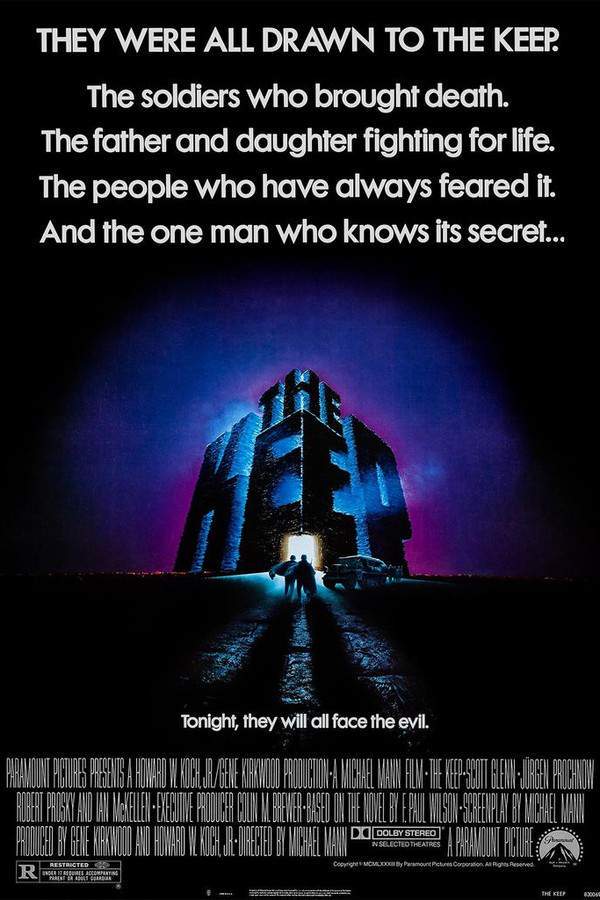
Year: 1983
Runtime: 96 min
Language: English
Director: Michael Mann
In a remote Romanian castle during World War II, a weary soldier discovers a terrifying, ancient evil. A determined Nazi captain and his troops are stationed nearby, but they are not the primary threat. As the war rages, the warrior must face a powerful, malevolent force linked to the castle's dark history, realizing the true danger lies beyond human conflict.
Find where to stream, rent, or buy The Keep (1983) in the US with current JustWatch availability, up-to-date pricing, and platform listings for subscription, rental, and digital purchase options.
Warning: spoilers below!
Haven’t seen The Keep yet? This summary contains major spoilers. Bookmark the page, watch the movie, and come back for the full breakdown. If you're ready, scroll on and relive the story!
Read the complete plot breakdown of The Keep (1983), including all key story events, major twists, and the ending explained in detail. Discover what really happened, and what it all means.
In 1941 Romania sits at the edge of a widening war as Operation Barbarossa unfolds to the east. A motorized Gebirgsjäger unit of the Wehrmacht, commanded by Captain Klaus Woermann, arrives at a remote and seemingly forsaken citadel known as The Keep, intent on seizing control of the strategic Dinu Pass high in the Carpathians. What begins as a routine operation quickly slips into something far more dangerous. Two soldiers, privates Lutz and Anton, dare to loot a gleaming metal icon housed within the keep’s ancient walls, and their act destabilizes the place. They awaken a spectral entity named Radu Molasar, a force that does not stay contained. Over the next days, Molasar stalks the fortress, killing five more soldiers and gradually taking a more tangible form as the fear and awe it inspires spreads through the garrison.
Into this volatile situation the German command sends a harsh response. A detachment of SS Einsatzkommandos, led by the ruthless SD Sturmbannführer Erich Kaempffer, arrives under the pretense of rooting out supposed Soviet partisan activity nearby. Kaempffer’s convoy carries out brutal reprisals, executing three civilians as collective punishment and seizing five more as hostages, despite Woermann’s attempts to restrain such extreme measures. The clash between orders and conscience becomes a stark undercurrent to the unfolding horror.
Meanwhile, a thread of history and myth twists through the keep’s cold stone. Following the urging of a local village priest, Father Mihail Fonescu, the Germans retrieve Theodore Cuza, an aging Jewish historian who has endured captivity in a concentration camp. Cuza works to decipher an enigmatic message carved in Old Slavonic using the Glagolitic alphabet, a clue etched on the citadel’s wall that hints at deeper powers at work. Molasar’s influence reaches even further as he saves Cuza’s daughter Eva from two Einsatzkommandos and heals Cuza’s debilitating scleroderma by touch. This act binds Cuza to Molasar in a troubling debt, for the entity now demands that Cuza remove a talisman from the keep so Molasar can escape its confinements.
From the shadows, a mysterious stranger named Glaeken Trismegestus arrives from Axis-occupied Greece. His presence unsettles Cuza, and he quickly seduces Eva, drawing Cuza’s ire and suspicion. The village around the keep begins to feel the malignant pull of Molasar’s power, bending minds and stirring unrest among the people who live closest to the fortress. A confrontation with Glaeken ends badly for him—the soldiers fire on him and push him into a ravine, though he survives, bloodied but undeterred.
Captain Woermann outwardly condemns Kaempffer’s brutal tactics, arguing that the monster supposedly hunting the Nazis is, in truth, a mirror of their own malevolence. Yet the din of gunfire and the unsettling screams emanating from the courtyard interrupt their debate. Kaempffer returns to the inner yard to find a nightmare: Woermann has been slain by Molasar, and every member of his garrison has fallen to the entity’s unseen force, their military vehicles mysteriously disabled and his own authority met with a catastrophic collapse.
As Cuza moves to remove the talisman, Molasar kills Kaempffer when he detects the danger Cuza poses to his plan. Eva, attempting to intervene, cannot avert Molasar’s command that Cuza kill her; Cuza resists, but Molasar’s power reverses his progress and sends Cuza back into the decline of illness and weakness that the entity first exploited. In the midst of this, Glaeken returns, recovers the talisman, and confronts Molasar in a climactic struggle.
The battle concludes with Molasar being weakened and banished back into the deepest recesses of The Keep. Glaeken, transformed by a surge of light, seals the aperture that had freed Molasar, containing the entity once again within the fortress’s heart. With danger contained for the moment, the villagers offer Eva and Cuza shelter and guidance, guiding them away from the keep’s lingering shadows as they seek safety beyond its walls. The Keep settles into a tense quiet, a reminder of the uneasy intersection of war, ancient power, and the choices that define humanity under pressure.
Last updated: October 09, 2025 at 15:38
Explore frequently asked questions about The Keep (1983) with spoiler-rich answers covering the full plot summary, major story beats, character motivations, hidden details, and ending meaning. This movie summary FAQ helps explain confusing scenes, plot twists, and narrative decisions in clear, searchable detail.
Molasar saves Cuza from his scleroderma and rescues Eva from two SS soldiers not out of benevolence, but to forge a debt. The entity then commands Cuza to remove a talisman from the keep that binds Molasar within the fortress, offering Cuza's healing as leverage. This creates a moral dilemma where Cuza must choose between his freedom from illness and releasing an ancient evil.
The talisman's power was hinted at in the Glagolitic message Cuza decoded, which warned of deeper powers within the citadel.
The talisman is a mystical object embedded in the keep's walls that acts as a binding force, imprisoning Radu Molasar within the fortress. Removing it would allow the spectral entity to escape into the outside world. Glaeken Trismegestus retrieves the talisman during the climax to confront and weaken Molasar, then uses it to seal the aperture and contain the entity once more.
The encoded message Cuza deciphered mentioned the citadel's deeper powers, foreshadowing the talisman's existence and purpose.
Glaeken Trismegestus is a mysterious stranger who arrives from Axis-occupied Greece, revealed to be an ancient adversary of Molasar. He possesses knowledge of the entity's weaknesses and wields power capable of battling the spectral force. When he confronts Molasar in the keep's final battle, he is transformed by a surge of light and uses the talisman to seal the entity away, suggesting he is a guardian or immortal warrior tasked with containing such ancient evils.
Glaeken's arrival unsettles Cuza specifically because of his knowledge about the keep's supernatural history.
Molasar kills soldiers as part of its nature as a malevolent spectral entity. When privates Lutz and Anton loot the metallic icon from the keep's walls, they destabilize whatever ancient binding held Molasar, releasing the entity. From that point, Molasar stalks the fortress, taking lives and gradually manifesting into a more tangible form fueled by the fear and awe it generates among the garrison.
The keep was described as a forsaken citadel with a foreboding presence even before the soldiers arrived, hinting at dormant danger.
Kaempffer shoots Woermann in a fit of rage during a confrontation in the courtyard. Earlier, Woermann had condemned Kaempffer's brutal tactics, including the execution of civilians as collective punishment. When Kaempffer returns to the inner yard after this argument, he discovers that Molasar has slaughtered the entire garrison and disabled their vehicles. The exact motivation for shooting Woermann isn't fully detailed, but it appears to be a combination of Kaempffer's rage, paranoia, and the chaotic realization that their position has collapsed.
Tension had been building between the two officers throughout the film, with Woermann repeatedly opposing Kaempffer's extreme measures.
Cuza deciphers an enigmatic message carved in Old Slavonic using the Glagolitic alphabet on the citadel's walls. While the exact translation isn't provided in the summary, the message hints at deeper powers at work within the keep and points toward the existence of the talisman that binds Molasar. This decoding establishes the supernatural lore of the fortress and sets up the final confrontation.
The message serves as both a warning and a guide, leading Cuza to discover the talisman's significance.
The metallic icon appears to be part of the ancient binding system that keeps Molasar trapped within the keep. When privates Lutz and Anton remove the gleaming icon from the citadel's walls, they inadvertently break or destabilize this containment, allowing the spectral entity to emerge. The icon's removal is the catalyst that sets the supernatural events in motion.
The keep was described as a forsaken place with ancient walls, suggesting historic defenses were in place.
When Cuza initially refuses Molasar's command to kill Eva and remove the talisman, the entity punishes him by reversing the physical improvement it had granted. Cuza is sent back into his diseased, weakened state from his scleroderma. This demonstrates Molasar's manipulative nature, offers of healing or rescue come with strings attached, and defiance results in having those gifts revoked.
The deal was always transactional; Molasar explicitly demanded the talisman's removal in exchange for Cuza's cure.
After Molasar is contained, Eva and Cuza are escorted away from the keep by villagers who offer them shelter and guidance. Cuza, having been returned to his diseased state by Molasar when he resisted the entity's command, is in poor health but alive. The villagers help them seek safety beyond the keep's walls, providing a bittersweet resolution where they escape the immediate danger but face an uncertain future.
The villagers' earlier fear of the keep's power suggested they would ultimately be the ones to help the Cuzas.
The Nazis bring Cuza to the keep at the urging of Father Mihail Fonescu, a local village priest. Cuza is a Jewish historian who had been imprisoned in a concentration camp. The Germans needed his expertise to decipher an enigmatic message carved on the citadel's wall in Old Slavonic using the Glagolitic alphabet. Cuza's scholarly background made him essential for understanding the ancient text and uncovering the keep's secrets.
Father Fonescu's involvement suggests the local community had knowledge of the keep's supernatural history.
Glaeken survives being shot by soldiers and pushed into a ravine, appearing bloodied but undeterred. This suggests he possesses either extraordinary resilience or supernatural abilities beyond those of ordinary humans. His survival underscores his nature as an ancient figure with powers comparable to Molasar's, allowing him to recover and return to confront the entity in the final battle.
Glaeken's mysterious arrival from Greece and his knowledge of the keep's powers hint at his otherworldly nature.
Discover curated groups of movies connected by mood, themes, and story style. Browse collections built around emotion, atmosphere, and narrative focus to easily find films that match what you feel like watching right now.
Ancient supernatural forces are unleashed during dark chapters of human history.If you liked the clash of WWII horrors with an ancient entity in The Keep, you'll find similar stories here. These movies combine grim historical backdrops with supernatural threats, creating a unique and oppressive dread. Explore films where history's darkest moments awaken something far older and more terrifying.
The narrative typically begins with human conflict—often war or occupation—that inadvertently disturbs a long-dormant evil. Characters find themselves caught between a tangible human enemy and a far more dangerous supernatural one, forcing uneasy alliances and moral compromises in a desperate bid for survival.
Movies in this thread are grouped by their core premise of an ancient evil unleashed within a specific historical context. They share a dark, oppressive tone, a steady pacing that builds dread, and the thematic exploration of humanity's small place in a much larger, darker cosmic order.
A confined group is hunted by a malevolent force they cannot understand.Fans of The Keep's tense atmosphere of a group trapped and hunted in a single location will enjoy these films. Discover stories of supernatural sieges where characters are isolated and must confront an invisible, intelligent evil. These movies deliver high tension, psychological dread, and a fight for survival in a confined space.
The plot revolves around a group—often fractured by internal conflict—being isolated in a fortress, remote outpost, or other confined space. A supernatural entity systematically targets them, exploiting their fears and weaknesses. The story is a desperate battle of attrition, focusing on survival, crumbling sanity, and the revelation of the force's true nature.
These films are connected by their core structure: a confined setting and a group under supernatural siege. They share a high-intensity, claustrophobic vibe, a steady pacing that ratchets up tension, and a dark tone focused on psychological and physical survival against an overwhelming, unknown foe.
Don't stop at just watching - explore The Keep in full detail. From the complete plot summary and scene-by-scene timeline to character breakdowns, thematic analysis, and a deep dive into the ending - every page helps you truly understand what The Keep is all about. Plus, discover what's next after the movie.
Track the full timeline of The Keep with every major event arranged chronologically. Perfect for decoding non-linear storytelling, flashbacks, or parallel narratives with a clear scene-by-scene breakdown.
Discover the characters, locations, and core themes that shape The Keep. Get insights into symbolic elements, setting significance, and deeper narrative meaning - ideal for thematic analysis and movie breakdowns.
Discover movies like The Keep that share similar genres, themes, and storytelling elements. Whether you’re drawn to the atmosphere, character arcs, or plot structure, these curated recommendations will help you explore more films you’ll love.
The Keep (1983) Scene-by-Scene Movie Timeline
The Keep (1983) Movie Characters, Themes & Settings
The Keep (1983) Spoiler-Free Summary & Key Flow
Movies Like The Keep – Similar Titles You’ll Enjoy
The Secrets We Keep (2020) Complete Plot Breakdown
The Cave (2005) Ending Explained & Film Insights
Keep Watching (2017) Detailed Story Recap
The Impaler (2013) Detailed Story Recap
Where Blood Lies (2019) Ending Explained & Film Insights
The Mysterious Castle in the Carpathians (1981) Full Summary & Key Details
Castle Freak (2020) Story Summary & Characters
The Haunted Palace (1963) Film Overview & Timeline
Castle Freak (1995) Movie Recap & Themes
The Keeper (1976) Spoiler-Packed Plot Recap
The Castle of the Living Dead (1964) Story Summary & Characters
Horror Castle (1963) Detailed Story Recap
The Black Castle (1952) Plot Summary & Ending Explained
The Terror (1963) Film Overview & Timeline
Keeper (2025) Detailed Story Recap