




Plot Explained Spoilers guaranteed!
Plot Explained

Browse by genre

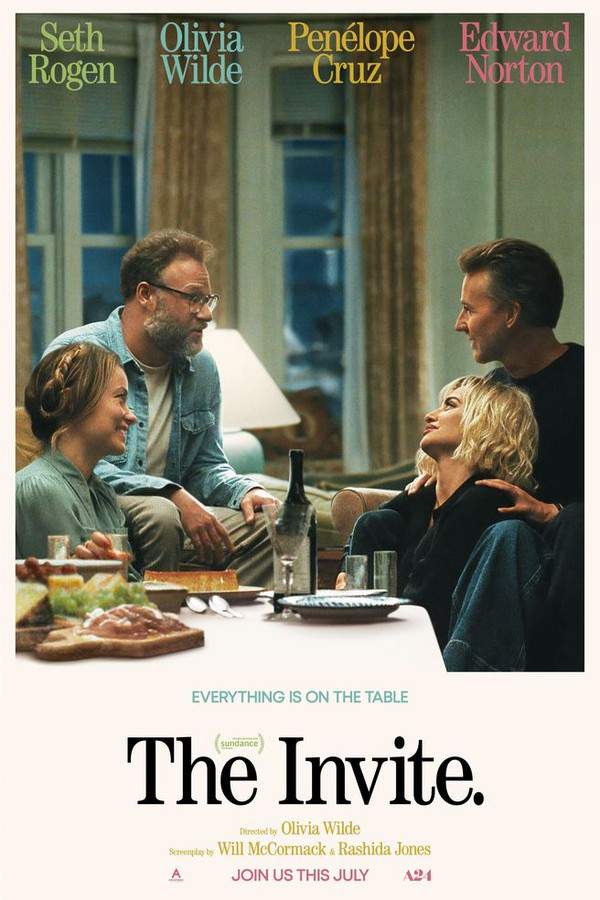
The Invite (2026) movie poster

Ending Explained

The Invite (2026) Ending Explained – Final Scene & Meaning

Release, runtime and language
2026 · 1 h 47 m · English
Echo score 74
Starring
Olivia Wilde, Edward Norton, Penélope Cruz, Seth Rogen, Mel Powell, Rachel Thurow

Joe and Angela’s marriage is strained, and when they invite the mysterious couple living upstairs to a dinner party, the evening takes an unsettling turn. As secrets surface and old tensions flare, they must decide whether the night rekindles lost intimacy or ignites a fire that consumes everything.

On this page (6)
  1. 1 Where to watch
  2. 2 What happens at the end
  3. 3 Final events in order
  4. 4 Ending questions answered
  5. 5 Movie threads
  6. 6 Every angle

Where to watch

Where to Watch The Invite (2026)

Where can you watch The Invite? Stream, rent or buy it in the US, including on Amazon Video, Apple TV Store and Fandango At Home: current JustWatch availability with up-to-date prices.

Streaming availability powered by JustWatch

Ending explained · contains spoilers

What Happens at the End of The Invite?

How The Invite (2026) ends, what the final scene means, which earlier moments set it up and how to read the ending if the film leaves it open. The full ending explained, with every spoiler.

After the dinner exposes fractures in Joe and Angela’s marriage, Pina and Hawk leave the house and give them space to decide what remains. Angela sits in Maggie’s room while Joe retreats to the piano, initially unable to find a rhythm. She joins him, and their playing becomes a duet viewed from their daughter’s room. Angela eventually stops playing and touches Joe’s head as he continues. No dialogue or promise confirms whether they remain married, separate amicably, or attempt a new version of the relationship; the ambiguity is deliberate.

The duet suggests Joe and Angela can coordinate again, but it does not restore the marriage they had before the evening. Maggie’s empty room frames the choice through the life their decisions affect, while the shift from two players to Angela’s quiet touch allows reconciliation and release to coexist. Pina and Hawk function less as an ideal couple than as a disruption forcing hidden needs into view, so their disappearance returns responsibility to the hosts. The hopeful note is not that marriage automatically wins, but that Joe and Angela finally respond to one another instead of maintaining a resentful performance.

Last updated: August 26, 2026 at 20:31

Was this helpful?

The last 4 events

How The Invite Ends: The Final Events in Order

The last events of The Invite (2026) in chronological order, the run-up to the ending explained above. The complete timeline has all 12 events, scene by scene.

Open the full timeline
  1. Piña mediates deeper issues and options

    Piña analyzes their situation and proposes either separating or reframing their relationship, especially given their daughter Maggie's presence in their lives. She frames a new path that acknowledges their needs while not sacrificing their family. The idea lingers as the couple processes the possibility of major life changes.

    When
    Late night
    Where
    San Francisco apartment
  2. Separation considered; neighbors leave

    Angela and Joe seem to agree to separate, planning their next moves, but when they return from the kitchen, they discover Piña and Hawk have already left. The sense of abrupt departure underscores the night’s unresolved tensions. The couple is left to face a future that won't resemble their previous arrangement.

    When
    Late night
    Where
    San Francisco apartment
  3. Joe returns to the piano; Angela joins

    Back in their home, Joe returns to his piano in his office, playing again after years of shame about his failed career. Angela gradually joins him, bridging a fragile moment of connection through music. The scene marks a possible reconciliation that remains tentative.

    When
    Night
    Where
    Joe's office
  4. A quiet, hopeful close to a chaotic night

    The evening ends with a nuanced shift rather than a full reconciliation. The dynamics between Joe, Angela, Piña, and Hawk linger in the air as the couple contemplates next steps. Joe’s music becomes a hopeful sign that he is reclaiming his passion.

    When
    Night
    Where
    Living room of the apartment

Ending questions answered

The Invite Ending: Your Questions Answered

The questions people ask most about the ending of The Invite (2026): what the final scene means, how the twist works, what happens to each character and how to read the ending. Each answer contains spoilers.

Q1

Why is the ending of The Invite ambiguous about whether Joe and Angela stay together?

The ambiguity is deliberate because The Invite is less interested in announcing a verdict on Joe and Angela than in showing them finally responding to each other honestly. After an evening that stripped away years of resentment, no dialogue or promise is offered to confirm whether they reconcile, separate amicably, or attempt a new version of the relationship. The film treats that openness as the point: the dinner forced hidden needs into view, and the final scene lets the audience sit with the consequences of that honesty rather than resolve them.

Foreshadowing: Earlier piano scenes between Joe and Angela show their failed attempts to play together, hinting that any reconnection would have to be rebuilt from scratch.

  • ambiguous ending
  • marriage fate
  • joe and angela
  • open ending
  • interpretation
Q2

What does the piano duet at the end of The Invite symbolize?

The duet represents Joe and Angela's ability to coordinate again after an evening of confrontation, but it does not signal a return to the marriage they had before. Joe initially cannot find a rhythm alone, and when Angela joins him, their synchronized playing shows that mutual responsiveness is still possible. The duet works as a metaphor for reconnection rather than repair, suggesting they can meet each other again without pretending the damage never happened.

Foreshadowing: Earlier moments of Joe playing alone and Angela listening from a distance establish the gap the duet eventually closes.

  • piano duet
  • symbolism
  • reconnection
  • coordination
  • metaphor
Q3

Why does Angela stop playing the piano and touch Joe's head at the end?

Angela stepping away from the keys and resting her hand on Joe's head allows reconciliation and release to coexist in a single gesture. She no longer needs to actively perform or compete with him, so the touch signals acceptance rather than demand. It also shifts the moment from a shared accomplishment to an intimate, vulnerable one, which is the emotional register The Invite has been building toward throughout the dinner.

Foreshadowing: Angela's habit of withdrawing when conversations get too honest, shown earlier in the film, is finally redirected into closeness instead of distance.

  • angela touch
  • head gesture
  • final scene
  • reconciliation
  • intimacy
Q4

Why does the ending of The Invite frame the duet through Maggie's empty room?

Viewing Joe and Angela from their daughter's bedroom forces the audience to see their choice through the life their decisions actually affect. Maggie's absence throughout the evening has already been a quiet pressure on every confession and argument, so placing the final image in her room ties the parents' fragile reconnection to the family structure their conflict endangers. It also keeps the resolution intimate rather than triumphant, since the room belongs to someone who is not there to witness it.

Foreshadowing: Maggie's empty room is referenced repeatedly before the ending, anchoring the film to the unspoken stakes of her parents' marriage.

  • maggie room
  • daughter
  • empty room
  • framing
  • family stakes
Q5

Why do Pina and Hawk leave the house at the end of The Invite?

Pina and Hawk leave so that the final decision about the marriage belongs entirely to Joe and Angela rather than to outside catalysts. Throughout the dinner they have functioned as a disruption that pulled hidden needs and resentments to the surface, but their lifestyle is never presented as a model the hosts should copy. By disappearing, they return responsibility to the couple and allow the ending to focus on what Joe and Angela do with what has been exposed.

Foreshadowing: Pina and Hawk repeatedly hint that their visit has a shelf life, suggesting they were never meant to stay past the confrontation.

  • pina and hawk
  • neighbors leaving
  • responsibility
  • catalysts
  • departure
Q6

Does The Invite have a happy ending?

The Invite ends on a hopeful but unresolved note rather than a traditionally happy one. Joe and Angela reach a moment of genuine responsiveness to one another after an evening of painful honesty, which reads as an emotional breakthrough. Whether that breakthrough produces a lasting reconciliation, a graceful separation, or a third option is left open, and the film treats that openness as more honest than a neat resolution would be.

Foreshadowing: The film's bittersweet tone from the opening scenes signals that any resolution will balance warmth with unresolved pain.

  • happy ending
  • hopeful
  • unresolved
  • bittersweet
  • conclusion
Q7

Why can't Joe find a rhythm on the piano by himself at the end of The Invite?

Joe's inability to settle into a rhythm on his own reflects that he has been performing the marriage rather than genuinely participating in it. Once the dinner stripped away the resentments he had been hiding behind, the old autopilot no longer works and he cannot conjure music from a single, isolated voice. Angela joining him gives the playing a missing counterweight, suggesting that whatever comes next for them requires a different kind of shared effort than what they had before.

Foreshadowing: Earlier scenes of Joe playing the piano alone are framed as solitary habits that mask rather than express what he actually feels.

  • joe piano
  • rhythm
  • solo playing
  • performance
  • isolation
Q8

What role do Pina and Hawk play in the ending of The Invite?

By the time the credits roll, Pina and Hawk have served their function as disruptors and are no longer needed in the frame. They exposed the fault lines in Joe and Angela's marriage and modeled an alternative to quiet resentment, but their lifestyle is not offered as a prescription. Their exit clears the stage so the hosts can finally answer the question the evening was always asking: whether they can face each other without an audience.

Foreshadowing: Throughout the dinner, Pina and Hawk push conversations past the point of polite deflection, foreshadowing that their presence is meant to provoke rather than comfort.

  • pina and hawk
  • role
  • disruptors
  • catalysts
  • neighbors
Q9

What does the shift from duet to Angela playing alone at the end of The Invite mean?

When Angela steps back and lets Joe continue on his own while she touches his head, the music stops being a shared task and becomes something he can hold without her active participation. It suggests that whatever they build next does not require constant negotiation or equal effort to survive. The gesture is also a small act of release, signaling that Angela is willing to let Joe exist without managing him, which is the kind of acceptance the marriage has been missing.

Foreshadowing: Angela's tendency to either over-engage or withdraw during moments of emotional weight sets up the choice she makes at the piano.

  • duet to solo
  • angela playing
  • shift
  • acceptance
  • release
Q10

What does the ending of The Invite say about the state of Joe and Angela's marriage?

The ending suggests that Joe and Angela's marriage is damaged but not finished, and that the damage itself can become a starting point if they are willing to respond to each other honestly. The film rejects the idea that the evening either saved or doomed the relationship, focusing instead on the fact that they finally stopped performing resentment. Whether that change is enough to sustain them is left to the viewer, but the closing image treats the willingness to try as the real outcome.

Foreshadowing: Years of bottled-up resentment, surfaced during the dinner, give the final scene its weight as a turning point rather than a casual resolution.

  • marriage state
  • interpretation
  • damage
  • honesty
  • outcome
Q11

Why does The Invite end without any dialogue between Joe and Angela?

Ending without dialogue is the clearest way for the film to refuse a verdict on the marriage, since words would have forced a specific commitment one way or another. The piano playing, the touch, and the silence around them carry the emotional truth without locking the couple into a promise. By leaving the conversation unspoken, The Invite lets the audience feel the connection without dictating what it officially means.

Foreshadowing: Throughout the dinner, words have repeatedly failed to express what Joe and Angela actually feel, so the ending's silence echoes that limit.

  • no dialogue
  • silence
  • unspoken
  • ending choice
  • commitment

Movie threads

More Movies Like The Invite, by Mood & Story

Curated lists built around what makes The Invite tick: the same mood, the same kind of story or the same emotional payoff. Each list explains why these movies belong together.

Pressure cooker dinner party movies like The Invite

Stories where a single gathering becomes the crucible that forces truth into the open. Movies like The Invite that trap characters in a single evening or gathering where old wounds resurface and truths spill out. If you liked The Invite, you'll love these contained dramas where a dinner party, night out, or social event becomes the turning point that reveals what a couple, family, or friend group has been hiding from each other.

  • contained
  • conversational
  • awkward
  • confessional
  • tension-filled
  • intimate
  • Tone: bittersweet, intimate, charged
  • Pacing: steady, real-time build
Why these movies?

The story pattern: These stories begin with an apparently routine social occasion that quickly becomes something far more charged. Characters arrive carrying secrets, resentments, or desires they have avoided naming. The confined setting and rituals of hospitality create both pressure and permission for honesty. As drinks pour and masks slip, the night escalates into confrontation, confession, or seduction, culminating in a moment where the characters' relationships are forever altered, sometimes for the better and sometimes not.

Why they belong together: They share the same ingredients: a contained time frame, a small cast circling each other in close quarters, dialogue-driven escalation, and an ending that rewrites the characters' understanding of themselves and each other. The humor is often uncomfortable, the intimacy is earned rather than given, and the tension sits in subtext as much as in action.

Marriage strain dramas like The Invite

Long-term loves pushed to the breaking point, where staying together becomes the real question. If you liked The Invite and want more movies about couples whose love has curdled into something harder to name, these relationship dramas deliver. Similar to The Invite, they probe the gap between what couples promised and what they have become, balancing sharp humor with heartbreak as partners reckon with infidelity, resentment, and the question of whether to stay or finally let go.

  • relationship
  • marriage
  • intimate
  • confessional
  • reflective
  • tender
  • Tone: bittersweet, tender, raw
  • Pacing: steady, reflective
Why these movies?

The story pattern: The central couple has years of shared history behind them and an uncertain future ahead. Early scenes establish both the tenderness that remains and the fault lines: unmet needs, faded ambitions, quiet betrayals. An outside catalyst, such as a new acquaintance, an affair, or a long-postponed conversation, forces the marriage into the open. The story moves through accusation, confession, and a fragile reckoning that leaves the relationship either quietly renewed or openly ended, but always changed.

Why they belong together: They share an unflinching focus on a single couple's interior weather, a bittersweet mix of wit and grief, and an ending that refuses easy resolution. The pacing privileges conversation over plot, the humor often comes from recognition rather than jokes, and the emotional weight sits in what the characters cannot say to each other until the film makes them.

Every angle

The Invite (2026) Explained: Plot, Ending, Timeline & Characters

Everything about The Invite in one place: what happens in the plot summary, the timeline in chronological order, the characters and meaning, the ending explained and a spoiler-free summary. What's After the Movie adds the cast, box office and post-credit scenes.

Coming soon on iOS and Android

The Plot Explained Movie Summary App

Plot summaries, endings explained and timelines on your phone. Catch up on any movie in minutes, save your favorites and never miss a twist again.

Be the first to know when we launch. Your email stays private, always.

Learn more about the app