Plot Explained Spoilers guaranteed!
Plot Explained

Browse by genre

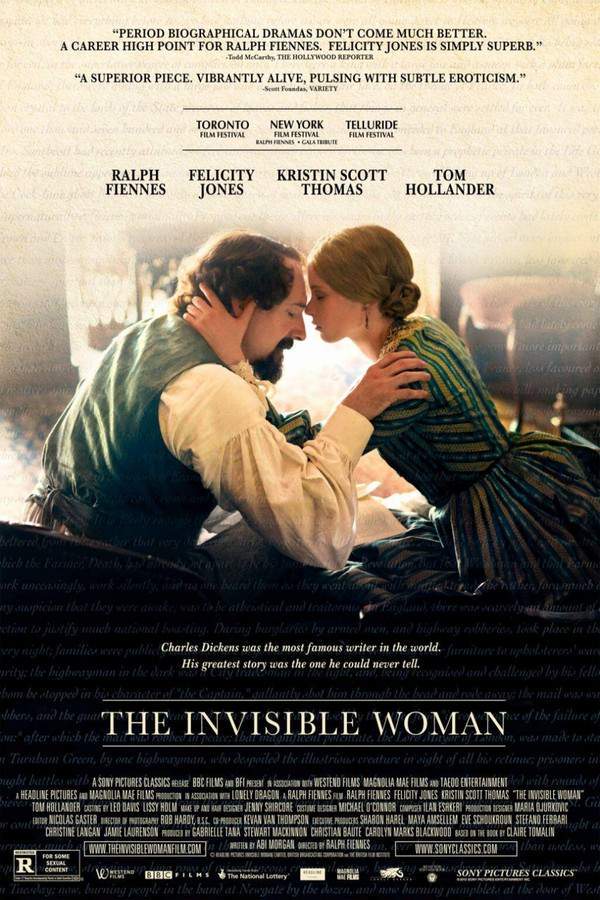
The Invisible Woman (2013) movie poster

Plot Summary

The Invisible Woman (2013) Plot Summary Explained

Release, runtime and language
2013 · 111 min · English
Loading streaming availability…
Starring
Ralph Fiennes, Felicity Jones, Kristin Scott Thomas, Tom Hollander

This biographical drama explores the memories of Nelly Wharton Robinson, revealing a secret and passionate affair with the renowned author Charles Dickens. As a woman largely hidden from public view, she experienced a tumultuous romance that deeply impacted her life and intersected with Dickens’s creative work. The story delves into the complexities of their relationship and the blurred boundaries between their personal lives and Dickens's literary achievements.

On this page (6)
  1. 1 Where to watch
  2. 2 What happens: full plot
  3. 3 Plot questions answered
  4. 4 Movie threads
  5. 5 Movies like The Invisible Woman
  6. 6 Every angle
Loading streaming availability…

Full plot summary · contains spoilers

What Happens in The Invisible Woman: Full Plot Summary

The whole story of The Invisible Woman (2013) explained, from the opening scene to the final frame: every key event, every twist and what it all adds up to. Read it as a quick recap before the sequel, to check a scene you missed, or to finally understand what really happened.

In 1857, forty-five-year-old Charles Dickens [Ralph Fiennes] notices eighteen-year-old Ellen "Nelly" Ternan [Felicity Jones] while she is performing at London's Haymarket Theatre. He later casts her, along with her mother and sister Maria, in a performance of Wilkie Collins's The Frozen Deep at Dickens's Free Trade Hall in Manchester. At a party following the performance, Dickens and Nelly share a moment alone.

Nelly and her family attend one of Dickens's readings at the Harrow Speech Room. Delighted to see Nelly again, Dickens takes the Ternans to Doncaster Racecourse. No longer having feelings for his wife Catherine Dickens, who is busy taking care of their ten children and does not share his passion for literature, Dickens falls for Nelly. Nelly, in turn, is fascinated by Dickens's fame and ideas.

One morning, Dickens slips out of Gads Hill Place, his country home, and walks to East London to see Nelly in a play. Her mother invites him to their cottage. Noticing the looks between them, Mrs. Ternan cautions him that she cannot afford to risk Nelly's reputation. Dickens responds that he has no intention of compromising Nelly's name. After organising a reading and fundraiser to benefit London's "fallen women" and their children, Dickens invites the Ternans to his town house.

Mrs. Ternan thinks that this blossoming relationship may offer Nelly the financially stable future she would not find on stage, believing that Nelly is not as talented as her sisters. Overhearing her, Nelly is angered and confused by her mother's plans for her to become the mistress of a married man. Catherine mistakenly receives Dickens's gemstone bracelet for Nelly and is ordered by Dickens to bring it to Nelly. Catherine warns her of the pain of being with Dickens, while Nelly is disturbed by his cruelty.

Dickens and Collins arrive late to Nelly's birthday party and talk her into visiting the house that Collins shares with his mistress, Caroline Graves. After demanding to leave, she confronts Dickens about insulting her honour by bringing her there and his suggested arrangement of her being his whore. After arguing that he no longer loves Catherine, Dickens asks to enter Nelly's home and kisses her.

On a walk, Dickens and Nelly have an encounter with his son, who is saddened to see her affections with his father. Dickens later announces in The Times his "amicable" separation from Catherine while denying the rumours of his affair. The news devastate his wife and children.

Mrs. Ternan assures Nelly that Dickens is an honourable man, while Collins tells Nelly that he is a great man and that she has a choice. Nelly argues that only men have the freedom to choose and suggests that she has few other options in life. He urges her to be with Dickens and "break conventions". Nelly visits Dickens, who excitedly reveals that he completed Great Expectations. Nelly expresses her approval of the ending, which does not bring Estella and Pip together. They become lovers.

Nelly becomes pregnant. She and Dickens speak of the gossip of their affair spreading from city to city. Their child is stillborn. After saving a lock of the child's hair, Dickens signs the death certificate with a false name, "M. Charles Tringham".

After returning to England from France in the spring of 1865, Dickens and Nelly board a train at Folkestone for London. Near Staplehurst in Kent, the train derails. As he speaks to Nelly, the workers ask the uninjured Dickens to assist with wounded passengers in the wreckage. He pretends he was travelling alone, to avoid public scandal. As he walks away to help, she watches him retrieve a page from a work in progress.

Dickens installs Nelly at a country house and promises to visit twice weekly, though acknowledges that his family has a claim on his time. Nelly remains his secret mistress until his death in 1870. In 1876, she marries Oxford graduate George Wharton-Robinson, who is twelve years her junior and unaware that she was once the mistress of Charles Dickens. They have a son together. Only Reverend Benham knows about the affair and Nelly's real age. In 1883, while watching her son perform in a school play, Nelly recalls the lines she spoke in The Frozen Deep.
Last updated: October 09, 2025 at 16:21

Was this helpful?

Plot questions answered

The Invisible Woman Plot Explained: Your Questions Answered

The questions people ask most about The Invisible Woman (2013): what happens in the confusing scenes, why the characters do what they do, the twists, hidden details and what the ending means. Each answer contains spoilers.

Q1

Why did Charles Dickens become attracted to Nelly Ternan?

Dickens noticed Nelly during a performance at London's Haymarket Theatre in 1857 and was immediately captivated. At that point, he had been married to Catherine for over twenty years but felt emotionally disconnected from her, she was busy caring for their ten children and did not share his literary passion. Nelly, young and fascinated by his fame and ideas, represented a new beginning and intellectual companionship that his marriage no longer provided.

Foreshadowing: Dickens's earlier dissatisfaction with his domestic life is hinted at when the summary notes he 'no longer has feelings for his wife' before meeting Nelly.

  • charles dickens
  • nelly ternan
  • attraction
  • marriage
  • catherine dickens
Q2

Why did Nelly agree to become Dickens's mistress?

Nelly faced limited options as a young woman in Victorian England. While she was angered and confused when she overheard her mother's plans for her to become a mistress, she ultimately accepted the arrangement. Wilkie Collins encouraged her to 'break conventions,' and Nelly herself noted that only men have the freedom to choose. Her mother also believed Dickens could provide financial stability that Nelly would never find on stage.

Foreshadowing: Mrs. Ternan's calculation that Nelly 'is not as talented as her sisters' foreshadows the economic pressure that drives Nelly's decision.

  • nelly ternan
  • mistress
  • victorian women
  • social constraints
  • marriage
Q3

What was the significance of the gemstone bracelet?

Dickens gave Nelly a gemstone bracelet, but it was mistakenly delivered to his wife Catherine instead. Dickens ordered Catherine to bring the bracelet to Nelly, treating his wife as a messenger in his affair. Catherine warned Nelly about the pain of being involved with Dickens, revealing both her awareness of the relationship and her compassion for the young woman who would suffer from it.

Foreshadowing: The bracelet incident demonstrates Dickens's willingness to prioritize his desires over his family's feelings, foreshadowing his later public separation from Catherine.

  • gemstone bracelet
  • catherine dickens
  • affair
  • warning
Q4

How is Great Expectations connected to Nelly?

Dickens completed Great Expectations around 1860-1861, during his affair with Nelly. When Nelly visited him, he excitedly revealed the completed manuscript to her. Notably, Nelly approved of the ending, which does not bring Estella and Pip together, suggesting she understood and accepted the story's melancholic tone. Shortly after this meeting, they became lovers.

Foreshadowing: The story's ending, which denies Pip and Estella a happy union, mirrors the secret and ultimately unfulfilled nature of Dickens and Nelly's relationship.

  • great expectations
  • novel
  • ending
  • estella
  • pip
  • connection
Q5

What happened to Nelly and Dickens's baby?

Nelly became pregnant by Dickens, and the couple faced anxious gossip spreading across cities about their affair. Their child was stillborn. Dickens saved a lock of the baby's hair as a memento and signed the death certificate with the false name 'M. Charles Tringham', a name that still included his own initials, suggesting his need to maintain a private connection despite the secrecy.

Foreshadowing: The tragedy of the stillborn child casts a shadow over their relationship and represents the personal cost of their secret affair.

  • pregnancy
  • stillborn
  • death certificate
  • tragedy
  • secret
Q6

Why did Dickens use a false name for the baby?

Dickens signed the stillborn baby's death certificate with the name 'M. Charles Tringham' to protect both Nelly's reputation and his own public image. As a famous author and public figure, any scandal could destroy his career and legacy. The false name allowed him to acknowledge the birth privately while maintaining public deniability about the affair.

Foreshadowing: This act of deception anticipates Dickens's similar behavior during the Staplehurst rail disaster, when he again prioritized protecting the secret of his relationship.

  • false name
  • tringham
  • scandal
  • reputation
  • deception
Q7

What happened during the Staplehurst rail disaster?

In spring 1865, Dickens and Nelly were returning from France and boarded a train at Folkestone for London. Near Staplehurst in Kent, the train derailed. While Nelly was uninjured, Dickens was asked to help with wounded passengers. He pretended he was traveling alone to avoid public scandal about their affair, then walked away to assist others. Nelly watched him retrieve a page from a work in progress from the wreckage.

Foreshadowing: The disaster occurred while they were returning from France, a trip that would have been scandalous if their relationship had been exposed.

  • staplehurst
  • train derailment
  • rail disaster
  • 1865
  • accident
Q8

Why did Dickens hide Nelly during the train accident?

Dickens hid Nelly's presence because he feared the public scandal of being discovered with his young mistress. Although he was uninjured and could have simply acknowledged Nelly, he told workers he was traveling alone. This preserved his public reputation as a family man and respected author, even though it left Nelly alone and vulnerable during the chaos.

Foreshadowing: This moment reveals the fundamental imbalance of their relationship, Dickens protected his public image while Nelly remained his hidden secret.

  • scandal
  • reputation
  • hide
  • secret
  • public image
Q9

What happened to Nelly after Dickens died?

After Dickens's death in 1870, Nelly remained his secret mistress until the end. Dickens had installed her at a country house and promised to visit twice weekly, though he acknowledged his family had a claim on his time. In 1876, Nelly married Oxford graduate George Wharton-Robinson, who was twelve years her junior and had no knowledge of her past affair. They had a son together, and only Reverend Benham knew about her true history with Dickens.

Foreshadowing: Nelly's marriage to someone unaware of her past represents her final attempt to leave the scandal of her youth behind her.

  • marriage
  • george wharton's robinson
  • 1876
  • secret
  • afterlife
Q10

Why did Nelly marry George Wharton-Robinson without telling him about Dickens?

Nelly kept her past with Dickens hidden because the affair would have been deeply shameful in Victorian society. A young woman marrying an older man who had been her married lover's secret mistress would have faced severe social stigma. By 1876, Dickens was dead, and Nelly likely wanted a clean start and a respectable life with someone who would never judge her for her youth.

Foreshadowing: Her silence about Dickens represents the lasting impact of the secrecy that defined her relationship with him, secrecy that continued to shape her life long after his death.

  • marriage secret
  • victorian society
  • shame
  • disclosure
  • wharton robinson
Q11

What is the significance of The Frozen Deep in the story?

The Frozen Deep, a play by Wilkie Collins, was the setting where Dickens first spotted Nelly in 1857, he cast her and her family in the production. The play's title carries thematic weight, as the story explores themes of love, sacrifice, and moral duty. Nelly's final memory in 1883, recalling the lines she spoke in The Frozen Deep while watching her son perform in a school play, brings the narrative full circle, connecting her youth to her present life.

Foreshadowing: The play served as the literal starting point of the affair, and its final echo suggests Dickens and Nelly's story was always destined to be one of hidden depths and unfulfilled longing.

  • the frozen deep
  • play
  • wilkie collins
  • symbolism
  • beginning
  • ending

Movie threads

More Movies Like The Invisible Woman, by Mood & Story

Curated lists built around what makes The Invisible Woman tick: the same mood, the same kind of story or the same emotional payoff. Each list explains why these movies belong together.

Forbidden Historical Romances like The Invisible Woman

Stories of secret loves that defy social conventions and exact a heavy emotional toll. If you enjoyed the secret affair in The Invisible Woman, explore more movies about forbidden historical romances. These dramas feature passionate, hidden loves set in the past, often involving scandal, power dynamics, and heavy emotional consequences, perfect for fans of tragic romantic stories.

  • romantic
  • tragic
  • secretive
  • sorrowful
  • oppressive
  • passionate
  • Tone: melancholic, tragic, romantic
  • Pacing: slow, deliberate
Why these movies?

The story pattern: Narratives in this thread typically follow a clandestine relationship that blossoms against all odds, only to be threatened by societal pressures, scandal, or personal tragedy. The journey is often one of intense passion followed by loss, regret, or a bittersweet resolution, emphasizing the cost of defying convention.

Why they belong together: Movies are grouped here for their shared focus on secret, impassioned relationships within a specific historical context. They share a melancholic tone, heavy emotional weight, and explore themes of constraint, sacrifice, and the blurring of personal desire with public personas.

Movies about Quiet Sorrows like The Invisible Woman

Character studies of individuals bearing profound grief and loss in silence. Viewers who appreciated the reflective sorrow in The Invisible Woman will find similar movies here. These films focus on characters living with hidden pain, memory, and regret, offering a slow, melancholic, and emotionally heavy viewing experience for those who enjoy introspective dramas.

  • melancholic
  • reflective
  • sorrowful
  • tragic
  • introspective
  • memory
  • Tone: melancholic, reflective, sorrowful
  • Pacing: slow, introspective
Why these movies?

The story pattern: Stories in this thread often use a reflective structure, such as memories or a look back on a life. The plot is less about external events and more about unraveling the layers of a character's hidden suffering, exploring how past trauma or loss continues to shape their present in a quiet, profound way.

Why they belong together: These films are united by a dominant melancholic and reflective mood, a slow pacing that allows for introspection, and a focus on the theme of concealed emotional trauma. They prioritize the internal emotional world over fast-paced plot, creating a cohesive vibe of dignified sadness.

If you liked this

Movies Like The Invisible Woman

Similar movies to The Invisible Woman: the same genre, themes or kind of story. Each one comes with its own plot summary, timeline and ending explained.

Browse all movie summaries

Every angle

The Invisible Woman (2013) Explained: Plot, Timeline & Characters

Everything about The Invisible Woman in one place: what happens in the plot summary, the timeline in chronological order, the characters and meaning and a spoiler-free summary. What's After the Movie adds the cast, box office and post-credit scenes.

Coming soon on iOS and Android

The Plot Explained Movie Summary App

Plot summaries, endings explained and timelines on your phone. Catch up on any movie in minutes, save your favorites and never miss a twist again.

Be the first to know when we launch. Your email stays private, always.

Learn more about the app