Plot Explained Spoilers guaranteed!
Plot Explained

Browse by genre

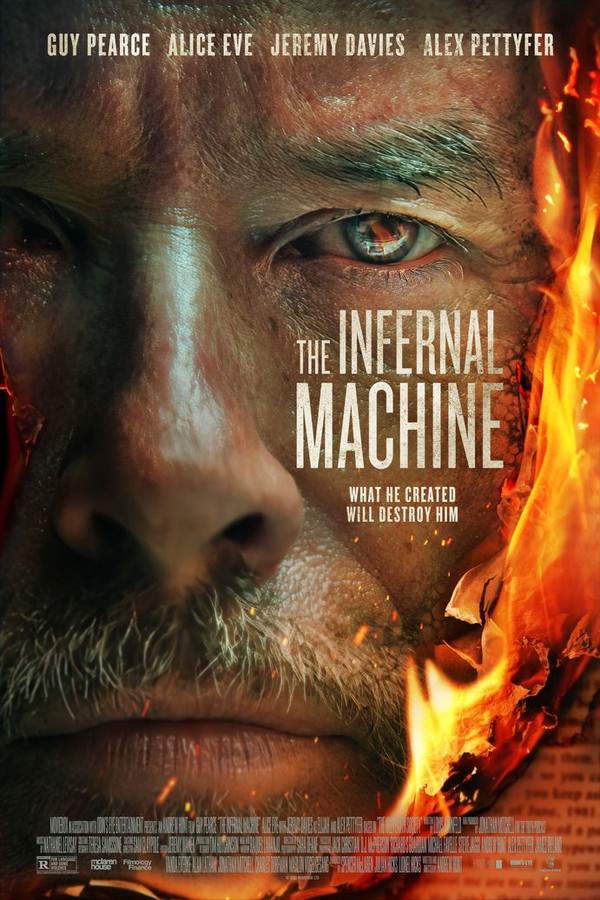
The Infernal Machine (2022) movie poster

Plot Summary

The Infernal Machine (2022) Plot Summary & Ending Explained

Release, runtime and language
2022 · 117 min · English
Echo score 66
Loading streaming availability…
Directed by
Andrew Hunt
Starring
Guy Pearce, Alex Pettyfer, Ben Temple, Jeremy Davies, Alice Eve, Georgia Goodman

Reclusive author Bruce Cogburn is disturbed by unsettling letters from an anonymous admirer, drawing him into a dangerous search for answers. As he investigates, he uncovers a complex network of lies and is forced to confront painful memories and the shadowy forces connected to the mysterious messages. His pursuit reveals shocking truths about his celebrated novel, The Infernal Machine, and the secrets it holds.

On this page (7)
  1. 1 Where to watch
  2. 2 What happens: full plot
  3. 3 Plot questions answered
  4. 4 How it ends
  5. 5 Movie threads
  6. 6 Movies like The Infernal Machine
  7. 7 Every angle
Loading streaming availability…

Full plot summary · contains spoilers

What Happens in The Infernal Machine: Full Plot Summary

The whole story of The Infernal Machine (2022) explained, from the opening scene to the final frame: every key event, every twist and what it all adds up to. Read it as a quick recap before the sequel, to check a scene you missed, or to finally understand what really happened.

Bruce Cogburn, the reclusive and controversial author of the acclaimed novel The Infernal Machine, has lived in self-imposed isolation in the American southwest for 25 years. His retreat from society began in 1981 after a young man committed a mass shooting at a university in Knoxville, Tennessee, killing 13 people and claiming that Cogburn's writing inspired the massacre.

Cogburn's solitude is interrupted when he begins receiving persistent letters from a writer named William DuKent, who is seeking an interview. As Cogburn's paranoia and alcohol abuse escalate, he leaves increasingly threatening messages for DuKent, demanding that the correspondence stop. In a desperate attempt to find answers, Cogburn uses a fake name to visit the original shooter, Dwight Tufford, in prison. Shortly after, Tufford manages to escape and confronts Cogburn at his home, where Cogburn ultimately kills him.

The truth eventually surfaces: Cogburn is a fraud who plagiarized The Infernal Machine from one of his former creative writing students, Elijah Barrett. Years prior, after Barrett suffered a mental breakdown and fell into a coma, Cogburn stole the manuscript to escape his own history of professional failure. However, Barrett survived and has spent his recovery writing a second book, The Divine Apostate, under Cogburn's name to lure him out. Following a violent confrontation in which Barrett attempts to kill them both in a fire, a wounded Cogburn survives. He finally returns home to send a confession to his agent, admitting that he stole the work and was never the true author of his famous book.

Last updated: November 01, 2026 at 15:36

Was this helpful?

Plot questions answered

The Infernal Machine Plot Explained: Your Questions Answered

The questions people ask most about The Infernal Machine (2022): what happens in the confusing scenes, why the characters do what they do, the twists, hidden details and what the ending means. Each answer contains spoilers.

Q1

Who actually wrote Cogburn's famous novel?

Elijah Barrett, Cogburn's former creative-writing student, actually wrote the manuscript that made Cogburn famous. After Barrett finished it and suffered a breakdown, Cogburn took the work while Barrett lay in a coma and published it as his own. The novel titled The Infernal Machine is therefore Barrett's story, even though Cogburn spent decades accepting public credit for it.

  • elijah barrett
  • bruce cogburn
  • true author
  • novel plagiarism
  • stolen manuscript
Q2

Why did Cogburn steal Barrett's manuscript?

Years of rejected manuscripts had made Cogburn a frustrated, professionally unsuccessful writer, while Barrett's completed work was extraordinary. When Barrett's family prepared to withdraw life support after his self-immolation, Cogburn seized the manuscript that would become The Infernal Machine and published it under his own name. He chose another author's success as a way out of his own history of failure.

Foreshadowing: The contrast between Cogburn's rejected manuscripts and Barrett's extraordinary work foreshadows that the famous novel's quality belongs to Barrett.

  • cogburn plagiarism
  • elijah barrett
  • rejected manuscripts
  • stolen book
  • literary fraud
Q3

Why did Cogburn visit Tufford in prison?

Cogburn went to confront the man whose 1981 university massacre had linked him publicly to The Infernal Machine. Using a fake name, he sought answers about Tufford's claim that the novel inspired the killing.

  • cogburn
  • dwight tufford
  • prison visit
  • fake name
  • knoxville massacre
Q4

Why did Cogburn live alone for 25 years?

He withdrew after Dwight Tufford's 1981 university shooting killed 13 people and was blamed on Cogburn's novel. The massacre tied Cogburn's name and The Infernal Machine to horrific violence, driving him into self-imposed exile in the American southwest. He stayed there for 25 years, isolated and drinking, until William DuKent's letters began arriving.

  • bruce cogburn
  • self-imposed exile
  • knoxville massacre
  • 25 years
  • alcohol
Q5

Did the Knoxville shooting cause the plagiarism?

No. Cogburn had already taken Barrett's manuscript and published it before the Knoxville massacre in 1981. The shooting made the stolen novel notorious by associating it with 13 deaths and forced Cogburn into exile; it was a consequence of the plagiarism, not its cause.

  • plagiarism timeline
  • knoxville shooting
  • stolen novel
  • mass shooting
  • cogburn
Q6

Why did Cogburn kill Tufford?

Cogburn killed Tufford because the escaped prisoner reached his secluded home and forced a deadly confrontation. The killing ends the immediate threat, but it does not resolve the deeper secret behind the letters and Barrett's return.

Foreshadowing: Cogburn's earlier prison visit under a false name sets up Tufford's later arrival at his home.

  • dwight tufford
  • cogburn
  • prison escape
  • home confrontation
  • murder
Q7

Why was Cogburn afraid of William DuKent's letters?

The persistent correspondence fed the paranoia created by Cogburn's connection to Tufford's massacre, so DuKent's requests for an interview felt like another danger closing in. Living remotely without a phone and drinking heavily, Cogburn responded with increasingly threatening phone messages intended to make DuKent stop. His fear turns ordinary attention into a perceived pursuit.

Foreshadowing: Cogburn's flight into isolation after the massacre foreshadows how deeply the shooting has distorted his response to attention.

  • william dukent
  • threatening letters
  • cogburn paranoia
  • phone booth
  • drinking
Q8

What do William DuKent's letters lead Cogburn to discover?

The letters lead Cogburn to investigate who has been contacting him, and that search exposes Barrett's survival and his use of Cogburn's name. The discovery reveals that The Infernal Machine was Barrett's stolen manuscript and that Cogburn's celebrated identity rests on fraud. The correspondence is the catalyst that forces the hidden relationship into the open.

Foreshadowing: The letters' arrival after 25 years of silence marks the first breach in the isolation that protected Cogburn's secret.

  • william dukent
  • investigation
  • elijah barrett
  • stolen manuscript
  • authorship truth
Q9

Why did Barrett publish a second book under Cogburn's name?

After surviving his coma, Barrett wrote The Divine Apostate and published it under Cogburn's identity to draw the man who stole his first manuscript into a confrontation. By reclaiming the name that made him famous, Barrett turns the success he lost into bait. The publication forces their hidden history into the open.

  • the divine apostate
  • elijah barrett
  • false authorship
  • cogburn
  • trap
Q10

Why did Barrett try to kill both himself and Cogburn?

Barrett's attempt to kill both of them is the final stage of his retaliation against Cogburn for stealing his work. After drawing him out and exposing the plagiarism, he turns the confrontation into a fire and tries to kill Cogburn along with himself. His willingness to die in the attack extends the revenge into mutual destruction.

Foreshadowing: Barrett's earlier act of setting himself on fire foreshadows that he will make his own death part of the attack.

  • barrett revenge
  • cogburn confrontation
  • final fire
  • mutual destruction
  • stolen work
Q11

Did Elijah Barrett survive the final fire?

No. Barrett dies in the blaze after trying to kill Cogburn and himself, while the wounded Cogburn manages to crawl out alive. The reversal completes the confrontation that began with Barrett surviving his earlier self-immolation.

Foreshadowing: The final blaze reverses the earlier self-immolation that left Barrett alive in a coma.

  • elijah barrett
  • final fire
  • self immolation
  • death
  • cogburn survival
Q12

What does Cogburn confess in his final letter?

He tells his agent that he did not write The Infernal Machine and that he stole the manuscript from Elijah Barrett. The confession formally acknowledges that his entire celebrated identity was founded on fraud. It arrives only after Tufford's death, Barrett's revenge, and Cogburn's near-death, so the ending offers truth without restoration.

  • cogburn confession
  • final letter
  • stolen manuscript
  • true authorship
  • literary fraud
Q13

Does Cogburn's confession redeem him?

Not fully. Cogburn finally accepts responsibility, but only after the plagiarism has been exposed and the surrounding violence has left him broken. The ending offers moral clarity rather than forgiveness, safety, or a redeemed public reputation.

  • cogburn redemption
  • confession
  • guilt
  • bleak ending
  • accountability

Ending explained

What Happens at the End of The Infernal Machine?

How The Infernal Machine (2022) ends, in short: the final scene, the last twist and what it means for the characters. The full ending explained, with every spoiler, lives on its own page.

Read the full ending explained

The ending of "The Infernal Machine" reveals that Bruce Cogburn's life and the story itself are deeply intertwined with a web of deception and vengeance. Throughout the film, Bruce, a struggling writer haunted by his past, discovers that the book "The Infernal Machine" that brought him fame was not entirely his own creation. In reality, it was written by a man named Elijah, who, suffering from a mental disorder, had crafted the story as an act of rebellion against God. Elijah's own guilt and despair ultimately led him to suicide, and Bruce, driven by greed and opportunity, published Elijah’s work under his name, gaining fame but also becoming entangled in Elijah’s dark obsession.

As Bruce delves deeper into the mystery, he uncovers the shocking truth that the entire narrative has been a carefully constructed revenge scheme by Elijah, who wanted to manipulate Bruce and force him to confront his own guilt. Elijah’s plan involved sending him cryptic letters, staging the Knoxville massacre as a part of his elaborate game. It turns out that the person haunting Bruce with the letters and leading him through a maze of confusion was actually Elijah himself, disguised and playing a role within the story he created.

Continue reading the ending (2 more paragraphs)

The climax reveals that Elijah is still alive, waiting at a desolate camp, where Bruce finally confronts him. Their encounter exposes that Elijah masterminded the entire plot, impersonating William Dukent to draw Bruce into his psychological trap. Elijah, once a talented writer and a troubled soul, sought to punish Bruce for stealing his story and to make him suffer by forcing him into a series of terrifying revelations. In the final moments, Bruce manages to shoot Elijah and escape, but not before learning that he is merely a character in Elijah’s twisted narrative. The truth hits Bruce that his own identity was a fabrication, a pawn in Elijah’s revenge.

As the story concludes, Bruce attempts to take responsibility for his actions by mailing a confession letter, acknowledging that he was not the true author of "The Infernal Machine" and that he was manipulated throughout the terrifying ordeal. The film ends with Bruce reflecting on his role as both writer and character in a story that circles back on itself, emphasizing the blurred lines between reality and fiction. Ultimately, Bruce's final act of sending the confession signifies acceptance of his true self and the conclusion of a tragic, surreal journey of guilt, deception, and redemption.

The Infernal Machine ending explained in full

Movie threads

More Movies Like The Infernal Machine, by Mood & Story

Curated lists built around what makes The Infernal Machine tick: the same mood, the same kind of story or the same emotional payoff. Each list explains why these movies belong together.

Paranoid psychological thrillers like The Infernal Machine

Anonymous threats consume a reclusive mind as investigation becomes obsession and collapse. If you liked The Infernal Machine, explore movies like it featuring isolated protagonists, threatening messages, obsessive investigation, and a steady erosion of sanity. These intense psychological thrillers trade quiet dread for sudden violence while keeping the mystery claustrophobic, complex, and emotionally punishing.

  • paranoid
  • isolated
  • claustrophobic
  • obsessive
  • brooding
  • grim
  • Tone: tense, paranoid, bleak
  • Pacing: variable, slow dread into sudden violence
Why these movies?

The story pattern: An anonymous contact disrupts a withdrawn protagonist’s controlled existence, turning ordinary clues into signs of persecution. The investigation gradually exposes hidden guilt and fractures the character’s grip on reality. Slow, claustrophobic suspicion gives way to bursts of pursuit and confrontation, ending with a damaging confession that offers clarity without redemption.

Why they belong together: These films share a grim atmosphere of isolation, suspicion, and psychological collapse. Their protagonists are driven by compelling yet destructive questions, and their stories sustain tension through ominous communication, mounting paranoia, and sudden violence. The emotional experience remains heavy because discovery brings accountability only after the protagonist’s life has been damaged.


Twist-heavy revenge thrillers like The Infernal Machine

A stolen idea becomes a deadly authorship duel where every revelation rewrites the motive. Movies like The Infernal Machine combine plagiarism, anonymous authorship, and retaliatory schemes with layered revelations. If you enjoyed its tense pursuit, find similar thrillers where an investigation into deception exposes hidden motives, turns rivalry into violence, and ends in ruin rather than catharsis.

  • twist-heavy
  • revenge
  • literary rivalry
  • fraud and deception
  • violent
  • bleak
  • Tone: tense, grim, psychologically charged
  • Pacing: variable, investigative build into frantic confrontation
Why these movies?

The story pattern: A disputed work becomes the center of a carefully manipulated conflict whose true purpose is concealed. As the protagonist investigates anonymous messages and suspicious evidence, each discovery recasts earlier events and reveals a broader pattern of deception. The final confrontation forces a confession and exposes the scheme, but moral clarity arrives only after ruin.

Why they belong together: The defining connection is a plot built around authorship, appropriation, and retaliation disguised as rivalry. Their layered reversals repeatedly alter the audience’s understanding of motive, while tense investigation and sudden violence drive the story toward a grim finale. Intellectual conflict becomes personal, morally destructive, and relentlessly suspenseful.

If you liked this

Movies Like The Infernal Machine

Similar movies to The Infernal Machine: the same genre, themes or kind of story. Each one comes with its own plot summary, timeline and ending explained.

Browse all movie summaries

Every angle

The Infernal Machine (2022) Explained: Plot, Ending, Timeline & Characters

Everything about The Infernal Machine in one place: what happens in the plot summary, the timeline in chronological order, the characters and meaning, the ending explained and a spoiler-free summary. What's After the Movie adds the cast, box office and post-credit scenes.

Coming soon on iOS and Android

The Plot Explained Movie Summary App

Plot summaries, endings explained and timelines on your phone. Catch up on any movie in minutes, save your favorites and never miss a twist again.

Be the first to know when we launch. Your email stays private, always.

Learn more about the app