Plot Explained Spoilers guaranteed!
Plot Explained

Browse by genre

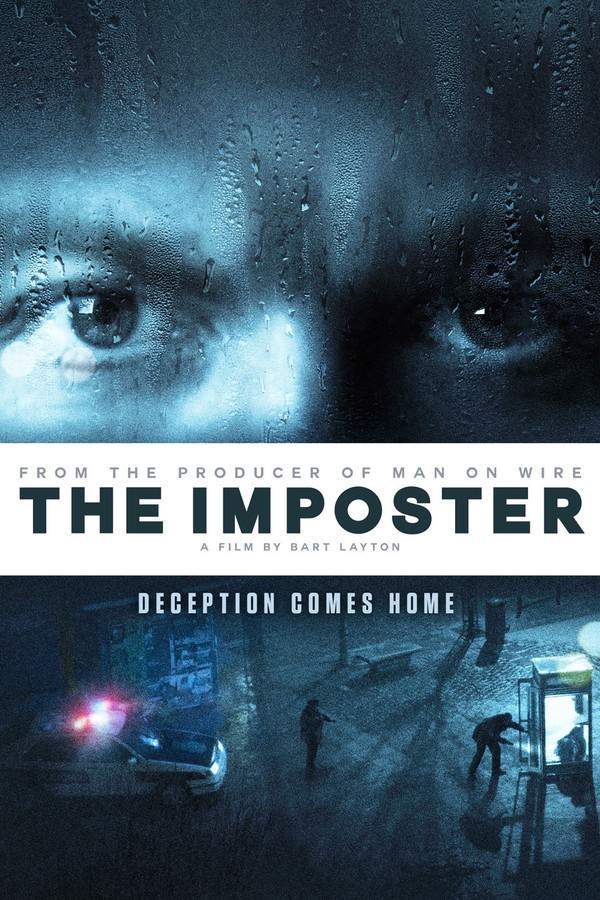
The Imposter (2012) movie poster

Plot Summary

The Imposter (2012) Plot Summary Explained

Release, runtime and language
2012 · 95 min · English
JustWatch #1,062 7
Directed by
Bart Layton
Starring
Adam O'Brian

In 1994, a 13-year-old boy disappeared from Texas. Three years later, he reappears, claiming to have endured kidnapping and torture. His family is overjoyed to welcome him back, but strange details quickly surface: a noticeable foreign accent, a changed appearance, and a family seemingly unaware of these differences. As investigators examine his story, unsettling inconsistencies emerge, leading to a shocking revelation that challenges everything everyone thought they knew. The case forces a repeated questioning of perception and leaves audiences captivated.

On this page (6)
  1. 1 Where to watch
  2. 2 What happens: full plot
  3. 3 Plot questions answered
  4. 4 Movie threads
  5. 5 Movies like The Imposter
  6. 6 Every angle

Where to watch

Where to Watch The Imposter (2012)

Where can you watch The Imposter? Stream, rent or buy it in the US, including on Amazon Prime Video, Philo and Fawesome: current JustWatch availability with up-to-date prices.

Streaming availability powered by JustWatch

Full plot summary · contains spoilers

What Happens in The Imposter: Full Plot Summary

The whole story of The Imposter (2012) explained, from the opening scene to the final frame: every key event, every twist and what it all adds up to. Read it as a quick recap before the sequel, to check a scene you missed, or to finally understand what really happened.

In a tense opening set inside a phone box in Spain, the impersonator Adam O'Brian Adam O'Brian calls the police claiming to be a tourist who has found a young boy and requests that the boy be collected. He is taken to a children's home and insists he is American. He asks to be left alone in an office overnight so he can contact his family, and there, he begins to work a meticulous ruse. He combs through records to reach various sheriff's offices in the United States, probing for information about missing children. From one lead he lands the name Nicholas Barclay, and then he calls another U.S. agency, posing as a Spanish official and asking for a faxed file on Nicholas. This marks the start of an elaborate attempt to pass as Nicholas, even plotting with tattoos and hair dyed blond to better resemble the missing boy.

Nicholas's family is notified of the discovery, and his sister flies to Spain to bring him home. A court accepts the identification, and he is declared a U.S. citizen. She transports him back to San Antonio, Texas, where most of the family accepts him, with the mother especially eager to welcome him and affirm him as her son. The young man at the center of this case appears to have found a place among relatives who want to believe him, even as doubt simmers beneath the surface.

But Bourdin turns out to be a man with a long history of impersonating children, real or imaginary, and he deepens his deception by alleging a brutal backstory—kidnapping for sexual abuse by Mexican, European, and U.S. military personnel and transportation from the United States to Spain. His impersonation fools a number of officials in both Spain and the United States, and many Barclay family members seem willing to accept him despite clear mismatches—he is seven years older than Nicholas, speaks with a French accent, and has brown eyes and dark hair instead of Nicholas's blue eyes and blond hair. The illusion begins to crack only when a private investigator, Charles Parker, and an FBI agent, Nancy Fisher, push back against the narrative and pursue the truth.

Bourdin is eventually arrested, and Interpol confirms his identity and long criminal record. In custody, he tells the police that the family killed the real Nicholas and that his presence was a cover for that crime. The remaining family scapegoats—most notably his dead brother Jason—are dragged into the mounting suspicion, challenging the fragile web of belief that had formed around the impostor.

Layton offered a pointed reflection on Bourdin's influence and charm: "He invites sympathy. He has this childlike quality about him, and he can be very charming. And at other times he can be quite repellent, because he can be remorseless and you're reminded about what he did. So as a filmmaker, I was asking: how can I find a way of getting the audience to experience a bit of that?"
Last updated: February 17, 2026 at 19:58

Was this helpful?

Plot questions answered

The Imposter Plot Explained: Your Questions Answered

The questions people ask most about The Imposter (2012): what happens in the confusing scenes, why the characters do what they do, the twists, hidden details and what the ending means. Each answer contains spoilers.

Q1

How did Bourdin manage to impersonate Nicholas Barclay?

Bourdin used a Spanish phone box to call police, claiming he found a young boy. Once in a children's home, he searched through records to find US missing children, specifically targeting the name Nicholas Barclay. He then posed as a Spanish official requesting faxed files on Nicholas, gathering enough personal details to construct a convincing backstory. He dyed his hair blond and got tattoos to better resemble the missing boy, then systematically built his false identity through contacts with US agencies.

Foreshadowing: Early in the film, Bourdin's meticulous research method is shown as he methodically pulls records to find the right missing child to impersonate.

  • impostor
  • identity fraud
  • deception
  • Frederic Bourdin
  • Nicholas Barclay
  • Spanish children home
Q2

Why did the Barclay family accept Bourdin despite obvious differences?

The family, especially the mother, was desperate to believe their missing son had survived. Bourdin was seven years older than Nicholas, spoke with a French accent, and had brown eyes and dark hair instead of blue eyes and blond hair. The mother was eager to affirm him as her son, likely driven by grief and the psychological need for closure. The family wanted to believe so badly that they overlooked or rationalized away the glaring discrepancies.

Foreshadowing: The mother's eager acceptance is established the moment she learns her son might have been found.

  • Barclay family
  • grief
  • belief
  • psychology
  • mother acceptance
  • denial
Q3

How did investigators discover Bourdin was an impostor?

Private investigator Charlie Parker and FBI agent Nancy Fisher began questioning the inconsistencies in Bourdin's story. They noticed the significant age difference, the foreign accent, and physical mismatches that the family had overlooked. Their persistent investigation and gathering of evidence eventually exposed the elaborate deception, leading to Bourdin's arrest.

Foreshadowing: The investigators' skepticism grows as they carefully examine the discrepancies that the family chose to ignore.

  • Charlie Parker
  • Nancy Fisher
  • FBI
  • investigation
  • evidence
  • exposure
  • arrest
Q4

Why did Bourdin claim the family killed the real Nicholas?

While in custody, Bourdin told police that the Barclay family had killed the real Nicholas and that his presence was intended as a cover for that crime. This confession shifted the case from simple impersonation to potential murder cover-up, with the focus turning to Jason, Bourdin's brother, as the alleged perpetrator, though Jason was already dead and could not defend himself.

Foreshadowing: Bourdin's ability to manipulate and deflect is demonstrated throughout his interactions with the family and authorities.

  • confession
  • murder cover-up
  • Jason
  • allegations
  • interrogation
  • manipulation
Q5

What was Bourdin's history with impersonation?

Bourdin had a long documented history of impersonating children, both real and imaginary, before assuming Nicholas Barclay's identity. This extensive experience explained his sophisticated approach to the deception and his ability to convincingly adopt a child's identity. His criminal past revealed a pattern of manipulating families and institutions.

Foreshadowing: The documentary reveals early hints that Bourdin had practiced similar deceptions before.

  • criminal record
  • past impersonations
  • fraud
  • pattern
  • Frederic Bourdin history
Q6

Why was the family so willing to believe Bourdin's story?

The family had suffered the trauma of Nicholas's disappearance three years earlier. The hope of having him back, even through an improbable discovery in Spain, was psychologically powerful. The mother in particular was desperate for closure and confirmation that her son had survived. This emotional need overrides logical assessment of the obvious mismatches.

Foreshadowing: The desperation for closure is evident from the moment the family receives news of a possible match.

  • hope
  • closure
  • trauma
  • grief
  • psychology
  • family denial
  • emotional need
Q7

What happened to the real Nicholas Barclay?

The real Nicholas Barclay was never found alive after disappearing in 1994. While Bourdin claimed the family killed him as part of a cover-up, the actual fate of Nicholas remains unknown and is one of the tragic unresolved aspects of the case. The documentary confirms he is dead, leaving the family and viewers with profound questions about what truly happened.

Foreshadowing: The documentary's somber tone and the investigators' focus on the family's possible involvement hint at Nicholas's tragic fate from the beginning.

  • Nicholas Barclay
  • fate
  • death
  • mystery
  • missing child
  • unresolved
Q8

Why did investigators push back against Bourdin's story?

Parker and Fisher noticed numerous inconsistencies that the family chose to ignore: the seven-year age gap, the French accent, the different eye and hair color. As professionals trained to verify identities, these discrepancies were too significant to overlook. Their persistence eventually unraveled the elaborate scheme and led to Bourdin's arrest and exposure.

Foreshadowing: The investigators' professional skepticism is evident from their first examination of the case details.

  • inconsistencies
  • discrepancies
  • evidence
  • professional investigation
  • verification
Q9

How did the faxed files help Bourdin's impersonation?

After learning Nicholas Barclay's name through his research, Bourdin called US agencies posing as a Spanish official and requested that the missing child's file be faxed to him. This gave him access to personal details about Nicholas, birth date, physical description, family information, that he used to build his convincing backstory and make his impersonation appear legitimate to authorities.

Foreshadowing: Bourdin's use of official records early in the film shows his methodical approach to gathering personal information.

  • fax
  • personal records
  • information gathering
  • identity documents
  • official channels
Q10

How did Bourdin's charm help his deception?

Bourdin possessed a childlike quality and significant charm that allowed him to gain trust quickly. Director Layton noted Bourdin could be both sympathetic and repellent, charming enough to win over the desperate family, yet capable of being remorseless about his manipulation. This psychological weapon was crucial in maintaining the illusion despite mounting evidence he was lying.

Foreshadowing: The documentary highlights Bourdin's ability to shift between charming and manipulative behavior throughout.

  • charm
  • manipulation
  • psychology
  • trust
  • remorseless
  • deception techniques

Movie threads

More Movies Like The Imposter, by Mood & Story

Curated lists built around what makes The Imposter tick: the same mood, the same kind of story or the same emotional payoff. Each list explains why these movies belong together.

Documentaries about deception and impostors like The Imposter

Documentaries where a bizarre case slowly reveals layers of psychological manipulation. A collection of true crime documentaries and films like The Imposter that investigate shocking cases of impostors, identity theft, and psychological manipulation, leaving viewers questioning perception and reality.

  • investigative
  • suspenseful
  • unsettling
  • psychological
  • disturbing
  • true crime
  • Tone: tense, unsettling, investigative
  • Pacing: steady, procedural
Why these movies?

The story pattern: The narrative follows an investigative structure, beginning with a seemingly straightforward mystery that quickly deepens with unsettling inconsistencies. The focus is on unraveling a web of lies, exploring the psychological motives of the deceiver and the often-complicit blindness of those involved, leading to a tragic or unsettling revelation.

Why they belong together: These films are grouped by their shared focus on real-life deception, a methodical and suspenseful pacing that uncovers the truth piece by piece, and their ability to deliver a powerful, emotionally heavy impact through the exploration of human tragedy and manipulation.

Psychological suspense movies that challenge perception like The Imposter

Stories where perception is distorted, forcing you to question what is real. If you liked the mind-bending suspense of The Imposter, explore these movies with unreliable narrators, psychological manipulation, and themes of identity, where the truth is elusive and perception is everything.

  • psychological
  • unsettling
  • mind-bending
  • suspenseful
  • tense
  • unreliable narrator
  • Tone: tense, psychological, unsettling
  • Pacing: steady, deliberate
Why these movies?

The story pattern: These narratives often center on a central mystery or character whose account of events cannot be trusted. The plot unfolds by deliberately obscuring the truth, creating a pervasive sense of doubt and unease. The journey is less about a simple resolution and more about the psychological impact of grappling with an unstable reality.

Why they belong together: They share a core theme of questioning reality and identity, a tense and complex tone that keeps viewers off-balance, and a focus on the psychological mechanics of deception—both self-deception and the manipulation of others.

If you liked this

Movies Like The Imposter

Similar movies to The Imposter: the same genre, themes or kind of story. Each one comes with its own plot summary, timeline and ending explained.

Browse all movie summaries

Every angle

The Imposter (2012) Explained: Plot, Timeline & Characters

Everything about The Imposter in one place: what happens in the plot summary, the timeline in chronological order, the characters and meaning and a spoiler-free summary. What's After the Movie adds the cast, box office and post-credit scenes.

Coming soon on iOS and Android

The Plot Explained Movie Summary App

Plot summaries, endings explained and timelines on your phone. Catch up on any movie in minutes, save your favorites and never miss a twist again.

Be the first to know when we launch. Your email stays private, always.

Learn more about the app