Plot Explained Spoilers guaranteed!
Plot Explained

Browse by genre

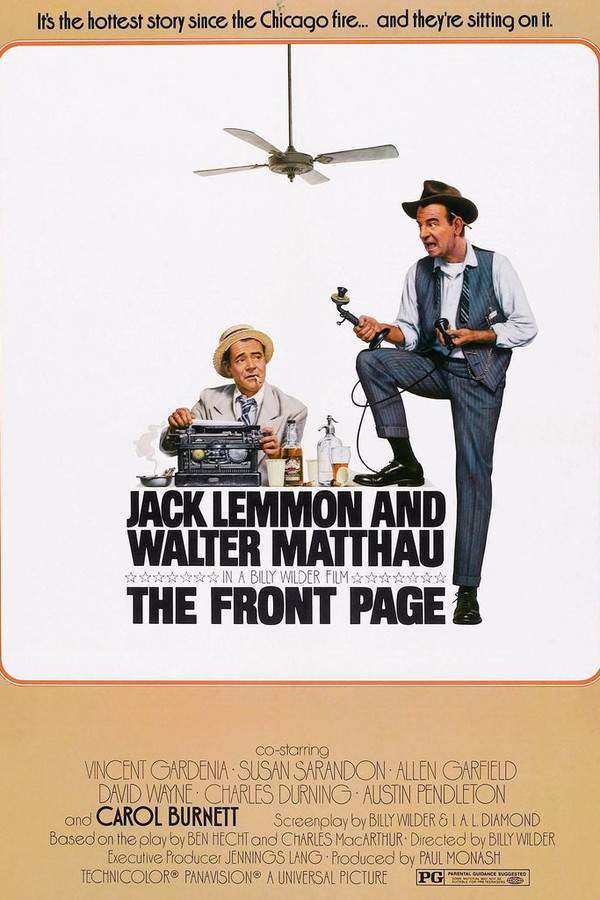
The Front Page (1974) movie poster

Timeline

The Front Page (1974) Timeline Explained – Every Event in Order

Release, runtime and language
1974 · 105 mins · English
JustWatch #10,252 8
Directed by
Billy Wilder
Starring
Martin Gabel, Susan Sarandon, Walter Matthau, Jack Lemmon, Austin Pendleton, Vincent Gardenia

The newsroom is buzzing over the biggest scoop since the Chicago fire, but the story sits idle on the desk. A hard‑pressed reporter, exhausted and on the brink of burnout, decides it’s time to leave his job for good. His ambitious editor, however, refuses to let him walk away, determined to keep the reporter on staff and the story alive.

On this page (6)
  1. 1 Where to watch
  2. 2 Events in order (11)
  3. 3 Timeline questions answered
  4. 4 Movie threads
  5. 5 Movies like The Front Page
  6. 6 Every angle

Where to watch

Where to Watch The Front Page (1974)

Where can you watch The Front Page? Stream, rent or buy it in the US, including on YouTube TV, Amazon Video and Apple TV Store: current JustWatch availability with up-to-date prices.

Streaming availability powered by JustWatch

11 events in order · contains spoilers

The Front Page Timeline: Events in Chronological Order

Every key event of The Front Page (1974) in order, scene by scene, with when and where it takes place. Use it to untangle flashbacks, time jumps and parallel storylines, to refresh your memory before the sequel or to find the exact scene you are thinking of.

  1. Hildy quits to marry Peggy and starts a new path as execution looms

    In 1920s Chicago, Hildy Johnson resigns from the Chicago Examiner to marry Peggy Grant and pursue a new path. The impending execution of Earl Williams frames this life change as a dramatic pivot rather than a quiet retirement. This decision sets up the tension between personal life and the possibility of a career-making scoop.

    Where
    Chicago, Illinois
  2. Walter Burns pressures Hildy to cover the story

    Walter Burns, the ruthless managing editor, urges Hildy to cover the Williams case to save his newspaper. Peggy grows frustrated as the couple rushes toward their train and away from their plans for a quiet life. The push-and-pull between work and marriage drives much of the early conflict.

    Where
    Chicago Examiner newsroom
  3. Earl Williams' backstory and the public appetite for justice

    Earl Williams is depicted as an impoverished, bumbling leftist who stuffed fortune cookies with messages. After he accidentally kills a police officer, the yellow press casts him as a Moscow threat, fueling public eagerness to see him executed. This sensational framing helps explain the case’s fevered attention.

    Where
    Chicago
  4. The execution agenda fuels crowd interest

    With the press stoking fear and anger, the town becomes eager for Williams's death as a governor's reprieve remains uncertain. The scheduled execution hangs over the city, turning the courthouse into a focal point of controversy and spectacle. Hildy’s role as a potential scoop hunter grows ever more central.

    Where
    Chicago
  5. Williams escapes and enters the courthouse pressroom

    Williams escapes from his cell and unexpectedly enters the courthouse pressroom where Hildy is present alone. The surprise appearance reignites Hildy’s appetite for a career-defining story, pulling him back into the story he thought he was leaving behind. The pressroom becomes the primary stage for the unfolding drama.

    Where
    Courthouse pressroom, Chicago
  6. Mollie Malloy creates a distraction

    Mollie Malloy, a friend to Earl, creates a distraction by leaping from the courthouse’s third floor window. The stunt buys crucial time and helps Earl evade immediate capture. The moment amplifies the chaos around the trial and the newsroom alike.

    Where
    Courthouse
  7. Earl is recaptured; arrests follow

    Earl Williams is recaptured, and Hildy and Walter are arrested for aiding and abetting a fugitive. The situation could have derailed their careers entirely, but the arrest also sets the stage for a larger reveal about political interference. The newsroom and authorities are locked in a tense stalemate.

    Where
    Courthouse/City Hall, Chicago
  8. Release and the revelation of political collusion

    Hildy and Walter are released when it becomes clear that the mayor and sheriff colluded to conceal Earl’s last-minute reprieve from the governor. This discovery exposes the corruption behind the courtroom drama and redefines the stakes for everyone involved. The reprieve upends the expected fate of the case.

    Where
    City offices, Chicago
  9. Walter gives a grudging token of respect

    Walter grudgingly accepts that he is losing his ace reporter to personal life and the lure of a sensational story. He presents Hildy with a watch as a token of appreciation, signaling a complex mix of rivalry, respect, and reluctant farewell. The gift underscores the shifting loyalties in the newsroom and beyond.

    Where
    Walter Burns's office, Chicago Examiner
  10. Hildy and Peggy depart to marry

    Hildy and Peggy decide to marry and leave the newsroom behind. They prepare to start their new life together, stepping away from the press circus that has defined their days. The couple’s departure marks a dramatic turn from career obsession to personal commitment.

    Where
    Chicago
  11. The watch and a new chase begin

    Walter telegraphs the next railway station to warn that the man who stole his watch is on the inbound train. The alert preserves the paper’s appetite for a follow-up and hints that the story—and the chase—are far from over. The watch becomes a tangible symbol of the ongoing chase for truth.

    Where
    Next railway station

Last updated: February 18, 2026 at 23:47

Was this helpful?

Timeline questions answered

The Front Page Timeline Explained: Your Questions Answered

When does it happen, and why in that order? The questions people ask about the chronology of The Front Page (1974): time jumps, flashbacks, cause and effect between scenes and the correct order of events, each answered with spoilers.

Q1

Why does Hildy Johnson quit his job at the Chicago Examiner?

Hildy quits because he's exhausted from the grind of journalism and wants to marry Peggy Grant and start a fresh life. However, his decision coincides with Earl Williams' execution case, which proves too tempting for a career reporter to walk away from.

Foreshadowing: Early scenes establish Hildy's burnout and his eagerness to leave the newsroom behind.

  • hildy johnson
  • quit job
  • chicago examiner
  • peg grant
  • career change
Q2

How does Walter Burns try to keep Hildy from leaving?

Walter resorts to psychological manipulation, first pressuring Hildy to cover the Williams story as a final assignment, then creating obstacles that delay Hildy's departure. He uses the excitement of the biggest scoop in years to appeal to Hildy's reporter instincts and undercut his resolve to leave.

Foreshadowing: Walter's egomaniacal personality is established early as he refuses to let his star reporter go.

  • walter burns
  • hildy johnson
  • manipulation
  • newsroom
  • editor
Q3

What crime did Earl Williams actually commit?

Earl Williams was an impoverished, bumbling leftist who stuffed fortune cookies with political messages advocating radical change. During a confrontation, he accidentally killed a police officer while trying to make a statement, which the press sensationalized into a major political threat.

Foreshadowing: The yellow press builds up Earl as a dangerous radical from the start, creating a mismatch between reality and narrative.

  • earl williams
  • fortune cookies
  • police officer
  • killing
  • political messages
Q4

Why is Earl Williams portrayed as a Moscow threat?

The Chicago Examiner deliberately cast Earl as a communist menace to boost newspaper sales, even though he was merely a bumbling idealist who distributed political messages through fortune cookies. The yellow press capitalized on Cold War fears to fuel public demand for his execution.

Foreshadowing: The press coverage consistently emphasizes the 'Moscow threat' angle despite Earl's harmless nature.

  • moscow threat
  • yellow press
  • communism
  • chicago examiner
  • execution
Q5

How does Earl Williams escape from prison?

Earl escapes from his prison cell and slips into the courthouse pressroom, where Hildy Johnson happens to be alone. The escape is opportunistic rather than meticulously planned, and his arrival in the pressroom sets up the film's central chaos.

Foreshadowing: The timeline builds toward the execution as the key narrative deadline.

  • earl williams
  • escape
  • prison
  • courthouse
  • pressroom
Q6

Why does Mollie Malloy jump from the courthouse window?

Mollie Malloy, a friend of Earl Williams who describes herself as a '$2 whore from Division Street,' creates a dramatic distraction by leaping from the third-floor window. Her selfless act buys Earl crucial time to evade capture, though she survives the jump.

Foreshadowing: Mollie's character is introduced as someone with personal loyalty to Earl.

  • mollie malloy
  • jump
  • courthouse window
  • distraction
  • earl williams
Q7

What political scandal is revealed at the end?

The mayor Harold Gould and sheriff Vincent Gardenia had secretly conspired to conceal Governor's last-minute reprieve for Earl Williams. This political cover-up was designed to let the execution proceed despite the governor's decision to commute the sentence, revealing corruption at the highest levels.

Foreshadowing: The reprieve is mentioned early as uncertain, making the cover-up surprising.

  • mayor
  • sheriff
  • reprieve
  • governor
  • corruption
  • cover-up
Q8

Why are Hildy and Walter arrested?

Both Hildy and Walter are arrested for aiding and abetting Earl Williams after he's found hiding in the courthouse. The arrest occurs when Earl is recaptured, and the authorities initially believe they helped facilitate his escape.

Foreshadowing: The chaos in the courthouse directly leads to their capture.

  • hildy johnson
  • walter burns
  • arrest
  • aiding and abetting
  • fugitive
Q9

What is the significance of the watch at the end?

Walter gives Hildy a watch as a grudging token of respect and farewell, acknowledging he may be losing his best reporter. However, the watch becomes a running gag when Hildy steals it, prompting Walter to telegraph ahead to have Hildy apprehended on the train, a final prank that underscores their competitive relationship.

Foreshadowing: The watch exchange happens after Walter admits he respects Hildy.

  • watch
  • gift
  • walter burns
  • hildy johnson
  • final prank
Q10

Does Hildy actually get married at the end?

Yes, Hildy and Peggy proceed with their wedding despite the chaos of the day. The film ends with wedding bells ringing as they prepare to start their new life together, stepping away from the newsroom drama that had threatened to derail their plans.

Foreshadowing: Peggy's frustration with the delays is established early in the film.

  • hildy johnson
  • peg grant
  • wedding
  • marriage
  • ending

Movie threads

More Movies Like The Front Page, by Mood & Story

Curated lists built around what makes The Front Page tick: the same mood, the same kind of story or the same emotional payoff. Each list explains why these movies belong together.

Screwball Newsroom Shenanigans like in The Front Page

Fast-talking journalists chase a scoop in a chaotic and cynical comedy. If you liked the madcap energy of The Front Page, discover more movies featuring journalists in chaotic newsrooms. These witty, fast-paced comedies spotlight cynical reporters chasing big scoops with energetic farce and satirical humor.

  • madcap
  • witty
  • cynical
  • energetic
  • satirical
  • screwball
  • Tone: light, cynical, witty
  • Pacing: fast, chaotic
Why these movies?

The story pattern: Stories typically revolve around a high-stakes news story that sends a group of journalists into a frenzy. The plot unfolds rapidly through a series of misunderstandings, slapstick chases, and sharp verbal sparring, focusing on the conflict between professional ambition and personal life, often culminating in a comedic resolution.

Why they belong together: These films share a specific combo: a fast-paced, farcical tone set against the backdrop of media sensationalism. They are united by their cynical yet lighthearted take on journalism, energetic pacing driven by dialogue and physical comedy, and a cast of characters more concerned with the story than the morality of getting it.

High-Stakes Workplace Farce like in The Front Page

Chaos erupts when professional ambition clashes with personal desires under pressure. Fans of The Front Page will enjoy these other movies about chaotic workplaces descending into farce. Discover similar fast-paced comedies where eccentric employees, tight deadlines, and clashing ambitions create a whirlwind of hilarious situations.

  • farce
  • chaotic
  • satirical
  • eccentric
  • high-energy
  • workplace
  • Tone: light, satirical, energetic
  • Pacing: fast, frantic
Why these movies?

The story pattern: The narrative follows employees in a demanding job who are pushed to their limits. A central conflict, often between a burnt-out employee and a demanding boss, triggers a cascade of comedic events, escapes, and deceptions. The fast pace and ensemble cast create a sense of controlled chaos that resolves with a happy, if slightly cynical, conclusion.

Why they belong together: These movies are linked by their specific setting—a high-stakes workplace—and their use of that setting to generate farce. They share a light tone despite the pressure, fast pacing that mirrors the chaotic environment, and a focus on the absurdity of professional life when ambition and personal escape plans inevitably clash.

If you liked this

Movies Like The Front Page

Similar movies to The Front Page: the same genre, themes or kind of story. Each one comes with its own plot summary, timeline and ending explained.

Browse all movie summaries

Every angle

The Front Page (1974) Explained: Plot, Timeline & Characters

Everything about The Front Page in one place: what happens in the plot summary, the timeline in chronological order, the characters and meaning and a spoiler-free summary. What's After the Movie adds the cast, box office and post-credit scenes.

Coming soon on iOS and Android

The Plot Explained Movie Summary App

Plot summaries, endings explained and timelines on your phone. Catch up on any movie in minutes, save your favorites and never miss a twist again.

Be the first to know when we launch. Your email stays private, always.

Learn more about the app