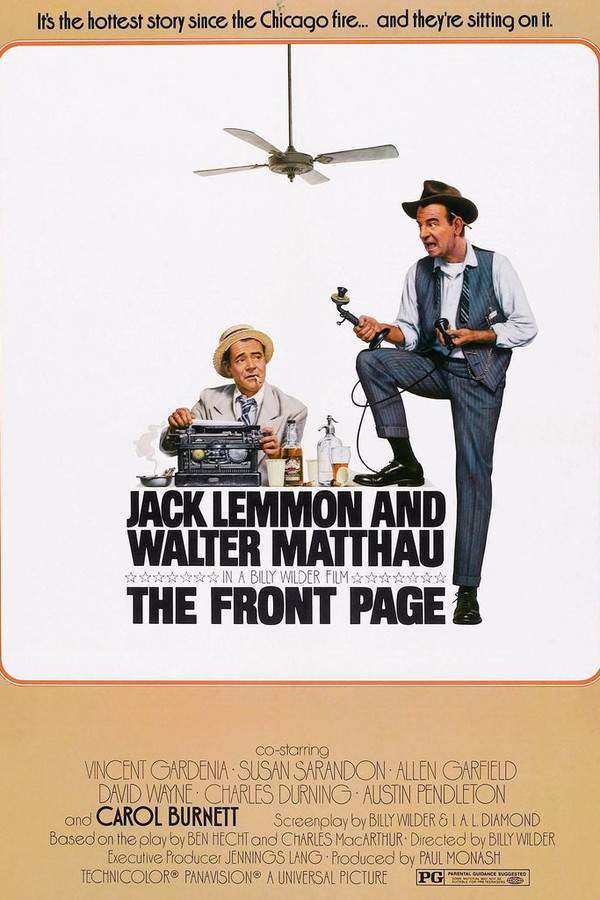
In 1920s Chicago, Hildebrand "Hildy" Johnson, a Chicago Examiner reporter, has just quit his job to marry Peggy Grant and start a new life, just as Earl Williams is set to be executed. Walter Burns, the ruthless, egomaniacal managing editor, is desperate to keep his star on the payroll and egged him on to cover the story, complicating Peggy’s plans and throwing their wedding timetable into disarray.
[Hildebrand] faces a moral tug-of-war between loyalty to his old boss and a genuine affection for Peggy, while Earl Williams—an impoverished, bumbling leftist whose crime involved stuffing fortune cookies with political messages—has become the focal point of a sensational, fear-driven press cycle. The public narrative casts Earl as a Moscow threat after he accidentally kills a police officer, and the crowd’s appetite for capital punishment grows as the city cheers to see him executed. The stakes are high, the clock is ticking, and the pressure to deliver the perfect scoop mounts quickly.
When Earl manages to escape from his prison cell, he slips into the courthouse pressroom while Hildy is there alone. The lure of what could be the last great breakthrough of Hildy’s career proves irresistible, and the chase for a headline trumps even the most personal commitments. In a tense dance of manipulation, Hildy navigates the precarious line between truth and sensationalism, all while Walter attempts to hold on to his top reporter by any means necessary.
Into this fraught mix steps Mollie Malloy, Mollie Malloy, a self-described "$2 whore from Division Street" who befriends Earl and creates a dramatic distraction by leaping from the third-floor window. Her bold act buys Earl crucial time, but it also intensifies the danger and spotlight surrounding the case, further entangling Hildy’s loyalties with the sensationalist machinery of a city obsessed with justice as show.
As the frenzy crescendos, Earl is ultimately recaptured, and both Hildy and Walter are arrested for aiding and abetting a fugitive. They are released when the truth comes to light: the mayor, Harold Gould, and the sheriff, Vincent Gardenia, had quietly conspired to conceal Earl’s last-minute reprieve by the governor. This revelation marks a turning point, with Walter reluctantly acknowledging that he may be losing his ace reporter to history, and he offers a parting token in the form of a watch.
With the wedding bells ringing in the distance, Hildy and Peggy prepare to start their new life together. Yet the day’s events leave an indelible mark on everyone involved. Walter, still in control of the newsroom, sends a telegraph to the next railway station to alert them that the man who stole his watch is on the inbound train and should be apprehended by the police, a final act that underscores the film’s sharp compression of ambition, loyalty, and the ethics of journalism. The story closes on a note that blends humor with a wary recognition of how the pursuit of a story can redefine personal destinies.