Plot Explained Spoilers guaranteed!
Plot Explained

Browse by genre

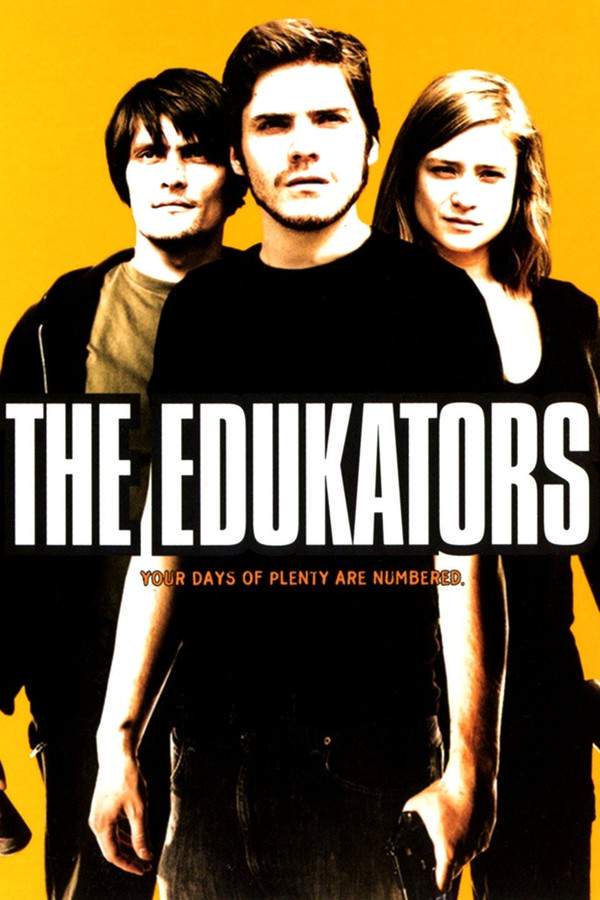
The Edukators (2005) movie poster

Plot Summary

The Edukators (2005) Plot Summary Explained

Release, runtime and language
2005 · 127 min · German
Directed by
Hans Weingartner
Starring
Daniel Brühl, Julia Jentsch, Stipe Erceg, Burghart Klaußner

Driven by revolutionary ideals, Peter and Jan carry out raids on the wealthy, distributing their resources without theft. Peter's life becomes intertwined with Jule, who asks for their assistance in confronting a ruthless businessman. As they delve deeper into their actions, the trio find themselves facing unexpected and serious repercussions, forcing them to question their methods and the impact they have on those around them.

On this page (5)
  1. 1 What happens: full plot
  2. 2 Plot questions answered
  3. 3 Movie threads
  4. 4 Movies like The Edukators
  5. 5 Every angle

Full plot summary · contains spoilers

What Happens in The Edukators: Full Plot Summary

The whole story of The Edukators (2005) explained, from the opening scene to the final frame: every key event, every twist and what it all adds up to. Read it as a quick recap before the sequel, to check a scene you missed, or to finally understand what really happened.

Set in 2004, the story follows three passionate young anti-capitalist activists navigating the heart of Berlin: Jule (Julia Jentsch), her boyfriend Peter (Stipe Erceg), and his close friend Jan (Daniel Brühl). Jule, a dedicated waitress, is engulfed in a €100,000 debt stemming from an accident a year prior where she accidentally collided with a luxurious Mercedes-Benz S-Class owned by the affluent businessman Hardenberg (Burghart Klaußner). Following her eviction due to unpaid rent, she seeks shelter with Peter and Jan, who seem to be always out and about.

While Peter is off in Barcelona, Jan reveals to Jule that he and Peter engage in what they consider "educational" acts against the upper class, breaking into their homes, rearranging their possessions, and leaving behind messages such as >"die fetten Jahre sind vorbei" ("the days of plenty are over") and "Sie haben zu viel Geld" ("you have too much money"). Intrigued by this, Jule persuades a hesitant Jan to join her in breaking into Hardenberg's home in the upscale suburb of Zehlendorf while he is away on a business trip.

During this audacious act, an unexpected thrill leads them to share a kiss; however, Jan soon departs, prioritizing his friendship with Peter. As Jule meanders outside, she inadvertently triggers the floodlights, prompting a hasty escape. The following day, when Peter returns, neither Jule nor Jan reveals the previous night's escapades. Later, realizing her phone is missing, Jule and Jan return to the house that night to search for it. Their plans take a turn when they encounter Hardenberg, leading to a struggle where Jan intervenes and knocks him unconscious with a flashlight.

Faced with the dilemma of their captive, the trio decides to transport Hardenberg to a secluded cabin owned by Jule's uncle in the serene Austrian Alps near Jenbach, overlooking the tranquil Achensee. Here, as they contemplate their next steps, they uncover Hardenberg's radical past; he was formerly a prominent leader in the Socialist German Student Union during the 1960s. The evolving dynamics of their relationships become central, especially as Peter and Jan grapple with Jan's burgeoning romantic interest in Jule.

Realizing their initial choice to kidnap Hardenberg was misguided, they ultimately choose to return him to his home and set him free. As they prepare for departure, Hardenberg gifts Jule a letter forgiving her debt and assuring her that he will not involve the authorities. The film’s climax reveals the trio asleep in the same bed as a team of heavily armed police (Spezialeinsatzkommando) approaches their flat and knocks on the door. Jule stirs awake at the sound of the knock, only to find the police breaking into their nearly vacant apartment. In a twist, while in Barcelona, Jule is met by a hotel maid ready to clean their room, leaving an intriguing note behind in the Berlin apartment: >"Manche Menschen ändern sich nie" ("some people never change"). Meanwhile, the original German ending shows the Edukators taking to Hardenberg's boat in the Mediterranean, presumably aiming to disrupt the signal towers powering much of Western Europe's television programming.

Last updated: November 08, 2024 at 03:11

Was this helpful?

Plot questions answered

The Edukators Plot Explained: Your Questions Answered

The questions people ask most about The Edukators (2005): what happens in the confusing scenes, why the characters do what they do, the twists, hidden details and what the ending means. Each answer contains spoilers.

Q1

Why does Jule owe €100,000 to Hardenberg?

Jule caused a car accident a year before the story begins when she collided with Hardenberg's luxury Mercedes-Benz. The accident left her with a €100,000 debt that she cannot pay, which ultimately leads to her eviction from her apartment and forces her to move in with Peter and Jan.

  • jule debt
  • hardenberg
  • mercedes
  • accident
  • car crash
Q2

What is the Edukators' method of activism?

Peter and Jan break into the homes of wealthy people while they are away, rearrange their possessions, and leave behind messages criticizing their wealth such as 'the days of plenty are over' and 'you have too much money.' They consider these acts educational rather than theft since they do not steal anything.

  • edukators
  • activism
  • anti-capitalist
  • break-in
  • wealth
Q3

Why does Jule want to break into Hardenberg's house specifically?

Jule specifically targets Hardenberg's home because she holds him responsible for her massive debt from the car accident. Breaking into his house represents both a way to confront the source of her financial ruin and an expression of her growing anti-capitalist sympathies.

  • jule
  • hardenberg
  • revenge
  • break-in
  • debt
Q4

How does the situation escalate from breaking and entering to kidnapping?

Jule and Jan return to Hardenberg's house to find her missing phone, but they unexpectedly encounter Hardenberg. During a struggle, Jan knocks him unconscious with a flashlight. Faced with an unconscious wealthy businessman and no clear way to escape without consequences, they panic and decide to take him to a remote cabin rather than leave him or call authorities.

Foreshadowing: Earlier, Jule triggers floodlights during their escape, showing how small mistakes can spiral into bigger problems.

  • kidnapping
  • hardenberg
  • escalation
  • cabin
  • panic
Q5

Why is Hardenberg's past as a socialist student leader significant?

While holding Hardenberg captive in the Austrian cabin, the trio discovers he was once a prominent leader in the Socialist German Student Union during the 1960s. This revelation complicates their worldview, as they realize their wealthy victim once shared their radical ideals, suggesting that wealth and power can corrupt even the most idealistic people.

  • hardenberg
  • socialist
  • student union
  • 1960s
  • idealism
Q6

Why do Jule, Peter, and Jan decide to release Hardenberg?

The trio recognizes that kidnapping a person is a serious crime that goes beyond their original philosophy of non-violent protest. Their 'educational' activism was meant to challenge wealth without causing harm, but kidnapping crosses a moral line they cannot justify. This marks a turning point where they choose to prioritize ethical boundaries over revenge or justice.

  • release
  • kidnapping
  • moral
  • ethics
  • turning point
Q7

What does Hardenberg's letter mean for Jule's debt?

Before releasing Hardenberg, he gives Jule a letter forgiving her entire €100,000 debt and promises not to involve the authorities. This surprising act of mercy suggests Hardenberg sees something in Jule that mirrors his own past idealism, or simply wants to close the chapter without further conflict.

  • forgiveness
  • letter
  • debt
  • hardenberg
  • jule
Q8

What happens at the end - do the police arrest them?

The film ends with police knocking on the apartment door while the three sleep together in bed. The camera shows heavily armed police (Spezialeinsatzkommando) breaking into their nearly vacant apartment. It remains ambiguous whether they are arrested, as the film cuts away before any confrontation is shown.

Foreshadowing: Earlier scenes establish that their activities would inevitably attract police attention.

  • police
  • arrest
  • ending
  • raid
  • ambiguous
Q9

What's the meaning of the note 'some people never change'?

In the ending, Jule is in Barcelona while a hotel maid enters her room. A note left in their Berlin apartment reads 'Manche Menschen ändern sich nie' ('some people never change'). This suggests that despite their moral awakening and release of Hardenberg, the trio cannot escape their rebellious nature - their ideals and patterns persist regardless of consequences.

  • barcelona
  • note
  • change
  • ending
  • rebellion
Q10

What is the Edukators' final act in the boat ending?

The original German ending shows Jan, Peter, and Jule sailing on Hardenberg's boat in the Mediterranean, apparently heading toward signal towers that power much of Western Europe's television programming. This suggests they are planning one final act of technological disruption - using the wealthy man's own resources against the system they oppose.

Foreshadowing: Their earlier message 'the days of plenty are over' foreshadows their desire to disrupt the established order.

  • boat
  • signal towers
  • mediterranean
  • rebellion
  • ending

Movie threads

More Movies Like The Edukators, by Mood & Story

Curated lists built around what makes The Edukators tick: the same mood, the same kind of story or the same emotional payoff. Each list explains why these movies belong together.

Movies about idealism under pressure like The Edukators

When radical beliefs collide with human reality and unintended consequences. If you liked The Edukators, explore more movies about young idealists whose activism escalates beyond their control. These films feature tense dramas and thrillers where characters confront the moral fallout of their radical actions, questioning their beliefs in the face of real-world consequences.

  • rebellious
  • anxious
  • idealistic
  • claustrophobic
  • moral dilemma
  • confrontational
  • Tone: tense, confrontational, melancholic
  • Pacing: steady, escalatory
Why these movies?

The story pattern: Stories in this thread typically begin with a firm ideological stance, often involving protest or direct action. The plot hinges on a catalytic event that transforms a symbolic act into a genuine crisis, trapping the characters in a situation that challenges their worldview and forces difficult, compromising choices.

Why they belong together: These movies are grouped by their shared exploration of the gap between youthful rebellion and complex reality. They share a tense, confrontational mood and a steady pacing that builds from passion to pragmatism, often culminating in ambiguous or bittersweet endings that reflect the unresolved nature of the characters' struggles.

Claustrophobic cabin dramas with moral dilemmas like The Edukators

Confrontations and moral crises that unfold in isolated, claustrophobic settings. Find movies similar to The Edukators where a secluded cabin becomes a pressure cooker for tension. These stories focus on characters forced together by a high-stakes situation, leading to intense dialogue, emotional confrontations, and a re-evaluation of their relationships and choices.

  • claustrophobic
  • tense
  • anxious
  • confrontational
  • moral dilemma
  • isolated
  • Tone: tense, claustrophobic, anxious
  • Pacing: steady, dialogue-heavy
Why these movies?

The story pattern: The narrative pattern involves characters retreating to or being trapped in an isolated space, such as a cabin or remote house, following a disruptive event. The confined setting acts as a crucible, stripping away external distractions and amplifying personal conflicts, secrets, and philosophical debates under the constant threat of discovery.

Why they belong together: They share a specific, tense vibe generated by spatial confinement and high emotional stakes. The pacing is often steady and dialogue-driven, building a sense of claustrophobic anxiety. The focus is on the psychological and relational fallout of a shared secret or crime in a contained environment.

If you liked this

Movies Like The Edukators

Similar movies to The Edukators: the same genre, themes or kind of story. Each one comes with its own plot summary, timeline and ending explained.

Browse all movie summaries

Every angle

The Edukators (2005) Explained: Plot, Timeline & Characters

Everything about The Edukators in one place: what happens in the plot summary, the timeline in chronological order, the characters and meaning and a spoiler-free summary. What's After the Movie adds the cast, box office and post-credit scenes.

Coming soon on iOS and Android

The Plot Explained Movie Summary App

Plot summaries, endings explained and timelines on your phone. Catch up on any movie in minutes, save your favorites and never miss a twist again.

Be the first to know when we launch. Your email stays private, always.

Learn more about the app