







Plot Explained Spoilers guaranteed!
Plot Explained

Browse by genre

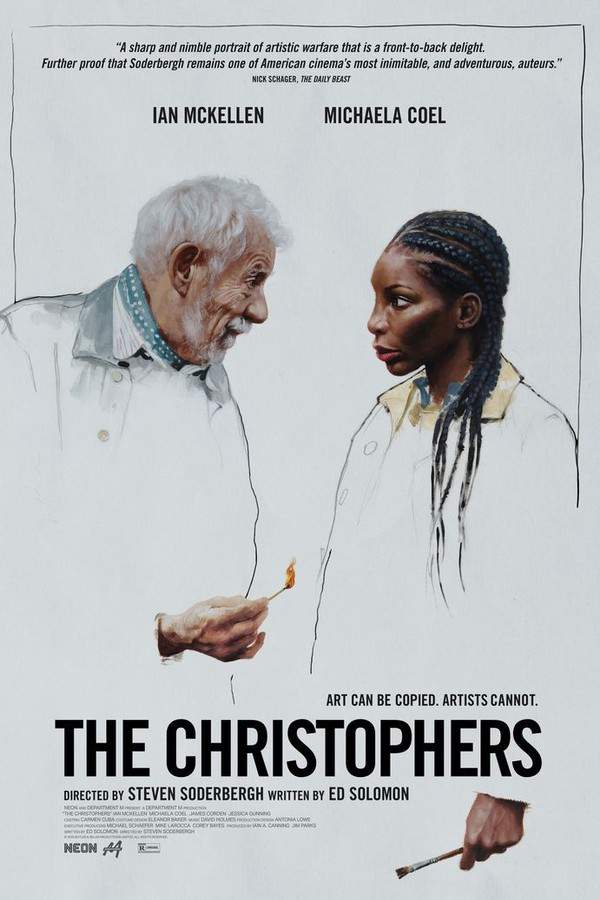
The Christophers (2026) movie poster

Ending Explained

The Christophers (2026) Ending Explained – Final Scene & Meaning

Release, runtime and language
2026 · 1 h 40 m · English
Echo score 80
JustWatch #119 60
Directed by
Steven Soderbergh
Starring
Michaela Coel, Ian McKellen, James Corden, Jessica Gunning, Dallas Campbell, Daniel Fearn

Julian Sklar (Ian McKellen) was a celebrated figure in London’s 1960s‑70s pop‑art boom, but he’s stopped painting and has lived in poverty for years. His two estranged children (James Corden, Jessica Gunning), eager for an inheritance, enlist Lori, an art restorer and former forger (Michaela Coel), to pose as a prospective assistant in order to gain access to his estate.

On this page (7)
  1. 1 Where to watch
  2. 2 What happens at the end
  3. 3 Final events in order
  4. 4 Ending questions answered
  5. 5 Movie threads
  6. 6 Categories
  7. 7 Every angle

Where to watch

Where to Watch The Christophers (2026)

Where can you watch The Christophers? Stream, rent or buy it in the US, including on Hulu, Amazon Video and Apple TV Store: current JustWatch availability with up-to-date prices.

Streaming availability powered by JustWatch

Ending explained · contains spoilers

What Happens at the End of The Christophers?

How The Christophers (2026) ends, what the final scene means, which earlier moments set it up and how to read the ending if the film leaves it open. The full ending explained, with every spoiler.

Sallie and Barnaby’s plan depends on Lori completing Julian’s unfinished Christopher series well enough for the works to be sold as originals. They have already promised the paintings to a businessman who intends to disguise the purchase as charity for a tax advantage, and they blackmail Lori with an earlier shady transaction when she tries to withdraw. Lori first tells them the originals were shredded, although they are actually waiting outside to be burned according to Julian’s wishes. Her refusal to destroy them makes Julian confront his own attachment to the series. He brings the canvases back to the studio intending to finish them badly as an insult to his children, only to discover that even his sabotage produces compelling work. The fragile collaboration collapses when he attacks Lori’s worth as an artist. Later he recognizes her Untitled No. 7 as the painting that had stayed in his memory, understands that his cruelty helped destroy her confidence, and apologizes at her studio. They agree to work together the following week, but Julian dies before that can happen. Lori ultimately gives Sallie and Barnaby the Christophers, yet neither sibling can authenticate who completed them. She also forges a letter in Julian’s name granting the works to his muse, Owen Christopher Appleton, who presents them at an exhibition. Whether the final surfaces belong to Julian, Lori, or both remains deliberately unprovable.

The missing authentication is not merely a caper twist; it overturns every character’s attempt to make authorship serve ownership. Sallie and Barnaby need a clean Julian signature because his name converts paint into a financial instrument. Julian initially treats Lori as an inferior imitator because defending the singularity of his talent protects both his ego and market value. Lori, however, knows the work closely enough to identify the private experiences behind it, and Julian’s recognition of her old painting proves that influence has already moved in both directions. Her forged letter is unlawful and self-interested, but it also blocks the children’s tax scheme and directs the series toward the muse whose presence helped generate it. The exhibition therefore rests on several incompatible truths: the paintings may contain Julian’s hand, Lori’s labor, Owen’s history, and the children’s coercion at once. Instead of resolving those claims, the ending removes the expert signature that would rank them. Viewers are left to look at the Christophers without the certainty the buyers demand, which is precisely the position Julian and Lori’s aborted collaboration made possible.

Last updated: August 26, 2026 at 20:31

Was this helpful?

The last 4 events

How The Christophers Ends: The Final Events in Order

The last events of The Christophers (2026) in chronological order, the run-up to the ending explained above. The complete timeline has all 15 events, scene by scene.

Open the full timeline
  1. Lori seizes the Christophers

    Lori takes the real Christophers from the house and forges a letter in Julian's name granting ownership of the works to Christopher, Julian's former lover. The move redirects the artworks away from Lori's original plan toward a new beneficiary. The deed deepens the mystery of authorship.

    When
    after Julian's death
    Where
    Julian's house
  2. Museum show and unsalable legacy

    At a museum show honoring Julian, Christopher exhibits the portraits—all finished in the unsalable late style. It remains unclear whether Lori or Julian completed them. The exhibit intertwines the past with current reinterpretations of ownership and value.

    When
    posthumous
    Where
    Museum
  3. Lori's modern homage alongside the Christophers

    Alongside the portraits, Lori presents a modern work honoring Julian by compiling dozens of his Cameo videos. The piece contrasts the old legacy with contemporary media and raises questions of authorship and influence. Viewers encounter a hybrid of old and new forms.

    When
    posthumous
    Where
    Museum or gallery
  4. Final painting and signature message

    The masseuse gives Lori Julian's final painting, an unfinished self-portrait, signed 'for Lori' on the back. The signature hints at an ambiguous end to the relationship and the artistic negotiation. The painting becomes a last, enigmatic token in the saga.

    When
    post-show
    Where
    Masseuse's space

Ending questions answered

The Christophers Ending: Your Questions Answered

The questions people ask most about the ending of The Christophers (2026): what the final scene means, how the twist works, what happens to each character and how to read the ending. Each answer contains spoilers.

Q1

Why does Julian die before he and Lori can work together?

Julian's death occurs after he apologizes to Lori at her studio and they agree to begin a genuine collaboration the following week. The timing means the Christopher series is never completed under the honest partnership both characters wanted, which is what makes the question of authorship permanent. His passing also removes the only person who could definitively confirm which brushstrokes are his, deepening the ambiguity that drives the ending.

Foreshadowing: Julian's age, frailty, and years of living in poverty establish early on that his time is limited.

  • julian death
  • lori collaboration
  • christopher series
  • ending
Q2

What happens to the Christopher paintings in the end?

Lori ultimately hands the canvases over to Sallie and Barnaby as the siblings demanded, but the businessman cannot authenticate the works and the sale falls apart. Lori also forges a letter in Julian's name donating the series to Owen Christopher Appleton, the original muse. The paintings are ultimately presented at an exhibition as a gift to Owen, with no expert able to confirm who actually finished them.

Foreshadowing: Julian repeatedly insists the Christopher series be destroyed, signaling that the works themselves, not the money, are the real battleground.

  • christopher paintings
  • ending
  • exhibition
  • owen appleton
Q3

Why can't anyone authenticate who finished the Christopher paintings?

Lori was hired specifically to complete Julian's unfinished canvases in his style, so the final surfaces blend her hand with his. Julian also tried to sabotage the paintings to spite his children, only to find that his deliberate mistakes still looked like his own work. Because no living artist steps forward to sign off and the physical evidence cannot separate the two contributions, the question of authorship is left permanently open.

Foreshadowing: Julian's discovery that even his bad-faith finishing produced convincing work shows the authentication problem was built into the plan from the start.

  • authentication
  • authorship
  • christopher paintings
  • lori forgery
  • julian
Q4

What does Lori's forged letter granting the paintings to Owen mean?

The letter is both a crime and an act of restitution. It blocks Sallie and Barnaby's tax-deductible sale and keeps the series out of the hands of a buyer who wanted it for a financial scheme. By naming Owen as the recipient, Lori redirects the work to the person whose life actually inspired it, turning a coerced forgery into a kind of justice. The fact that the letter is forged also mirrors the larger theme: a fake document controls the fate of real art.

Foreshadowing: Lori's decision to protect the originals from burning earlier shows she already viewed the Christophers as belonging to the people who created and inspired them.

  • lori forged letter
  • owen appleton
  • ending
  • charity scheme
Q5

Why does Julian attack Lori's worth as an artist?

Julian lashes out at Lori when the plan to finish the Christophers together starts to feel real, because accepting her as an equal collaborator threatens the idea that his talent is singular and unreproducible. His reputation and the market value of his name depend on nobody else being able to paint like him, so acknowledging her skill would undermine his identity as a once-celebrated artist. The cruelty is therefore less about Lori than about Julian defending the ego that years of poverty and irrelevance have already eroded.

Foreshadowing: Julian's earlier dismissal of Lori's copies as inferior contrasts with how closely he actually studies her work, hinting that he is threatened rather than unimpressed.

  • julian lori fight
  • artistic ego
  • collaboration
  • ending
Q6

Why does Julian recognize Lori's Untitled No. 7 at her studio?

Untitled No. 7 is a painting Lori made years earlier, and Julian realizes it is the image that had lingered in his memory without him knowing who made it. The recognition proves that Lori's vision had already shaped his thinking, which means his claim to total originality was never accurate. It is the moment that allows him to apologize and agree to collaborate, because he can no longer honestly treat her as a mere imitator.

Foreshadowing: Julian's unusual attentiveness to Lori's brushwork during the forgery process suggests he is responding to something familiar before he can name it.

  • untitled no 7
  • lori painting
  • julian recognition
  • influence
Q7

Why does Julian try to ruin the Christopher paintings as an insult to his children?

After refusing to let Lori burn the originals, Julian brings the canvases back intending to finish them badly so Sallie and Barnaby cannot profit from them. The sabotage is a final act of defiance from a man who has spent years cut off from his family. The irony is that even his deliberate mediocrity still looks like Julian, which exposes the deeper truth that his skill cannot be switched off, even when he wants it to be.

Foreshadowing: Julian's history of refusing to engage with the art market already hints that his resistance to his children would take a creative rather than a legal form.

  • julian sabotage
  • christophers
  • sallie barnaby
  • ending
Q8

What does the ending mean about art and ownership?

The ending argues that authorship and ownership are not the same thing, and that the art market's demand for a single, verifiable creator is itself a form of control. Sallie and Barnaby need a clean Julian signature because his name is what converts the canvases into money, and Julian guards his singularity because his ego and finances depend on it. By removing the expert authentication, the film refuses to let any of these claims win, leaving the Christophers in a state where their value rests on the work itself rather than on who is allowed to profit from it.

Foreshadowing: The opening scenes of Julian's abandoned studio already frame him as an artist whose worth has been separated from his ability to sell.

  • art ownership
  • authenticity
  • ending meaning
  • christophers
Q9

Why does Lori refuse to let the original canvases be burned?

Lori tells Sallie and Barnaby the originals were shredded, but she actually has them waiting outside Julian's flat to be destroyed as he asked, and she quietly prevents the burning. Her refusal signals that she sees the Christophers as more than a financial tool and that she is not willing to erase Julian's work even when the conspiracy around it is collapsing. It is the first time she openly defies the siblings and chooses the art over the deal.

Foreshadowing: Lori's earlier hesitation about destroying canvases hints that her loyalty to the work is stronger than her loyalty to the plan.

  • lori originals
  • burning
  • julian wishes
  • ending
Q10

Do Sallie and Barnaby get their inheritance in the end?

No. The siblings never receive a usable inheritance because the Christopher paintings cannot be authenticated and the businessman cannot complete the disguised charity purchase. Lori's forged letter further redirects the works to Owen, stripping Sallie and Barnaby of both the paintings and the tax benefit. The plan they built around their father's name collapses, and they are left with canvases nobody will certify as Julian's.

Foreshadowing: The children's eagerness to treat the Christophers as a financial instrument from the start hints that they are motivated by money rather than by their father's legacy.

  • sallie barnaby
  • inheritance
  • tax scheme
  • ending
Q11

Who is Owen Christopher Appleton, and why does he receive the Christophers?

Owen Christopher Appleton is Julian's original muse, the person whose life and presence fed the Christopher series in the first place. Lori's forged letter grants the finished paintings to him so that the works end up connected to the man who actually inspired them, rather than to the children who only saw them as an inheritance. Presenting the series at an exhibition also allows Owen to reclaim the art publicly, turning a secretive forgery into an open display.

Foreshadowing: Julian's emotional attachment to the Christopher subject matter, contrasted with his indifference to money, hints that the series is more about memory than commerce.

  • owen christopher appleton
  • muse
  • exhibition
  • ending
Q12

What does Julian's apology to Lori actually change?

The apology at Lori's studio is the moment Julian admits that his cruelty damaged her confidence as an artist and that her influence on his own work runs deeper than he wanted to believe. It reframes their entire relationship from a transaction built on forgery into a genuine creative partnership. Because Julian dies before that partnership can begin, the apology also becomes the last thing he gives Lori, leaving the collaboration as an imagined future rather than a completed body of work.

Foreshadowing: Julian's lingering attention to Lori's technique throughout the forgery plan suggests he already respects her more than he admits.

  • julian apology
  • lori studio
  • collaboration
  • ending

Movie threads

More Movies Like The Christophers, by Mood & Story

Curated lists built around what makes The Christophers tick: the same mood, the same kind of story or the same emotional payoff. Each list explains why these movies belong together.

Movies about artistic deception and legacy like The Christophers

Stories where the lines between artistic authenticity and forgery blur. Explore films similar to The Christophers that delve into the world of art, forgery, and legacy. If you liked the moral ambiguity and artistic themes of The Christophers, you'll find more movies about creative authenticity and the complicated relationships surrounding valuable art.

  • artistic
  • contemplative
  • fraught
  • witty
  • melancholic
  • reflective
  • Tone: bittersweet, contemplative
  • Pacing: steady, character-driven
Why these movies?

The story pattern: These narratives typically revolve around a central figure—a forgotten artist, a skilled forger, or a greedy inheritor—whose actions force a confrontation with the meaning of art itself. The plot is driven by deception, often a long con, that explores themes of greed, mentorship, and the subjective nature of artistic value, leading to an ending that questions who the real artist is.

Why they belong together: They are grouped by their shared focus on the art world as a setting for moral and personal conflict. They possess a similar contemplative and slightly melancholic mood, a steady pacing that allows for character development, and a moderate complexity arising from their thematic exploration of authenticity versus commercial success.
Movies about dysfunctional families and inheritance like The Christophers

Estranged families reunite over a potential inheritance, revealing old wounds. Discover movies like The Christophers that feature estranged family members brought together by a will or inheritance. If you enjoyed the complex dynamics and bittersweet tone of The Christophers, you'll find similar stories about greed, familial conflict, and unresolved pasts.

  • fraught
  • witty
  • nostalgic
  • redemptive
  • melancholic
  • contemplative
  • Tone: bittersweet, witty
  • Pacing: steady, conversational
Why these movies?

The story pattern: The narrative follows estranged relatives who reconvene, often under the pretext of caring for a dying patriarch or securing their share of an estate. Their interactions are fraught with tension, resentment, and darkly comic irony. The journey involves uncovering past grievances, negotiating present-day greed, and sometimes finding a path toward a fragile, bittersweet resolution or understanding.

Why they belong together: They share a core narrative structure of a family reunion catalyzed by material gain. They possess a consistent bittersweet tone, blending dramatic weight with witty dialogue. The pacing is steady, focusing on character interactions and revelations, and the emotional weight is medium, dealing with serious themes without being overwhelmingly heavy.

Categories

Movie Lists Featuring The Christophers

The Christophers appears in these hand-built movie categories. Each one groups movies by a specific mood, theme or story type, with their plot summaries and endings explained.

View all movie categories

Every angle

The Christophers (2026) Explained: Plot, Ending, Timeline & Characters

Everything about The Christophers in one place: what happens in the plot summary, the timeline in chronological order, the characters and meaning, the ending explained and a spoiler-free summary. What's After the Movie adds the cast, box office and post-credit scenes.

Coming soon on iOS and Android

The Plot Explained Movie Summary App

Plot summaries, endings explained and timelines on your phone. Catch up on any movie in minutes, save your favorites and never miss a twist again.

Be the first to know when we launch. Your email stays private, always.

Learn more about the app