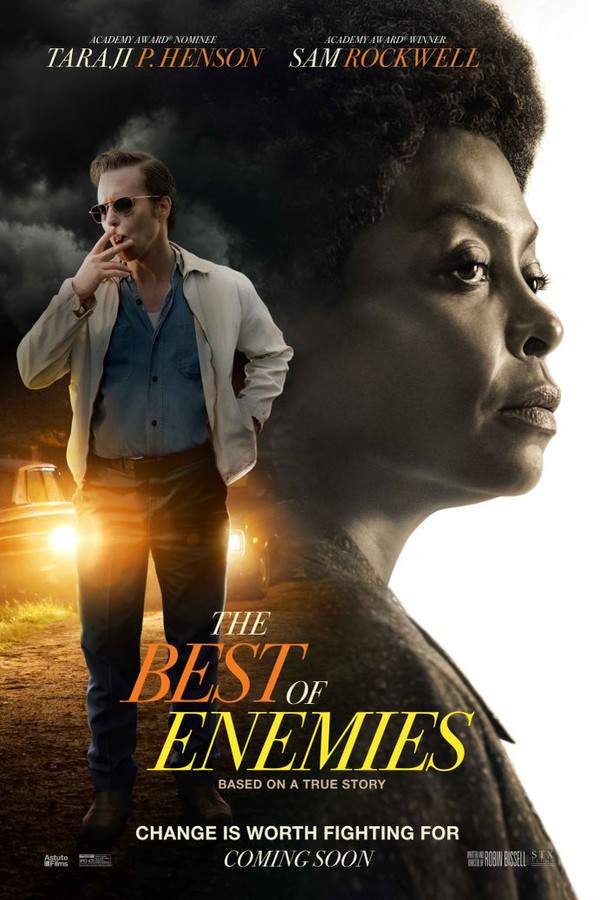
The Best of Enemies

The Best of Enemies

JustWatch#2,85932

Year: 2019

Runtime: 133 min

Language: English

Director: Robin Bissell

Echo Score: 53

Budget: $10M

BiographyDramaHistory

During the volatile summer of 1971, Durham, North Carolina faced intense racial divisions. Ann Atwater, a passionate civil rights activist, and C.P. Ellis, a Ku Klux Klan leader initially resistant to change, found themselves compelled to collaborate on a crucial desegregation initiative. Through their shared work, an unexpected bond developed, forcing both individuals to confront their beliefs and ultimately reshaping their personal journeys and impacting their community.

Where to Watch The Best of Enemies?

Find where to stream, rent, or buy The Best of Enemies (2019) in the US with current JustWatch availability, up-to-date pricing, and platform listings for subscription, rental, and digital purchase options.

Warning: spoilers below!

Haven’t seen The Best of Enemies yet? This summary contains major spoilers. Bookmark the page, watch the movie, and come back for the full breakdown. If you're ready, scroll on and relive the story!

The Best of Enemies (2019) – Full Plot Summary & Ending Explained

Read the complete plot breakdown of The Best of Enemies (2019), including all key story events, major twists, and the ending explained in detail. Discover what really happened, and what it all means.

In 1971, in Durham, North Carolina, a fierce community struggle unfolds as Ann Atwater [Taraji P. Henson] fights to improve housing conditions for poor Black residents, challenging an all-white panel of judges and the entrenched racial boundaries of the town. Her bold push for better living standards puts her on a collision course with C.P. Ellis [Sam Rockwell], the local Ku Klux Klan leader who, despite his harsh racist views, is a father who cares about his children and worries about the world his son will inherit.

When a fire devastates a Black community school, fear swells that Black children will flood white schools, heightening tensions between the two sides. To bridge the divide, Bill Riddick [Babou Ceesay], a pragmatic organizer, arranges a series of charrettes—intense, structured conversations designed to surface issues of segregation and social inequality. At first, Ann and C.P. refuse to participate, aware of how much they despise one another, yet circumstances push them toward a reluctant cooperation.

The group is instructed to select a cross-section of participants at random to vote on the key issues at the end of the sessions, a process intended to democratize the negotiations and reduce personal power plays. During the sessions, a Black reverend asks Bill to allow gospel music to close each meeting; C.P. balks, insisting that if gospel music is welcome, he should be able to display his KKK paraphernalia as well. Ann resists the demand, but Bill finds a compromise that keeps the conversation moving forward.

Tensions rise when a group of Black teenagers tries to damage the KKK items, but Ann intervenes, guiding them to try to understand the KKK rather than simply attack it. C.P. watches closely as the dynamic shifts from confrontation to reluctant dialogue. Bill then pushes for practical, human arrangements: he asks that Black and White participants sit together in the cafeteria, and he places C.P. and Ann side by side, forcing them to confront each other in a fragile, tense silence. The conversation deepens as Ann asks C.P. about his son who lives at a nearby facility for disabled boys; C.P. refuses to discuss his family, revealing the personal cost of his public stance. Ann learns more about Larry, and, moved by the need to protect him, visits Murdock and convinces Bernadette to give Larry a room of his own, a small act of compassion within a flawed system.

A pivotal moment comes when the group visits the burned Black school. The sight of the devastation underscored the stakes for everyone involved, including Mary, C.P.’s wife, who is touched by Ann’s support and support for her husband’s humanity. As the final vote approaches, C.P.’s KKK allies threaten the selected voters to vote for segregation, testing the resolve of both sides. When Ann hears of the intimidation, she condemns C.P. as a coward, underscoring how the struggle has become more than politics—it is a test of character.

When the votes are finally cast, the results align with the movement toward desegregation. Ann votes in favor, and in a surprising turn, C.P. also votes yes, publicly acknowledging the harm of the KKK and delivering a speech that culminates in him tearing up his KKK membership card. The act infuriates his former allies, who lash out with threats and attempt to burn his gas station. C.P. extinguishes the danger and stands by his decision, even as the white community shuns him. In a powerful counter-move, Ann and Bill help pivot the community to support him by encouraging Black residents to shop at his station, signaling a fragile reconciliation and a practical step toward integrated support networks.

The story behind the film is drawn from real life: Ann and C.P. traveled together to other cities to share their experiences, challenging audiences with an honest, ongoing dialogue about race and reconciliation. They remained connected in the later years, and Ann delivered the eulogy at C.P.’s funeral, a testament to a complicated friendship forged in the crucible of a turbulent era. This narrative highlights how personal courage, persistence, and a willingness to see the humanity in one another can gradually shift a community toward a more inclusive future.
Last updated: February 25, 2026 at 08:13

Was this helpful?

The Best of Enemies (2019) Plot Questions Answered – Summary FAQ

Explore frequently asked questions about The Best of Enemies (2019) with spoiler-rich answers covering the full plot summary, major story beats, character motivations, hidden details, and ending meaning. This movie summary FAQ helps explain confusing scenes, plot twists, and narrative decisions in clear, searchable detail.

Q1

What is a charrette and why was it used in Durham?

A.

A charrette is an intensive, structured community meeting designed to bring opposing groups together to solve complex problems. In 1971 Durham, organizer Bill Riddick used charrettes to force Black residents and white segregationists, including Ann Atwater and C.P. Ellis, to confront their differences and work toward solutions for school desegregation. The format was chosen because it forced direct dialogue in a controlled setting.

charrettebill riddickdurhamcommunity meetingdesegregation
Q2

Why did Ann Atwater stop Black teenagers from destroying the KKK items?

A.

Ann intervened because she believed destroying the KKK items would only strengthen the group's victim narrative and give them ammunition to accuse Black participants of violence. By asking the teens to understand what the KKK represents before attacking it, she demonstrated the same principle she later applied to C.P., that lasting change requires understanding your opponent rather than simply reacting emotionally.

ann atwaterkkk itemsblack teenagersmediationunderstanding
Q3

What happened to C.P. Ellis's son Larry at Murdock facility?

A.

Larry, C.P.'s son with intellectual disabilities, was placed in a room with a screaming roommate at the Murdock facility. C.P. rushed there demanding a private room for his son, but staff said it wasn't affordable. Moved by this, Ann visited Larry and convinced Bernadette (likely a staff member) to give Larry his own room, a small act of compassion that humanized both characters across their racial divide.

c.p. ellislarrymurdock facilitydisabled sonann atwater
Q4

Why did C.P. Ellis change his vote and tear up his KKK card?

A.

C.P. changed his vote after being called a coward by Ann Atwater when he failed to stop KKK threats against the selected voters. The charrette process had gradually exposed him to the human cost of segregation, particularly through Ann's compassion toward his son Larry. When the vote came, he voted yes for desegregation and publicly tore up his KKK membership card, abandoning his former allies.

c.p. ellisvotekkk carddesegregationcoward
Q5

Why did Ann Atwater help C.P. Ellis after the vote?

A.

After C.P. was ostracized by the white community and his gas station was threatened, Ann and Bill encouraged Black residents to shop at his station as a practical demonstration of reconciliation. This act showed that their partnership during the charrettes had created genuine change, Ann was willing to extend trust and support to someone who had been her ideological enemy, modeling the reconciliation the film advocates.

ann atwaterc.p. ellisgas stationreconciliationsupport
Q6

What was the significance of the burned school visit in the film?

A.

The visit to the burned Black school was a pivotal moment that showed both sides the real consequences of racial division. Seeing the devastation firsthand reminded everyone, including C.P.'s wife Mary, that the stakes were genuine lives and futures, not abstract politics. This visceral experience helped shift attitudes and made the final vote possible.

burned schooldurhamvisitconsequencesdesegregation
Q7

Why did Mary Ellis thank Ann Atwater?

A.

Mary thanked Ann because Ann had shown compassion toward her husband C.P. by helping their son Larry get a private room at Murdock facility. Despite being on opposite sides of the racial conflict, Ann's kindness to C.P.'s family demonstrated a humanity that transcended the political struggle, which moved Mary to express gratitude.

mary ellisann atwaterthanklarryfamily
Q8

What happened to C.P. Ellis after he voted for desegregation?

A.

After voting yes, C.P. was excommunicated from the KKK and faced threats from his former allies, including an attempt to burn down his gas station. The white community shunned him. However, with Ann and Bill's help, Black residents began supporting his business, creating a practical path toward reconciliation despite the personal cost he paid.

c.p. ellisthreatsgas stationshunningconsequences
Q9

Were Ann Atwater and C.P. Ellis real people?

A.

Yes, the film is based on true events. Ann Atwater and C.P. Ellis were real people who participated in the 1971 Durham charrettes. After the experience, they became friends and traveled together to share their story. Ann delivered the eulogy at C.P.'s funeral, demonstrating the lasting bond forged during that tumultuous period.

true storyreal peopleann atwaterc.p. ellisbiography
Q10

Why did C.P. Ellis agree to sit next to Ann Atwater in the cafeteria?

A.

Bill Riddick deliberately placed C.P. and Ann side by side during cafeteria meals as part of the charrette process. While both initially resisted, the forced proximity gradually broke down barriers. During these tense meals, they discussed personal matters including C.P.'s son Larry, which began their slow path toward mutual understanding.

c.p. ellisann atwatercafeteriaseatingbill riddick
Mobile App Preview

Coming soon on iOS and Android

The Plot Explained Mobile App

From blockbusters to hidden gems - dive into movie stories anytime, anywhere. Save your favorites, discover plots faster, and never miss a twist again.

Sign up to be the first to know when we launch. Your email stays private, always.

Explore Movie Threads

Discover curated groups of movies connected by mood, themes, and story style. Browse collections built around emotion, atmosphere, and narrative focus to easily find films that match what you feel like watching right now.

Unlikely Allies Forging Hope like in The Best of Enemies

Adversaries forced to cooperate find unexpected understanding and change.Discover movies similar to The Best of Enemies, where bitter enemies are compelled to work together, leading to profound personal transformations. If you liked the powerful dynamic between Atwater and Ellis, you'll appreciate these stories of adversarial collaboration and hard-won change.

transformativetensecourageousredemptivedramaticconfrontationaluplifting

Narrative Summary

These narratives begin with intense conflict between characters from opposing sides of a deep divide. A shared goal or external circumstance forces them into collaboration. Through direct confrontation and shared challenges, their animosity gradually gives way to mutual respect and understanding, culminating in a bond that forever alters their worldview.

Why These Movies?

Movies in this thread share a core narrative arc centered on the difficult but redemptive process of reconciliation. They typically feature a high-stakes, emotionally heavy atmosphere with steady pacing that allows the character transformation to feel earned, leading to a bittersweet but hopeful resolution.

Redemption Story Dramas like The Best of Enemies

Protagonists confront their own prejudice and seek a path to change.Find more films with powerful redemption arcs like The Best of Enemies. If you were moved by C.P. Ellis's transformation, explore these stories of characters facing their own prejudices and embarking on a difficult journey toward personal redemption and change.

redemptiontransformativeintrospectivedramaticcourageousemotionalheavy

Narrative Summary

The plot centers on a character who holds strong, often harmful beliefs. Through a catalytic event or relationship, they are forced to see the world differently. The story follows their internal struggle as they grapple with cognitive dissonance, leading to a rejection of their past and a commitment to a new path, often at great personal cost.

Why These Movies?

These films are grouped by their focus on a profound internal moral conflict. They share a heavy emotional weight, moderate narrative complexity, and a tone that evolves from dark tension to a sense of hard-won hope, driven by a steady pacing that makes the character's change feel authentic.

Unlock the Full Story of The Best of Enemies

Don't stop at just watching - explore The Best of Enemies in full detail. From the complete plot summary and scene-by-scene timeline to character breakdowns, thematic analysis, and a deep dive into the ending - every page helps you truly understand what The Best of Enemies is all about. Plus, discover what's next after the movie.

The Best of Enemies Timeline

Track the full timeline of The Best of Enemies with every major event arranged chronologically. Perfect for decoding non-linear storytelling, flashbacks, or parallel narratives with a clear scene-by-scene breakdown.

The Best of Enemies Timeline

Characters, Settings & Themes in The Best of Enemies

Discover the characters, locations, and core themes that shape The Best of Enemies. Get insights into symbolic elements, setting significance, and deeper narrative meaning - ideal for thematic analysis and movie breakdowns.

Characters, Settings & Themes in The Best of Enemies

The Best of Enemies Spoiler-Free Summary

Get a quick, spoiler-free overview of The Best of Enemies that covers the main plot points and key details without revealing any major twists or spoilers. Perfect for those who want to know what to expect before diving in.

The Best of Enemies Spoiler-Free Summary

More About The Best of Enemies

Visit What's After the Movie to explore more about The Best of Enemies: box office results, cast and crew info, production details, post-credit scenes, and external links - all in one place for movie fans and researchers.

More About The Best of Enemies

Similar Movies to The Best of Enemies

Discover movies like The Best of Enemies that share similar genres, themes, and storytelling elements. Whether you’re drawn to the atmosphere, character arcs, or plot structure, these curated recommendations will help you explore more films you’ll love.