Plot Explained Spoilers guaranteed!
Plot Explained

Browse by genre

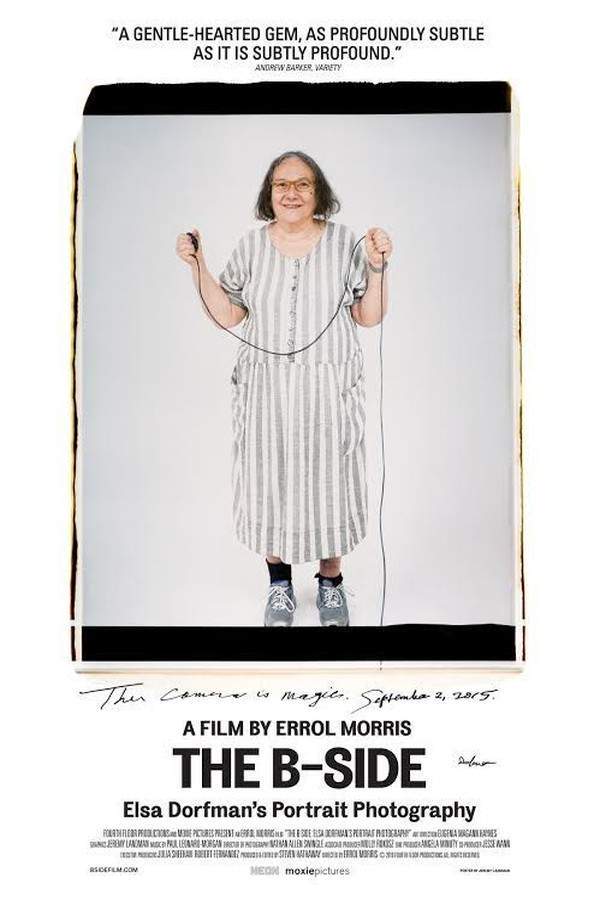
The B-Side: Elsa Dorfman's Portrait Photography (2017) movie poster

Plot Summary

The B-Side: Elsa Dorfman's Portrait Photography (2017) Plot Summary Explained

Release, runtime and language
2017 · 76 min · English
Echo score 76
Loading streaming availability…
Directed by
Errol Morris
Starring
Elsa Dorfman

This insightful documentary chronicles the career of portrait photographer Elsa Dorfman and her unique bond with the Polaroid Land 20x24 camera over three decades. Through her work, she captured the stories of diverse individuals, from Cambridge locals to celebrated musicians and Harvard students. As she approaches retirement, Dorfman reflects on a rich history of artistic expression, offering a touching exploration of art, personal identity, and the ephemeral quality of human relationships.

On this page (6)
  1. 1 Where to watch
  2. 2 What happens: full plot
  3. 3 Plot questions answered
  4. 4 Movie threads
  5. 5 Movies like The B-Side: Elsa Dorfman's Portrait Photography
  6. 6 Every angle
Loading streaming availability…

Full plot summary · contains spoilers

What Happens in The B-Side: Elsa Dorfman's Portrait Photography: Full Plot Summary

The whole story of The B-Side: Elsa Dorfman's Portrait Photography (2017) explained, from the opening scene to the final frame: every key event, every twist and what it all adds up to. Read it as a quick recap before the sequel, to check a scene you missed, or to finally understand what really happened.

Following her transition into retirement, the renowned photographer Elsa Dorfman provides an intimate and loving showcase of her extensive body of work, spanning a distinguished fifty-year career. Throughout the film, she reflects on her artistic journey, sharing a blend of personal anecdotes and professional milestones while detailing the core motivations that drove her creative vision.

The narrative unfolds in a loose chronological sequence, beginning with Elsa Dorfman presenting her earliest explorations in black and white photography. She recalls the formative period of her life when she moved to New York City to secure a position at Grove Press. It was during this vibrant era that she first became acquainted with the influential Beat writers, most notably Allen Ginsberg. Following this period, she describes her move back to Massachusetts to pursue a career in elementary education. It was here, through an introduction by a photographer assigned to work with her, that she discovered her true passion for the art of photography.

As her career progressed into the 1970s, her portfolio grew to include portraits of legendary figures and intellectuals, such as:

* Andrew Wylie and Victor Bockris

* Anaïs Nin and W. H. Auden

* Andrea Dworkin, Ed Sanders, and Gail Mazur

* Audre Lorde and Anne Sexton

A significant turning point in her work occurred in 1980 with the release of the 20x24 Large Format Polaroid. The film captures her genuine excitement regarding this technology, featuring footage of her utilizing one of only five such cameras available for rent. She proudly reveals the very first image she captured with this massive format: a striking portrait of Allen Ginsberg accompanied by an amaryllis.

As she navigates through other photographs taken with the 20x24 Polaroid, she delves into the deeply personal memories tied to each frame. This includes poignant imagery of her parents, her husband, and her son, as well as her lifelong bond with Ginsberg. She reflects with solemnity on the passing of her parents and Ginsberg, while contrasting those losses with more lighthearted recollections of her past birthdays.

The film concludes with her discussing the eventual decline and closure of the Polaroid company, examining how the loss of her preferred medium affected her work. Through these reflections, the film successfully conveys her profound artistic motivations and her deep technical understanding of the photographic mediums that defined her life's work.

Last updated: October 18, 2026 at 17:30

Was this helpful?

Plot questions answered

The B-Side: Elsa Dorfman's Portrait Photography Plot Explained: Your Questions Answered

The questions people ask most about The B-Side: Elsa Dorfman's Portrait Photography (2017): what happens in the confusing scenes, why the characters do what they do, the twists, hidden details and what the ending means. Each answer contains spoilers.

Q1

How did Elsa Dorfman first get into photography?

Elsa Dorfman's entry into photography came through a chance professional encounter. While teaching elementary school in Massachusetts, a photographer was assigned to work with her, and that collaboration sparked a lifelong passion for the medium. This unexpected introduction redirected her career from teaching toward the portrait work that would define the next fifty years of her life, and it forms the emotional starting point of The B-Side.

Foreshadowing: Her earlier time at Grove Press had already placed her in creative literary circles, quietly laying the groundwork for the artistic life she would later embrace.

  • elsa dorfman
  • photography career
  • teaching
  • massachusetts
  • photographer assignment
  • portrait photography
Q2

Why was the 20x24 Polaroid camera so important to her art?

The 20x24 Polaroid was central to Dorfman's artistic identity because it produced enormous instant prints that no other camera could match at that scale. When Polaroid released the camera in 1980, it gave her a uniquely direct, large-format medium that aligned perfectly with her desire to capture presence and intimacy. Dorfman eventually rented one of only five existing units and built her most recognizable body of work around the results.

Foreshadowing: Her years of small-format portrait work in the 1970s had already pushed her toward wanting a more physically commanding image, a desire the 20x24 would finally satisfy.

  • 20x24 polaroid
  • large format
  • polaroid camera
  • photographic medium
  • portrait photography
Q3

How did Polaroid going out of business affect her work?

Polaroid's shutdown cut off the supply of large-format film that the 20x24 camera required, directly threatening the medium Dorfman had built her late career around. Without fresh film, she could no longer reliably create new portraits in the style that had come to define her. This obsolescence of her primary tool became one of the central, bittersweet concerns of her retirement reflections in the film.

Foreshadowing: The decision to rent rather than buy the rare camera had already left her dependent on outside forces she could not control.

  • polaroid closing
  • film supply
  • obsolescence
  • retirement
  • large format film
Q4

What was the significance of the Ginsberg amaryllis portrait?

The portrait of Allen Ginsberg holding an amaryllis was the very first photograph Dorfman ever took on the 20x24 Polaroid, making it the founding image of her large-format practice. It also reflected her long friendship with Ginsberg, who had been a subject of her earlier work and remained a dear companion for decades. The image carries symbolic weight in The B-Side as the moment her two great artistic relationships, with the camera and with Ginsberg, officially converged.

Foreshadowing: Her earlier black and white work with Ginsberg, beginning during her Grove Press years, had already established the trust that would make this iconic first portrait possible.

  • allen ginsberg
  • amaryllis
  • first 20x24 photo
  • portrait
  • elsa dorfman
Q5

How did Allen Ginsberg's death affect Dorfman?

Ginsberg's death marked the end of a decades-long friendship that had been one of the defining relationships of Dorfman's life and art. As both an early subject and a lifelong confidant, his absence left a deep personal and creative void. His passing is one of the emotional centerpieces of the documentary, reinforcing its meditation on impermanence and the passage of time.

Foreshadowing: The very first 20x24 portrait of Ginsberg had already hinted at a bond meant to last a lifetime, making his eventual loss all the more resonant.

  • allen ginsberg death
  • friendship
  • loss
  • impermanence
  • bereavement
Q6

Why did Dorfman photograph so many literary figures in the 1970s?

Dorfman's access to major writers and poets came directly from her time at Grove Press, the publishing house that had immersed her in the New York literary world. Her acquaintance with Allen Ginsberg and other Beat writers opened doors to figures like Anaïs Nin, W. H. Auden, Audre Lorde, and Anne Sexton. By the 1970s, her literary network had grown into one of the most distinctive portrait portfolios of the era.

Foreshadowing: Her move back to Massachusetts placed her near Cambridge, where she could continue documenting the literary world she had first entered in New York.

  • literary figures
  • beat writers
  • grove press
  • 1970s
  • anais nin
  • anne sexton
  • audre lorde
Q7

How did she get access to one of only five 20x24 Polaroid cameras?

Dorfman did not own the camera herself but rented it, gaining periodic access to one of the rarest photographic tools in existence. Because Polaroid produced the 20x24 in extremely small numbers, only five were ever available, making each session a significant, scheduled event. This rental arrangement shaped the rhythm of her large-format work, with every new portrait requiring a planned visit with the enormous machine.

  • 20x24 polaroid rental
  • rare camera
  • large format access
  • polaroid availability
Q8

How did her time at Grove Press shape her career?

Working at Grove Press in New York City placed Dorfman at the heart of the Beat literary movement, where she met Allen Ginsberg and other writers who would become lifelong friends and subjects. Although her job was in publishing rather than photography, the relationships she built there defined the social world she would later document. This literary network became the foundation of her portrait practice for the decades that followed.

Foreshadowing: Ginsberg's presence at Grove Press foreshadowed his future role as both a defining subject and a personal anchor in her artistic life.

  • grove press
  • beat writers
  • new york
  • literary scene
  • allen ginsberg
  • publishing
Q9

Why did Dorfman move from New York back to Massachusetts?

Dorfman returned to Massachusetts to take a stable teaching position at an elementary school, stepping away from the intensity of New York's literary scene. The move brought her back to the Cambridge area, where she would eventually build her photography career and remain for the rest of her life. Her time teaching proved unexpectedly transformative, since it was during this period that a working photographer introduced her to the art form.

Foreshadowing: Her Cambridge address would later allow her to keep photographing literary friends who passed through the area, including Ginsberg.

  • massachusetts
  • teaching
  • grove press
  • career change
  • cambridge
  • elementary school

Movie threads

More Movies Like The B-Side: Elsa Dorfman's Portrait Photography, by Mood & Story

Curated lists built around what makes The B-Side: Elsa Dorfman's Portrait Photography tick: the same mood, the same kind of story or the same emotional payoff. Each list explains why these movies belong together.

Quiet artist retrospectives like in The B-Side: Elsa Dorfman's Portrait Photography

Quiet portraits of creators looking back at decades of work and lives touched. Movies like The B-Side: Elsa Dorfman's Portrait Photography that follow creators, photographers, and craftspeople through the gentle review of a lifetime's body of work. If you liked this documentary's reflective look at artistic legacy, you'll find similar documentary films and quiet character studies here, exploring memory, identity, and the bittersweet passage of time.

  • nostalgic
  • contemplative
  • intimate
  • reflective
  • warm
  • wistful
  • Tone: bittersweet, nostalgic
  • Pacing: slow and meditative
Why these movies?

The story pattern: These stories center on a single artist or craftsperson approaching a threshold moment, often late in life or facing the loss of their medium, and reflectively walking through their archive. The narrative moves slowly through past work, relationships, and eras, building a portrait not just of the art but of the human behind it. Conflicts are minimal, and the tension comes from time itself, mortality, and the fading of beloved practices.

Why they belong together: They share a slow, observational rhythm, a bittersweet and nostalgic tone, and an intimate focus on memory and creative legacy. Tension stays low, humor is gentle, and emotional weight remains light to medium. The thread rewards viewers who want meditative, character-driven documentaries or quiet films about creative lives lived fully and reflected on honestly.

Bittersweet meditations on fading eras like in The B-Side: Elsa Dorfman's Portrait Photography

Meditative stories about disappearing crafts, lost eras, and the quiet ache of things passing. Movies like The B-Side: Elsa Dorfman's Portrait Photography that find quiet melancholy in obsolescence, aging, and lost artistic mediums. If you liked this documentary's wistful look at the fading Polaroid era and the artist's reflection on impermanence, these contemplative films and documentaries share the same nostalgic, gentle mood about time's passage.

  • wistful
  • nostalgic
  • fading
  • impermanence
  • gentle
  • atmospheric
  • Tone: bittersweet, wistful
  • Pacing: slow, meditative
Why these movies?

The story pattern: These films don't drive a plot so much as hold space for disappearance. Often observational or meditative, they trace a craft, place, or era as it fades, whether an obsolete camera, a dying art form, a closing institution, or a life nearing its end. The emotional journey is one of acceptance and quiet celebration rather than dramatic confrontation, leaving viewers with warm melancholy and a deepened appreciation for what is briefly here.

Why they belong together: They share a slow, observational pace, low intensity, and consistently bittersweet tone. Mood words like nostalgic, wistful, gentle, and contemplative apply across all of them. They foreground atmosphere over plot, memory over drama, and the beauty of impermanence over urgency, making them feel like quiet companions rather than demanding entertainments.

If you liked this

Movies Like The B-Side: Elsa Dorfman's Portrait Photography

Similar movies to The B-Side: Elsa Dorfman's Portrait Photography: the same genre, themes or kind of story. Each one comes with its own plot summary, timeline and ending explained.

Browse all movie summaries

Every angle

The B-Side: Elsa Dorfman's Portrait Photography (2017) Explained: Plot, Timeline & Characters

Everything about The B-Side: Elsa Dorfman's Portrait Photography in one place: what happens in the plot summary, the timeline in chronological order, the characters and meaning and a spoiler-free summary. What's After the Movie adds the cast, box office and post-credit scenes.

Coming soon on iOS and Android

The Plot Explained Movie Summary App

Plot summaries, endings explained and timelines on your phone. Catch up on any movie in minutes, save your favorites and never miss a twist again.

Be the first to know when we launch. Your email stays private, always.

Learn more about the app