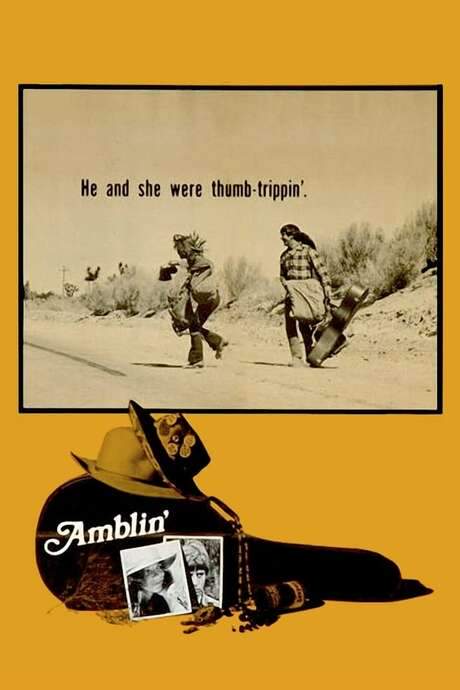
On a sun-drenched stretch of the Mojave Desert, a young man carrying a closely guarded guitar case meets a free-spirited young woman who becomes his traveling companion. The man, Richard Levin, is known in the moment as Boy, while the woman, Pamela McMyler, steps into the role of Girl. Their meeting unfolds without drama or harsh words, only a shared sense of adventure as they hitchhike and accept ride after ride along the lonely road.
Together they drift from one ride to the next, moving toward a Pacific coast beach as their casual camaraderie deepens into something more intimate. They pass time with playful, simple gestures—an olive pit spitting game that punctuates their growing bond, and a shared cannabis joint that blurs the line between strangers and lovers. The desert heat beats down, but their connection offers a fleeting warmth, and the journey itself feels like a small, private odyssey across a vast landscape.
As their destination nears, their relationship becomes more poignant and complex. The two lovers share the road and the quiet, letting the miles stretch out behind them while they lean on each other in small, unscripted moments. Yet the path ahead is not merely romantic; it hints at what each of them might be hiding behind the carefree exterior. The mood shifts subtly as the ride options continue to roll in, and the sense of discovery remains tempered by something unspoken beneath the surface.
When they finally reach the beach, the Boy runs fully clothed into the surf, the water splashing around him in a raw, almost playful rebellion against restraint. The Girl, her hair threaded with daisies, hesitates at the edge of the waves, then points her gaze toward his guitar case. With a quiet curiosity, she opens it and lays out its contents in a deliberate, almost ritualistic reveal: a tie, wingtip shoes, Thrifty Drugs mouthwash, a paperback of Arthur C. Clarke's The City and the Stars, a white shirt, Right Guard spray deodorant, a suit, a roll of toilet paper, white crew socks, Phillips' Milk of Magnesia, and toothpaste. The assortment reads like a snapshot of meticulous preparation—an almost clinical contrast to the freedom of their earlier, sun-soaked escapade. She smiles with bemusement, perhaps recognizing that her companion was not the unburdened free-spirit she had imagined, and a shadow of disappointment crosses her face as she climbs back up the beach stairs without him.
The film speaks through sound as much as through image. There is no spoken dialogue beyond the lyrics to the opening and closing theme songs. Instead, an ambient soundscape carries the mood: birdsong, wind, distant car noises, soft pops from the characters, occasional fire sounds, and moments of laughter, all woven together with instrumental music. This restrained approach heightens the sense of mood and gesture, inviting viewers to read emotion in the quiet, the pauses, and the careful choreography of two people who travel together but may still be strangers to one another in the most intimate ways.