Plot Explained Spoilers guaranteed!
Plot Explained

Browse by genre

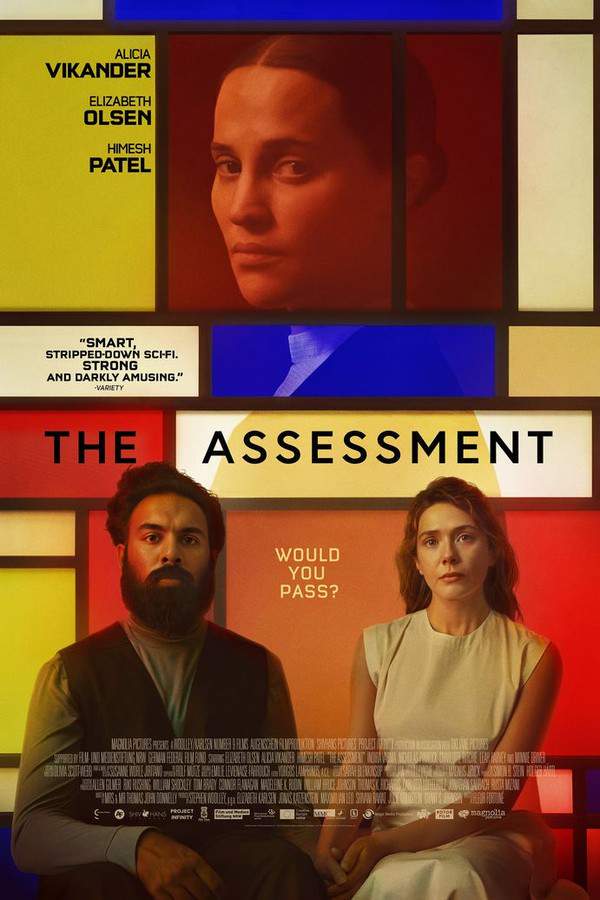
The Assessment (2025) movie poster

Ending Explained

The Assessment (2025) Ending Explained – Final Scene & Meaning

Release, runtime and language
2025 · 1 h 54 m · English
Echo score 77
Loading streaming availability…
Directed by
Fleur Fortune
Starring
Elizabeth Olsen, Himesh Patel, Alicia Vikander, Leah Harvey, Indira Varma, Minnie Driver
Budget
$8M

In a future where resources are scarce and the government strictly regulates reproduction, Mia and Aaryan, a successful couple, plan to start a family. Their hopes are complicated when an assessor named Virginia is assigned to their home for a week to evaluate their suitability as parents. Virginia's presence disrupts their lives as she observes and assesses their relationship and lifestyle, leading to unexpected revelations and challenges for all involved.

On this page (7)
  1. 1 Where to watch
  2. 2 What happens at the end
  3. 3 Final events in order
  4. 4 Ending questions answered
  5. 5 Movie threads
  6. 6 Movies like The Assessment
  7. 7 Every angle
Loading streaming availability…

Ending explained · contains spoilers

What Happens at the End of The Assessment?

How The Assessment (2025) ends, what the final scene means, which earlier moments set it up and how to read the ending if the film leaves it open. The full ending explained, with every spoiler.

In the end, Mia makes a radical choice that reflects her rejection of the false, controlled world she’s been trapped in. Tired of the illusion and yearning for genuine human experience, she decides to leave the new world behind and seek a more authentic life. By crossing the border into the old, unregulated lands, she reclaims her agency and embraces the rawness of reality—something the manufactured society had stripped away. Her removal of the mask and her deep breath symbolize her breaking free from the artificial veneer of her recent life, affirming her desire to reconnect with true emotion and human imperfection. This act of defiance underscores the film’s critique of a future where elites safeguard their comfort by creating a meticulously curated but ultimately hollow existence. Meanwhile, Aaryan chooses to retreat into his virtual world, hiding behind AI-generated memories and a fabricated version of Mia. His decision to stay behind and work with artificial experiences highlights his inability to face genuine human vulnerability and the painful truths of their reality. Virginia, or Grace, symbolizes the tragic toll of this soulless society, and her final act of suicide signifies her exhaustion and disillusionment. Her death, connected to her own lost child, serves as a grim reminder that the pursuit of perfection and control can lead to despair. Overall, the ending emphasizes the importance of authentic human connection, the dangers of illusion, and the desperation to break free from a society built on lies. Mia’s choice to return to the old world affirms her longing for truth and genuine life, contrasting sharply with the artificial existence embraced by others in the film.

Last updated: June 25, 2025 at 08:44

Was this helpful?

The last 4 events

How The Assessment Ends: The Final Events in Order

The last events of The Assessment (2025) in chronological order, the run-up to the ending explained above. The complete timeline has all 14 events, scene by scene.

Open the full timeline
  1. The Truth About Virginia

    Mia tracks down Virginia to uncover shocking truths: there have been no successful applications for parenthood in six years. Virginia reveals she was offered a child to replace her deceased daughter but had to fail all couples to secure it.

  2. Virginia's Despair

    After the confrontation, Virginia is assigned to assess another couple but, overwhelmed by her role and the systemic failures, decides to take her own life. This tragic end highlights the psychological burdens imposed by the oppressive regime.

  3. Mia's Rebellion

    Disillusioned with the oppressive nature of their society, Mia resolves to leave her sheltered life behind. She seeks refuge in the Old World, where her mother, a dissenter against state policies, had been exiled for her beliefs.

  4. Aaryan's New Reality

    As Mia departs, Aaryan turns to technology, creating simulated versions of both a child growing up and a digital version of Mia. This serves as a coping mechanism for his loss but emphasizes his inability to connect with reality.

Ending questions answered

The Assessment Ending: Your Questions Answered

The questions people ask most about the ending of The Assessment (2025): what the final scene means, how the twist works, what happens to each character and how to read the ending. Each answer contains spoilers.

Q1

Why does Mia leave at the end of The Assessment?

Mia leaves because she has grown disillusioned with the artificial, controlled society she lives in. Throughout the assessment, she realizes the system is designed to strip away genuine human experience in favor of manufactured perfection. Her decision to cross the border into the old, unregulated lands represents her rejection of this false existence and her yearning for authentic human connection and raw reality.

Foreshadowing: Earlier scenes show Mia struggling with the artificial nature of her surroundings and the invasive assessment process.

  • mia
  • new world
  • old world
  • escape
  • freedom
  • dystopia
Q2

What does Mia removing her mask symbolize in the ending?

Mia removing her mask symbolizes her breaking free from the artificial veneer of her controlled existence. The mask represents the false persona she had to maintain to pass the assessment and survive in the curated society. Her deep breath after removing it signifies reclaiming her authentic self and embracing genuine emotion over manufactured perfection.

Foreshadowing: The assessor's invasive observations force Mia to constantly perform and maintain a facade throughout the week.

  • mask
  • symbolism
  • freedom
  • authenticity
  • breaking free
Q3

Why does Virginia commit suicide at the end of The Assessment?

Virginia, whose real name is Grace, commits suicide because she has become completely exhausted and disillusioned with the system she serves. Her own child was likely taken or lost due to the same ruthless assessment process she now administers. This loss, combined with her role in destroying other families, leaves her without hope, making her death a tragic statement about the human cost of a perfection-obsessed society.

Foreshadowing: Virginia's intense emotional investment in the assessment and her invasive methods hint at deeper personal trauma.

  • virginia
  • grace
  • suicide
  • death
  • child loss
  • despair
Q4

Why does Aaryan stay in the virtual world at the end?

Aaryan chooses to stay in the virtual world because he cannot face the painful reality of his failed assessment and the collapse of his family dreams. Rather than confronting the genuine human vulnerability and loss required to move forward, he retreats into AI-generated memories and a fabricated version of Mia. This represents his inability to handle authentic human emotion and his preference for comfortable illusion over painful truth.

Foreshadowing: Aaryan consistently avoids confrontation throughout the assessment and shows discomfort with genuine emotional vulnerability.

  • aaryan
  • virtual world
  • ai
  • retreat
  • denial
  • escape
Q5

What is the old world that Mia goes to at the end of The Assessment?

The old world refers to the unregulated, chaotic lands outside the controlled new society. While the new world offers safety and material comfort through strict governance, the old world represents freedom but also uncertainty and hardship. Mia's choice to go there signifies her preference for authentic, imperfect human experience over the sterile but suffocating existence of the curated society.

Foreshadowing: The film establishes early on that the government maintains strict borders between the regulated new world and the wild, uncontrolled old world.

  • old world
  • new world
  • border
  • wilderness
  • freedom
  • chaos
Q6

What is Virginia's real name in The Assessment?

Virginia's real name is Grace. This revelation comes at the end of the film and adds depth to her character, showing that she too has been forced to adopt a different identity within the system. The name Virginia appears to be a professional persona she uses while conducting assessments, contrasting with her true identity as Grace.

Foreshadowing: Virginia's unusual emotional intensity during the assessment hints at personal stakes beyond her professional duties.

  • virginia
  • grace
  • name reveal
  • true identity
Q7

What is the purpose of the assessment system in The Assessment?

The assessment system exists to regulate reproduction in a resource-scarce future. The elite maintain their comfort by strictly controlling who can have children, using invasive evaluations to determine parental suitability. However, the ending reveals the system is fundamentally hopeless, it destroys families rather than supporting them, and even those who pass like Virginia suffer tragic consequences.

Foreshadowing: The film's dark tone and the constant psychological pressure of the assessment hint that the system serves more sinister purposes than mere evaluation.

  • assessment
  • system
  • reproduction
  • control
  • government
  • evaluation
Q8

What are the main themes of The Assessment ending?

The ending emphasizes authentic human connection versus manufactured perfection, the dangers of illusion and control, and the desperation to break free from systemic oppression. Mia's escape represents hope for genuine life, while Aaryan's retreat into virtual reality and Virginia's suicide demonstrate how the system crushes those who cannot escape. The film critiques a society where elites safeguard comfort by creating hollow, curated existences.

Foreshadowing: The steady pacing of the seven-day assessment builds psychological tension that reflects the film's thematic focus on artificial versus authentic existence.

  • themes
  • authenticity
  • illusion
  • freedom
  • control
  • society
  • critique
Q9

Does Mia find happiness by going to the old world?

Mia's escape to the old world offers her freedom and authentic existence, but the ending is not triumphant, she goes alone. The film presents her choice as a personal victory over the artificial system rather than a collective triumph. She finds liberation from oppression but must do so in isolation, highlighting the individual cost of defying a totalizing system.

Foreshadowing: The film's bleak tone and the meta notes emphasize that no character achieves a truly redemptive outcome.

  • mia
  • happiness
  • old world
  • freedom
  • solitude
  • isolation

Movie threads

More Movies Like The Assessment, by Mood & Story

Curated lists built around what makes The Assessment tick: the same mood, the same kind of story or the same emotional payoff. Each list explains why these movies belong together.

Dystopian stories of domestic control like The Assessment

Personal lives unravel under the chilling gaze of a controlling state. If you liked The Assessment, explore more movies like it where the oppressive force of a dystopian society invades the home. These films focus on psychological drama and the breakdown of personal relationships under systemic pressure, offering similar themes of control and marital strain.

  • oppressive
  • unsettling
  • claustrophobic
  • dystopian
  • tense
  • melancholic
  • Tone: dark, oppressive
  • Pacing: steady, deliberate
Why these movies?

The story pattern: Stories typically feature a family or couple isolated within their own home, confronted by a representative of a larger, oppressive system. The conflict is internal and psychological, as the characters' beliefs, relationships, and sanity are systematically tested. The narrative arc often leads to a shattering of the family unit or a bleak realization of powerlessness.

Why they belong together: Movies in this thread share a chilling premise where large-scale societal control is made terrifyingly personal. They combine the intellectual dread of a broken world with the visceral pain of broken relationships, creating a uniquely claustrophobic and emotionally heavy viewing experience.

Slow burn psychological dramas with bleak endings like The Assessment

Where quiet tension and invasive observation methodically break characters down. Find more movies like The Assessment that feature a slow, steady build of psychological tension. These films share a dark tone, heavy emotional weight, and often end on a bleak note, focusing on character unraveling and the destructive power of scrutiny.

  • anxious
  • unsettling
  • psychological
  • claustrophobic
  • melancholic
  • slow burn
  • Tone: dark, bleak, tense
  • Pacing: steady, slow burn
Why these movies?

The story pattern: The narrative structure is often linear and confined, mirroring the characters' trapped feeling. A seemingly normal situation is gradually poisoned by an ever-present threat or observer. The central conflict is internal, as characters are forced to confront their own flaws, lies, and vulnerabilities under relentless pressure, leading to a breakdown rather than a breakthrough.

Why they belong together: This thread groups films that prioritize psychological dread over physical action. They share a specific mood mix of anxiety and melancholy, a steady pacing that feels like a tightening vise, and a narrative commitment to exploring how people fall apart under strain, resulting in a profoundly heavy and unsettling experience.

If you liked this

Movies Like The Assessment

Similar movies to The Assessment: the same genre, themes or kind of story. Each one comes with its own plot summary, timeline and ending explained.

Browse all movie summaries

Every angle

The Assessment (2025) Explained: Plot, Ending, Timeline & Characters

Everything about The Assessment in one place: what happens in the plot summary, the timeline in chronological order, the characters and meaning, the ending explained and a spoiler-free summary. What's After the Movie adds the cast, box office and post-credit scenes.

Coming soon on iOS and Android

The Plot Explained Movie Summary App

Plot summaries, endings explained and timelines on your phone. Catch up on any movie in minutes, save your favorites and never miss a twist again.

Be the first to know when we launch. Your email stays private, always.

Learn more about the app