Year: 1989
Runtime: 126 min
Language: English
Budget: $47M
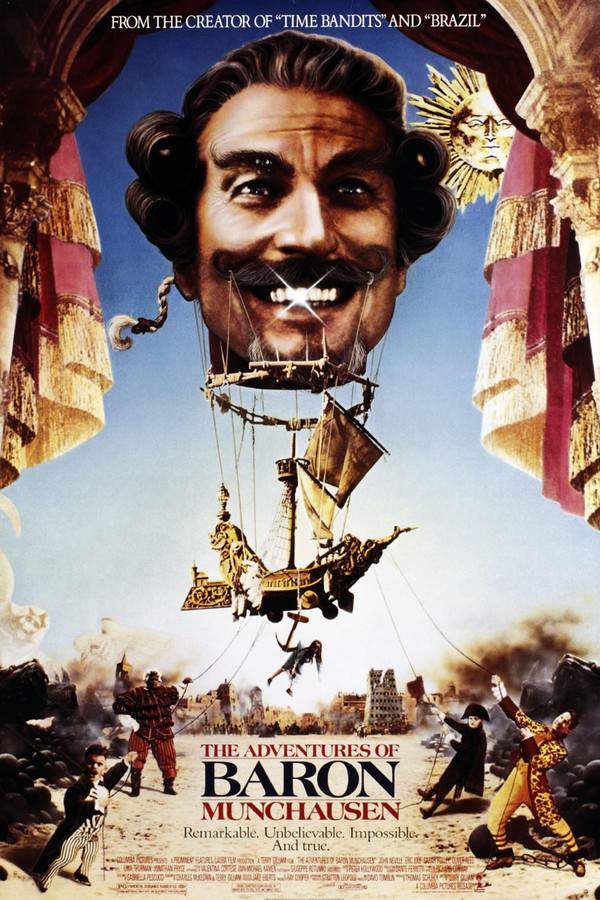
During the 18th century, a theatrical production of the fantastical tales of Baron Munchausen causes disruption. The Baron himself (John Neville) appears, claiming his actual experiences are even more unbelievable than the play depicts. Threatened by the Turkish army, he embarks on a series of extraordinary adventures, challenging perceptions of reality and blurring the boundary between truth and elaborate storytelling, as he strives to protect the city.
Find where to stream, rent, or buy The Adventures of Baron Munchausen (1989) in the US with current JustWatch availability, up-to-date pricing, and platform listings for subscription, rental, and digital purchase options.
Warning: spoilers below!
Haven’t seen The Adventures of Baron Munchausen yet? This summary contains major spoilers. Bookmark the page, watch the movie, and come back for the full breakdown. If you're ready, scroll on and relive the story!
Trace every key event in The Adventures of Baron Munchausen (1989) with our detailed, chronological timeline. Perfect for unpacking nonlinear stories, spotting hidden connections, and understanding how each scene builds toward the film’s climax. Whether you're revisiting or decoding for the first time, this timeline gives you the full picture.
Last updated: November 08, 2024 at 03:45
Find frequently asked questions about the The Adventures of Baron Munchausen (1989) timeline, including chronological order, nonlinear jumps, cause-and-effect links, and scene sequence clarifications. This timeline FAQ helps explain when key events happen, how moments connect, and why the story unfolds in that specific order.
Mayor Jackson believes that heroic acts demoralize the citizens during the siege. As the city's leader, he is determined to uphold strict reason and order, viewing displays of individual heroism as disruptive to the collective mindset needed to survive the Turkish invasion. His drastic action shocks the audience at the theatrical performance and establishes him as an authoritarian figure opposed to the Baron's fantastical tales of individual heroism.
Jackson's hostility toward the Baron later culminates in him firing at the Baron during the victory celebration.
Sally Salt is the daughter of the acting troupe's leader. She first appears when the Angel of Death comes to claim the Baron, saving him through her quick thinking and resourcefulness. Throughout the film, she becomes the Baron's willing companion, secretly stowing away on his balloon to the Moon and helping rally citizens against the Turkish invaders. She represents the bridge between the rational world of the theater and the Baron's fantastical reality.
Sally's belief in the Baron contrasts with Jackson's skepticism throughout the film.
The Angel of Death appears three times throughout the Baron's story. Each time, the Baron either outsmarts him or escapes through clever tricks. In the South Seas, he is swallowed by a sea creature but manages to escape through the creature's blowhole, cleverly tricking the Angel of Death in the process. The film suggests the Baron has a natural resistance to death, and his stories repeatedly involve cheating fate, which ties into the larger theme of his impossible adventures.
The Angel of Death's final appearance during Jackson's attack suggests the Baron has encountered him many times before.
The Baron and Sally escape danger by crafting a hot air balloon from women's undergarments. This whimsical method of transportation reflects the film's absurd and fantastical tone. They travel to the Moon where the Baron discovers his friend Berthold, who has been living there. However, their visit angers the Moon's giant King, forcing them to flee back to Earth in a chaotic escape.
The balloon's origin foreshadows the film's playful attitude toward practical realities.
After the sea creature adventure, the Baron heads toward the Turkish army, but his friends have aged significantly and struggle in the confrontation. The Baron resigns himself to surrendering to the Grand Turk. However, his companions rally and, through what can only be described as miraculous efforts aided by the Baron's legendary luck, they manage to triumph over the Turkish forces. The film presents their victory as a triumph of belief and friendship over seemingly insurmountable odds, matching the fantastical tone of the Baron's tales.
The earlier flashback showed the Baron winning a life-or-death wager with the Grand Turk, establishing his luck against the Turks.
The film deliberately leaves this question unanswered. The narrative frame reveals that the Baron is recounting his adventures to an enchanted audience at the theater, and his claim that the funeral was 'one of the many occasions on which I met my death' suggests his tales blur reality and fantasy. Sally's final question, 'It wasn't just a story, was it?', and the Baron's mysterious departure into the horizon leave the truth ambiguous, fitting the film's exploration of storytelling versus reality.
The entire film is framed as a play within the film, constantly reminding viewers of the storytelling nature.
The Baron introduces five remarkable companions: Berthold, an incredibly fast runner who can outpace anything; Adolphus, a sharpshooter with extraordinary vision; Gustavus, blessed with incredible hearing that allows him to hear distant sounds; Albrecht, who possesses immense physical strength; and Bucephalus, the Baron's loyal horse. These characters represent the fantastical elements of the Baron's stories and each contributes to various adventures throughout the narrative.
The companions' abilities become essential in their various adventures, from the Moon to the South Seas.
The theatrical production serves as the film's central framing device, establishing the theme of storytelling versus reality. The real Baron interrupts the play to protest its inaccuracies, which then gives him the opportunity to recount his 'true' adventures. This structure allows the film to blend fantasy and reality, questioning whether the Baron's tales are genuine recollections or elaborate embellishments. The play also provides context for the city under siege and introduces key characters like Mayor Jackson.
The ending returns to the same theater, completing the circular narrative structure.
After fleeing the Moon, the Baron and his companions arrive at Vulcan's fiery domain, where they are treated as guests. The Baron dances with Venus, Vulcan's wife, which enrages the god of fire. In his jealousy, Vulcan attacks, sending the group tumbling out of his domain and into the South Seas. This episode highlights the film's playful treatment of Greek and Roman mythology, as well as the consequences of the Baron's charm and recklessness.
The incident establishes the chaotic, episodic nature of the Baron's adventures.
Despite the city's liberation from the Turkish army, Mayor Jackson maintains his hostility toward the Baron. During the celebratory parade, Jackson fires at the Baron, attacking him once again. This act triggers another confrontation with the Angel of Death, reinforcing Jackson's role as the antagonist who rejects the Baron's fantastic worldview. The attack occurs in the city square, the same location where he previously ordered the soldier's execution, highlighting his consistent opposition to the Baron's brand of heroism.
Jackson's earlier execution order foreshadows his violent rejection of the Baron.
Discover curated groups of movies connected by mood, themes, and story style. Browse collections built around emotion, atmosphere, and narrative focus to easily find films that match what you feel like watching right now.
Imaginative adventures that playfully blur the line between truth and fiction.If you enjoyed the playful storytelling and surreal adventures in The Adventures of Baron Munchausen, you'll love these movies. This collection features imaginative journeys where fantasy challenges reality, perfect for fans of whimsical tales and magical escapades that defy logic.
Stories in this thread typically follow an imaginative protagonist on a picaresque journey through impossible realms. The central conflict is often between drab reality and vibrant fantasy, with the narrative structure itself (e.g., a story being told) becoming part of the plot. The journey is episodic, encountering bizarre characters and situations that reinforce the theme of imagination's power.
These films are grouped by their shared whimsical tone, light emotional weight, and thematic focus on the act of storytelling. They create a cohesive experience through fantastical settings, a playful approach to danger, and an ambiguous relationship with objective truth, making the viewing experience feel like a delightful, elaborate tall tale.
Stories framed by performances, where the stage and the tale intertwine.Fans of the play-within-a-film structure and self-aware storytelling in The Adventures of Baron Munchausen will appreciate these movies. Discover similar films that break the fourth wall, use theatrical framing, and explore the relationship between performance and reality in clever, engaging ways.
The narrative pattern involves a story being framed by another narrative layer, such as a play, a recounting of tales, or a character who is a storyteller. This framing device comments on the main action, creating a dialogue about truth, exaggeration, and the art of narrative itself. The journey often feels like a series of acts or vignettes, heightening the sense of spectacle.
These movies share a specific structural similarity: the use of meta-fiction and theatrical framing. They are united by a moderate narrative complexity, an ambiguous ending that questions the story's veracity, and a tone that is conscious of its own artifice. This creates a distinct, intellectually playful vibe beyond standard genre conventions.
Don't stop at just watching - explore The Adventures of Baron Munchausen in full detail. From the complete plot summary and scene-by-scene timeline to character breakdowns, thematic analysis, and a deep dive into the ending - every page helps you truly understand what The Adventures of Baron Munchausen is all about. Plus, discover what's next after the movie.
Read a complete plot summary of The Adventures of Baron Munchausen, including all key story points, character arcs, and turning points. This in-depth recap is ideal for understanding the narrative structure or reviewing what happened in the movie.
Discover the characters, locations, and core themes that shape The Adventures of Baron Munchausen. Get insights into symbolic elements, setting significance, and deeper narrative meaning - ideal for thematic analysis and movie breakdowns.
Discover movies like The Adventures of Baron Munchausen that share similar genres, themes, and storytelling elements. Whether you’re drawn to the atmosphere, character arcs, or plot structure, these curated recommendations will help you explore more films you’ll love.
The Adventures of Baron Munchausen (1989) Plot Summary & Movie Recap
The Adventures of Baron Munchausen (1989) Scene-by-Scene Movie Timeline
The Adventures of Baron Munchausen (1989) Spoiler-Free Summary & Key Flow
Movies Like The Adventures of Baron Munchausen – Similar Titles You’ll Enjoy
The Mummy (2017) Full Summary & Key Details
Your Highness (2011) Full Movie Breakdown
The Mummy (1999) Plot Summary & Ending Explained
The Golden Voyage of Sinbad (1974) Detailed Story Recap
The Adventurer: The Curse of the Midas Box (2014) Plot Summary & Ending Explained
Minotaur (2006) Detailed Story Recap
The Baron Against the Demons (2006) Plot Summary & Ending Explained
The Secret of the Selenites (1983) Film Overview & Timeline
Munchie (1992) Story Summary & Characters
The Adventures of Gerard (1970) Ending Explained & Film Insights
Meet the Baron (1933) Ending Explained & Film Insights
The Fabulous Adventures of the Legendary Baron Munchausen (1979) Plot Summary & Ending Explained
The Emperor and the Golem (1952) Film Overview & Timeline
The Very Same Munchhausen (1979) Detailed Story Recap
The Fabulous Baron Munchausen (1962) Full Movie Breakdown