Plot Explained Spoilers guaranteed!
Plot Explained

Browse by genre

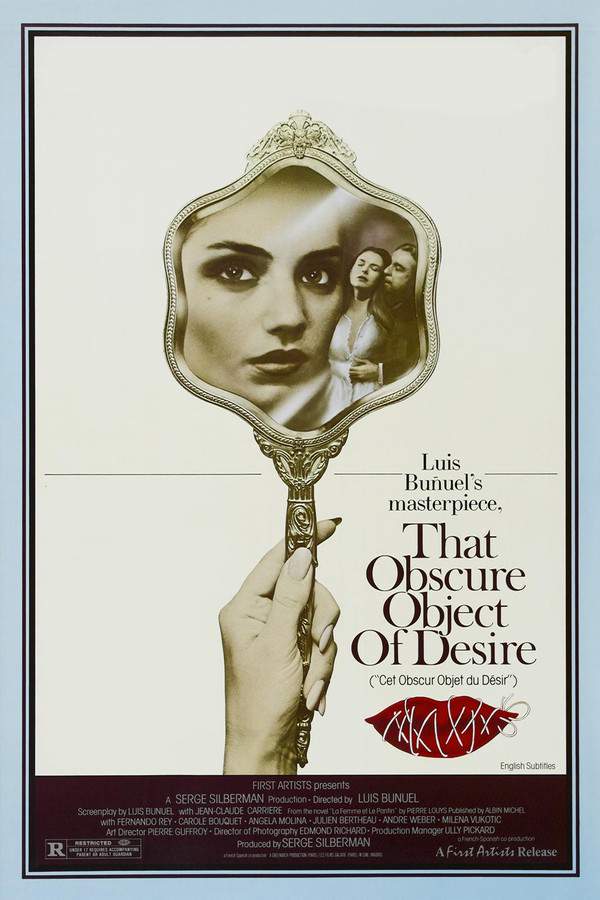
That Obscure Object of Desire (2001) movie poster

Characters & Themes

That Obscure Object of Desire (2001) Characters, Setting & Themes Explained

Release, runtime and language
2001 · 102 min · French
Loading streaming availability…
Directed by
Luis Buñuel
Starring
Fernando Rey, Ángela Molina, Carole Bouquet

A wealthy Frenchman's life takes a dramatic turn when he meets a passionate flamenco dancer, leading to a whirlwind romance. While traveling on a train, he recounts their intense and tumultuous relationship to his fellow passengers, revealing a complex story of desire, betrayal, and the blurring of boundaries between love and cruelty. The narrative explores the intricacies of human connection and the potential for both beauty and pain within passionate relationships.

On this page (7)
  1. 1 Where to watch
  2. 2 Characters explained (2)
  3. 3 Where & when it takes place
  4. 4 Themes & meaning (2)
  5. 5 Character & meaning questions
  6. 6 Movie threads
  7. 7 Every angle
Loading streaming availability…

2 main characters · contains spoilers

That Obscure Object of Desire Characters Explained: Who Is Who

The main characters of That Obscure Object of Desire (2001), heroes and villains: what drives them, how they change over the course of the story and what each of them reveals about the film's bigger ideas.

  • Mathieu (Fernando Rey)

    Mathieu is a wealthy, middle-aged Frenchman who finds himself caught in a chaotic love affair with Conchita. His character is driven by a mix of desire and frustration, layered with moments of introspection about his choices. Mathieu often oscillates between moments of anger and moments of vulnerability, showcasing the complexity of his emotional state.

    • 👨‍💼 Wealthy
    • 💔 Heartbroken
  • Conchita (Carole Bouquet, Ángela Molina)

    Conchita is a beautiful and enigmatic flamenco dancer who embodies both allure and defiance. Her character is defined by her complexity—she is youthful yet manipulative, promising intimacy while maintaining emotional distance. Conchita's actions are driven by the need for autonomy, often at the cost of her relationship with Mathieu, showcasing her duality as both a lover and a provocateur.

    • 💃 Dancer
    • 🔥 Alluring

Last updated: October 22, 2024 at 21:22

Was this helpful?

Setting

Where and When Does That Obscure Object of Desire Take Place?

The setting of That Obscure Object of Desire (2001): the year and time period, the places and locations, and how they shape the characters, the mood and the tension of the story.

Time period

The film takes place during a period characterized by political upheaval and social unrest, as leftist factions engage in violent protests. This chaotic climate affects the characters' lives and relationships, creating a sense of urgency and tension throughout the narrative. The historical context intensifies the dynamics within Mathieu and Conchita's fraught love story.

Location

Seville, Paris, Madrid

Seville is known for its rich history and vibrant flamenco culture, serving as the backdrop for Conchita's passionate performances. Paris symbolizes wealth and sophistication, contrasting with Mathieu's turbulent emotions. Madrid, the capital of Spain, adds a layer of urban chaos, representing the couple's tumultuous relationship amidst political tensions.

  • 🇪🇸 Spain
  • 🇫🇷 France
  • 🏙️ City

Last updated: October 22, 2024 at 21:22

Was this helpful?

2 major themes

That Obscure Object of Desire Meaning: Themes & Message Explained

What is That Obscure Object of Desire (2001) really about? The emotional, social and philosophical themes the film keeps returning to, its symbolism and the message beneath the surface.

  • Love and Turmoil

    The movie explores the complexities of love through the lens of a tumultuous relationship marked by passion, betrayal, and pain. Mathieu and Conchita's love story is riddled with misunderstandings and emotional conflict, reflecting the often chaotic nature of romantic entanglements. Their relationship ultimately showcases love's capacity to be both euphoric and destructive.

  • Violence and Conflict

    Set against a backdrop of political violence, the film highlights how external chaos reflects the internal turmoil of its characters. Scenes of physical confrontation and emotional abuse illustrate the destructive cycles of anger and power struggle. This theme serves as a commentary on how personal relationships are often influenced by larger societal issues.

Last updated: October 22, 2024 at 21:22

Was this helpful?

Character & theme questions

That Obscure Object of Desire Characters & Meaning: Your Questions Answered

The questions people ask about That Obscure Object of Desire (2001): who the characters really are, their relationships, what the symbols mean, where it takes place and what the movie is really about. Each answer contains spoilers.

Q1

Where does the movie take place?

The film unfolds across three major European cities. Seville, Spain, serves as the backdrop for Conchita's passionate flamenco performances and represents her cultural roots. Paris symbolizes wealth and sophistication, reflecting Mathieu's world. Madrid adds an urban layer of chaos, representing the couple's tumultuous relationship amid political tensions.

  • seville
  • paris
  • madrid
  • setting
  • spain
  • france
  • locations
Q2

What historical period does the film depict?

The movie takes place during a period marked by political upheaval and social unrest, where leftist factions engage in violent protests. This chaotic historical context creates an atmosphere of urgency and tension that mirrors the internal turmoil in Mathieu and Conchita's relationship.

  • political unrest
  • historical period
  • spain
  • protests
  • era
  • 1970s
Q3

What are the main themes of the film?

The movie centers on two primary themes. 'Love and Turmoil' explores the chaotic nature of romantic relationships, where passion, betrayal, and emotional conflict intertwine. 'Violence and Conflict' examines how external societal chaos reflects and influences personal relationships, with physical and emotional abuse illustrating destructive cycles of anger and power.

  • themes
  • love
  • turmoil
  • violence
  • conflict
  • betrayal
  • passion
Q4

How does the film portray love and turmoil?

The film depicts love as both euphoric and destructive through Mathieu and Conchita's relationship. Their romance is riddled with misunderstandings, emotional manipulation, and intense conflict. The narrative shows how passionate love can simultaneously bring joy and cause profound pain, reflecting the chaotic nature of romantic entanglements.

  • love
  • turmoil
  • relationship
  • passion
  • emotional conflict
  • romantic entanglements
Q5

How does violence function in the story?

Violence operates on both personal and political levels in the film. Physically confrontational scenes and emotional abuse illustrate destructive cycles of anger and power struggle within the relationship. The film uses this violence as a commentary on how personal relationships are deeply influenced by larger societal issues, with the political chaos outside mirroring the turmoil within the couple.

  • violence
  • conflict
  • abuse
  • power struggle
  • political chaos
  • emotional abuse
Q6

Who is Mathieu?

Mathieu is a wealthy, middle-aged Frenchman who becomes embroiled in a chaotic love affair with Conchita. His character oscillates between desire and frustration, displaying moments of anger alongside vulnerability. He serves as the narrator on the train, recounting their tumultuous relationship to fellow passengers.

  • mathieu
  • frenchman
  • wealthy
  • narrator
  • character
  • fernando rey
Q7

Who is Conchita?

Conchita is a beautiful flamenco dancer who embodies both allure and defiance. Played by Carole Bouquet and Ángela Molina, she is youthful yet manipulative, promising intimacy while maintaining emotional distance. Her character is defined by her need for autonomy, often at the cost of her relationship with Mathieu, showcasing her duality as both lover and provocateur.

  • conchita
  • dancer
  • flamenco
  • carole bouquet
  • ángela molina
  • character
Q8

What motivates Conchita's actions?

Conchita is primarily motivated by her need for autonomy and independence. Her actions are driven by a desire to maintain emotional distance while still wielding control over her relationship with Mathieu. This pursuit of autonomy often comes at the expense of their relationship, making her both alluring and frustrating to Mathieu.

  • conchita
  • autonomy
  • independence
  • motivation
  • control
  • emotional distance
Q9

What is the significance of flamenco in the film?

Flamenco serves as a central cultural element in Seville, representing Conchita's passionate artistic expression and her cultural identity. The dance form embodies the intense emotions and dramatic tension that characterize her relationship with Mathieu, with the performances reflecting themes of desire, conflict, and emotional depth.

  • flamenco
  • seville
  • dance
  • culture
  • passion
  • spanish culture
  • performance
Q10

How does the train setting function in the story?

The train serves as both a literal setting and a narrative framing device. While traveling on a train, Mathieu recounts his intense relationship with Conchita to fellow passengers. This structure allows the story to unfold through flashbacks, creating a complex, unreliable narrative that shifts between the slow reflective moments on the train and the chaotic flashbacks of the affair.

  • train
  • narrative structure
  • framing device
  • flashback
  • unreliable narrator
  • storytelling
Q11

What does the ending suggest about their relationship?

The ending is deliberately ambiguous, with Mathieu and Conchita walking away together amidst a terrorist bombing. This conclusion leaves their ultimate fate uncertain, suggesting a cyclical, unresolved nature to their relationship. The ambiguity implies their reconciliation may be temporary or that their bond transcends conventional notions of love and compatibility.

  • ending
  • ambiguous
  • reconciliation
  • couple
  • terrorist bombing
  • resolution

Movie threads

More Movies Like That Obscure Object of Desire, by Mood & Story

Curated lists built around what makes That Obscure Object of Desire tick: the same mood, the same kind of story or the same emotional payoff. Each list explains why these movies belong together.

Movies about obsessive toxic love like That Obscure Object of Desire

Movies where passionate love becomes a dark, psychologically consuming battle. Explore movies like 'That Obscure Object of Desire' that delve into destructive, all-consuming relationships. If you were captivated by the film's depiction of a passionate yet painful affair, these recommendations feature similar stories of obsessive desire, emotional volatility, and the unsettling power dynamics within toxic romances.

  • obsessive
  • tumultuous
  • unsettling
  • passionate
  • chaotic
  • frustrating
  • Tone: dark, unsettling
  • Pacing: variable, intense
Why these movies?

The story pattern: Stories in this thread often follow a similar downward spiral, where an initial, magnetic attraction between two people devolves into a game of psychological warfare. The narrative structure may involve flashbacks or unreliable narrators, emphasizing the chaotic, subjective nature of the relationship as power constantly shifts and boundaries are violated.

Why they belong together: These films are grouped together because they share a core focus on the destructive nature of obsessive love. Viewers can expect a consistent experience of high emotional intensity, dark tone, and complex character studies that challenge conventional notions of romance, focusing instead on jealousy, manipulation, and the potential for violence in passion.

Movies with framed narratives like That Obscure Object of Desire

Stories told through a character's unreliable, emotionally charged recollection. Discover films with narrative structures similar to 'That Obscure Object of Desire,' where a character recounts a pivotal story from their past. If you enjoyed the film's train journey framing device, these movies feature similar non-linear storytelling, unreliable narrators, and plots that explore how memory shapes our understanding of desire, betrayal, and trauma.

  • reflective
  • melancholic
  • complex
  • unreliable
  • psychological
  • non-linear
  • Tone: melancholic, reflective
  • Pacing: variable, reflective
Why these movies?

The story pattern: This thread encompasses movies where the plot is structured around a character retelling a significant, often painful, chapter of their life. The primary conflict exists in the past, but its emotional weight is felt in the present frame. This structure often creates complexity, as the gap between the narrator's perspective and the objective truth becomes a central theme.

Why they belong together: Movies are grouped here based on their shared use of a framing device to explore memory and subjective truth. They commonly feature complex, non-linear storytelling, an ambiguous or bittersweet ending feel, and a heavy emotional weight, as the act of retelling the story is itself a part of the character's emotional journey.

Every angle

That Obscure Object of Desire (2001) Explained: Plot, Timeline & Characters

Everything about That Obscure Object of Desire in one place: what happens in the plot summary, the timeline in chronological order, the characters and meaning and a spoiler-free summary. What's After the Movie adds the cast, box office and post-credit scenes.

Coming soon on iOS and Android

The Plot Explained Movie Summary App

Plot summaries, endings explained and timelines on your phone. Catch up on any movie in minutes, save your favorites and never miss a twist again.

Be the first to know when we launch. Your email stays private, always.

Learn more about the app