Plot Explained Spoilers guaranteed!
Plot Explained

Browse by genre

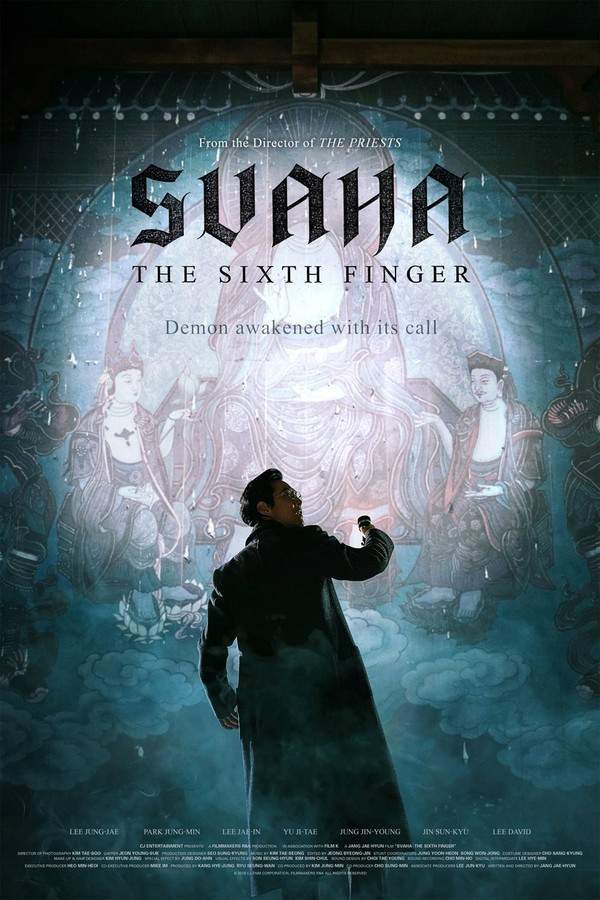
Svaha: The Sixth Finger (2019) movie poster

Plot Summary

Svaha: The Sixth Finger (2019) Plot Summary Explained

Release, runtime and language
2019 · 122 min · Korean
Echo score 61
Loading streaming availability…
Directed by
Jae-hyun Jang
Starring
Jung-min Park, Hong-Fa Kim, Ji-tae Yu, Jin-yeong Jeong, Jung-Jae Lee, Jung-min Hwang

A brilliant but troubled detective investigates a series of gruesome murders that grip a city in fear. As he delves deeper, he uncovers a connection to ancient rituals and a sinister force manipulating events from the shadows. Driven by his investigative instincts, he must unravel the mystery before the killings escalate further and the truth remains hidden.

On this page (6)
  1. 1 Where to watch
  2. 2 What happens: full plot
  3. 3 Plot questions answered
  4. 4 Movie threads
  5. 5 Movies like Svaha: The Sixth Finger
  6. 6 Every angle
Loading streaming availability…

Full plot summary · contains spoilers

What Happens in Svaha: The Sixth Finger: Full Plot Summary

The whole story of Svaha: The Sixth Finger (2019) explained, from the opening scene to the final frame: every key event, every twist and what it all adds up to. Read it as a quick recap before the sequel, to check a scene you missed, or to finally understand what really happened.

The narrative unfolds with the tragic birth of Lee Geum-hwa and her twin sister, whose existence leads to unexpected consequences. While Geum-hwa enters the world with a deformed leg—her sister's fetus having nourished itself parasitically—she is born into a bleak reality. Their mother tragically succumbs shortly after childbirth, and their father, overwhelmed by despair, takes his own life. As a result, Geum-hwa is raised in a remote village by her grandparents, who relocated there to raise dogs for a living. Meanwhile, her sister, deemed a "thing" by society, is concealed from public view, imprisoned in a shed in the backyard, her existence unregistered and silenced.

In the village, strange occurrences arise, prompting a group of locals, guided by a shaman, to investigate the unusual behavior of the livestock. Their search leads them to the shed, where chaos ensues as snakes escape, inflicting bites on the curious onlookers.

Amidst this, Pastor Park, a determined individual dedicated to exposing cults, embarks on an investigation into a clandestine group known as Dongbanggyo or "Deer Mountain." Meanwhile, law enforcement opens a case regarding the discovery of a girl’s body, horrifyingly interred in concrete. During this time, Gwangmok, an individual tormented by guilt, confesses to his friend Kim Cheol-Jin, a truck driver who feels he has failed his duties to a father figure. Gwangmok reveals the haunting visits he receives from dead children at night, urging him towards oblivion.

Autopsy findings on the deceased girl unveil a talisman within her mouth, prompting the pathologist to recollect similar occurrences from the past. The police trace the girl back to Kim Cheol-Jin through his construction company, but when confronted, he tragically leapt from a rooftop. During this tumultuous period, Gwangmok is handed information about Geum-hwa by a member of Dongbanggyo, fueling his obsession to watch her closely. As nightmares of dead girls plague him, they are often accompanied by a woman singing a haunting melody.

Pastor Park delves into the origins of Dongbanggyo, discovering the scriptures penned by Kim Pungsa. His investigation leads him to the esteemed Nechung Tenpa, a Buddhist master who once sought to meet the cult's founder, Kim Je-seok. Insights reveal that Kim Je-seok made a notable donation to a youth detention center decades prior and had adopted a group of troubled youths—one of whom was the now-deceased Kim Cheol-Jin. Through careful deduction, Park concludes that three of these boys have perished, each depicted as deities in drawings, with the surviving figure identified as Gwangmok.

As the story progresses, Gwangmok visits Geum-hwa's home with sinister intentions, determined to bring about her demise. However, an unexpected interruption occurs when birds flock through the window, diverting his attention. Venturing to the shed, he encounters Geum-hwa's sister, who seizes his leg and drives him away in fear.

Gwangmok subsequently arrives at the Dongbanggyo Residence, speaking to a youthful henchman. There, he learns that Geum-hwa is regarded as "the snake." A confrontation with his fading "Father" reveals memories of being branded as Gwangmok, a protector of the light.

Park engages in a pivotal conversation with Nechung Tenpa, who recounts a significant encounter with the revered Master in 1985. Tenpa claims the Master achieved immortality, showcasing twelve fingers—an identity attributed to Donggon scriptures that foretell a "snake" set to extinguish the light. This impending malevolence is believed to emerge from the Master’s birthplace, with the prophecy linking it to the demise of young girls in the vicinity of Yeongwul during 1999.

In a chilling turn of events, Gwangmok, now having abducted Geum-hwa, contemplates her execution. As Geum-hwa queries the rationale behind her death, he chillingly labels her as evil, yet offers the unsettling notion that her death isn’t final. In a desperate plea, Geum-hwa brings up her sister, asking Gwangmok to kill her as well, dreaming of being reborn as a human in the next life.

Meanwhile, Gwangmok discovers the sister and contemplates the action he intends to take. However, she undergoes a profound transformation, adopting a serene Buddha-like form. In a shocking revelation, she confesses to having awaited his arrival, revealing her role as a comforting presence in his dark dreams. Repeating the same song as in his visions, she implores him to seek a mark from the Father figure he holds dear—six fingers, signifying a crucial prophecy.

Back at the residence, Gwangmok recants his experience to the henchman, only to learn an astonishing truth about his dying "Father," who only possesses five fingers. This revelation culminates in a betrayal as the henchman, revealed to be Kim Je-seok himself, leads Gwangmok into a trap where he is shot. The henchman drives Gwangmok away to eliminate Geum-hwa’s sister.

While all these dark revelations unfold, Pastor Park covertly investigates the residence, confused about the origins of the old man's illness. As he hides, it becomes clear that the ailing figure is but a disciple, with Pastor Park learning the shocking truth behind the cult's manipulation.

Kim Je-seok eventually reveals to Gwangmok the reality of their roles in this grim narrative—he is the light while Gwangmok is but a star meant to guard him. The conversations take a deadly turn, resulting in decisions that entwine fate and morality, leading to a catastrophic car crash that enmeshes both characters in a deadly struggle amidst leaking gasoline.

In a climax filled with desperation, Gwangmok seizes an object gifted by the sister—a lighter—which he ultimately uses to set Kim Je-seok ablaze. In the poignant aftermath, Geum-hwa, still breathing, cradles her sister in her arms as she succumbs to the tragedy of their intertwined fates, marking a bittersweet end to a harrowing tale of reliance, sacrifice, and the search for redemption.

Last updated: December 13, 2024 at 06:47

Was this helpful?

Plot questions answered

Svaha: The Sixth Finger Plot Explained: Your Questions Answered

The questions people ask most about Svaha: The Sixth Finger (2019): what happens in the confusing scenes, why the characters do what they do, the twists, hidden details and what the ending means. Each answer contains spoilers.

Q1

Why does Gwangmok want to kill Geum-hwa?

Gwangmok believes Geum-hwa is the 'snake' referenced in the Dongbanggyo prophecy, a being destined to extinguish the light. The cult has convinced him that eliminating her is necessary to prevent the prophecy from coming true. However, this belief is manipulated by Kim Je-seok, who uses the prophecy to control Gwangmok and other followers.

Foreshadowing: Earlier in the film, Pastor Park discovers that Dongbanggyo's scriptures reference a 'snake' that will emerge from the Master's birthplace.

  • gwangmok
  • geum-hwa
  • dongbanggyo
  • snake prophecy
  • cult
Q2

What do the six fingers symbolize in the movie?

The six fingers represent a mark of the true Master who achieved immortality according to the Donggon scriptures. The prophecy foretells that the 'snake' will be born where the six-fingered Master was born, and only the six-fingered figure possesses the authority to confront the evil. Gwangmok learns that Kim Je-seok, the cult founder, claims to have this mark, but the revelation comes too late, he only has five fingers.

Foreshadowing: Nechung Tenpa tells Pastor Park about the legendary Master with twelve fingers who achieved immortality in 1985.

  • six fingers
  • prophecy
  • donggon scriptures
  • immortality
  • kim je-seok
Q3

Why is Geum-hwa's twin sister kept hidden in the shed?

Geum-hwa's sister was born as a parasitic twin that fed on Geum-hwa's leg during pregnancy, causing her deformity. The family considered her a 'thing' and hid her from society, keeping her imprisoned in a shed, unregistered and unseen. The villagers knew nothing of her existence, and even Geum-hwa's grandparents kept her concealed until the film's events.

Foreshadowing: The opening scenes establish the tragic birth circumstances, showing how the sister's fetus nourished itself parasitically.

  • twin sister
  • shed
  • parasitic twin
  • hidden
  • family tragedy
Q4

What is the relationship between Gwangmok and Kim Je-seok?

Kim Je-seok founded Dongbanggyo and adopted several troubled youths, including Gwangmok and Kim Cheol-Jin. Gwangmok was raised to believe Kim Je-seok was his 'Father' and the embodiment of light. In reality, Kim Je-seok manipulated these boys as tools, he reveals at the end that Gwangmok was merely a 'star' meant to protect him, the 'light.' The ailing 'Father' Gwangmok knew was actually just a disciple.

Foreshadowing: Pastor Park's investigation reveals that Kim Je-seok adopted troubled youths decades ago, with three already dead and Gwangmok as the survivor.

  • gwangmok
  • kim je-seok
  • adopted
  • cult leader
  • father figure
Q5

Why does Gwangmok see dead girls in his nightmares?

Gwangmok is haunted by the spirits of dead girls because he was complicit in their deaths through the cult's rituals. He visits Kim Cheol-Jin early in the film, who confesses to being tormented by dead children, these are victims of Dongbanggyo's killings. The girls appear to Gwangmok as a manifestation of his guilt and the cult's crimes, eventually guiding him toward redemption.

Foreshadowing: The police investigation reveals girls' bodies buried in concrete with talismans in their mouths, confirming the ritualistic murders.

  • nightmares
  • dead girls
  • guilt
  • spirits
  • cult murders
Q6

Why does Geum-hwa's sister transform into a Buddha-like form?

When Gwangmok confronts the sister in the shed, she undergoes a spiritual transformation, appearing serene and Buddha-like. This transformation signifies her role as a spiritual guide, she has been waiting for Gwangmok to come to her. She reveals she has been comforting him in his dark dreams and imparts crucial knowledge about the six-fingered prophecy, guiding him toward the truth.

Foreshadowing: Earlier, Gwangmok encounters the sister when she grabs his leg from under the shed door, an act that initially frightens him but sets up their later encounter.

  • sister
  • transformation
  • buddha
  • spiritual
  • prophecy
Q7

Why does Geum-hwa ask Gwangmok to kill her sister too?

When Gwangmok prepares to kill Geum-hwa, she desperately asks him to kill her sister as well. Her reasoning is tragic, she wants both of them to die together so they can be reborn as humans in their next life. This reflects Geum-hwa's belief that their current existence as a deformed girl and a hidden 'thing' is so miserable that death would be preferable.

Foreshadowing: The sisters' bond is established from birth, with Geum-hwa being the only person who knows her sister exists.

  • geum-hwa
  • sister
  • death
  • rebirth
  • mercy killing
Q8

Who is the real leader of Dongbanggyo?

Kim Je-seok is the true founder and leader of Dongbanggyo, though he operates through deception. He appears as a young henchman but is actually the elderly founder who donates to youth detention centers and adopts troubled boys. He manipulates his followers by posing as a disciple while controlling the elderly 'Father' figure. His goal is to maintain power and escape justice by eliminating those who know the truth.

Foreshadowing: Pastor Park discovers that Kim Je-seok made a significant donation to a youth detention center and adopted boys including Kim Cheol-Jin.

  • kim je-seok
  • dongbanggyo
  • cult leader
  • deception
  • founder
Q9

What gift does Geum-hwa's sister give Gwangmok?

Before Gwangmok leaves the shed, the sister gives him a lighter. This object becomes crucial in the climax when Gwangmok uses it to set Kim Je-seok ablaze during their confrontation. The lighter represents her blessing and empowerment for Gwangmok to destroy the true evil, the manipulative cult leader who has orchestrated so much suffering.

Foreshadowing: The sister tells Gwangmok to seek the mark of six fingers from his Father, hinting at the truth he needs to confront.

  • lighter
  • gift
  • sister
  • revenge
  • climax
Q10

What happens to Geum-hwa's sister at the end?

In the aftermath of the confrontation, Geum-hwa cradles her dying sister as she succumbs to her injuries. The sister has already undergone her spiritual transformation and delivered her final message to Gwangmok, so her death brings peace. Geum-hwa is left holding her sister as she fades away, marking a bittersweet and tragic conclusion to their story.

Foreshadowing: The sister's transformation into a Buddha-like form foreshadows her imminent departure from the mortal realm.

  • sister
  • death
  • ending
  • geum-hwa
  • tragic

Movie threads

More Movies Like Svaha: The Sixth Finger, by Mood & Story

Curated lists built around what makes Svaha: The Sixth Finger tick: the same mood, the same kind of story or the same emotional payoff. Each list explains why these movies belong together.

Thrillers about ancient rituals like in Svaha: The Sixth Finger

Stories where ancient evils or pagan rituals resurface to torment the present. Discover movies like Svaha: The Sixth Finger that explore the collision of the modern world with ancient, sinister forces. If you enjoyed the detective's descent into a world of pagan cults and ritualistic murders, you'll find similar dark and complex thriller stories here.

  • ancient evil
  • sinister cult
  • prophecy
  • investigative dread
  • religious horror
  • unsettling
  • Tone: dark, ominous, unsettling
  • Pacing: steady, investigative
Why these movies?

The story pattern: These stories typically follow an investigator or skeptic who is drawn into a mystery that challenges their rational worldview. Their pursuit of the truth leads them to uncover a hidden network, often a cult or ancient belief system, that is actively working to fulfill a dark prophecy or enact a ritual with malevolent consequences. The journey is one of disillusionment and confrontation with a primal, unstoppable force.

Why they belong together: Movies in this thread are connected by their central conflict: a clash between rational modernity and supernatural or fanatical antiquity. They share a dark, investigative tone, a steady pacing that builds mystery, and a heavy emotional weight derived from the existential threat of the ancient evil.

Thrillers with bittersweet endings like Svaha: The Sixth Finger

Where solving the mystery comes at a profound personal cost. Find movies similar to Svaha: The Sixth Finger where the detective's success is tempered by tragedy. If you were moved by the heavy emotional cost of uncovering the truth in Svaha, these complex thrillers and mysteries explore the same theme of painful victory.

  • bittersweet ending
  • emotional toll
  • grim truth
  • traumatic victory
  • heavy drama
  • somber
  • Tone: dark, bittersweet, somber
  • Pacing: steady, character-driven
Why these movies?

The story pattern: The narrative arc follows a determined protagonist, often a detective or journalist, who pieces together a complex and disturbing puzzle. Their perseverance reveals the truth and stops the immediate threat, but the journey leaves them scarred. The ending is characterized by the loss of allies, the burden of grim knowledge, or the realization that some wounds cannot be healed, resulting in a somber and emotionally resonant conclusion.

Why they belong together: These films are grouped by their shared emotional trajectory and ending feel. They prioritize heavy emotional weight over catharsis, featuring complex mysteries that conclude not with triumph, but with a sobering acknowledgment of the sacrifices made. The tone is consistently dark, and the pacing is steady to allow the emotional consequences to fully resonate.

If you liked this

Movies Like Svaha: The Sixth Finger

Similar movies to Svaha: The Sixth Finger: the same genre, themes or kind of story. Each one comes with its own plot summary, timeline and ending explained.

Browse all movie summaries

Every angle

Svaha: The Sixth Finger (2019) Explained: Plot, Timeline & Characters

Everything about Svaha: The Sixth Finger in one place: what happens in the plot summary, the timeline in chronological order, the characters and meaning and a spoiler-free summary. What's After the Movie adds the cast, box office and post-credit scenes.

Coming soon on iOS and Android

The Plot Explained Movie Summary App

Plot summaries, endings explained and timelines on your phone. Catch up on any movie in minutes, save your favorites and never miss a twist again.

Be the first to know when we launch. Your email stays private, always.

Learn more about the app