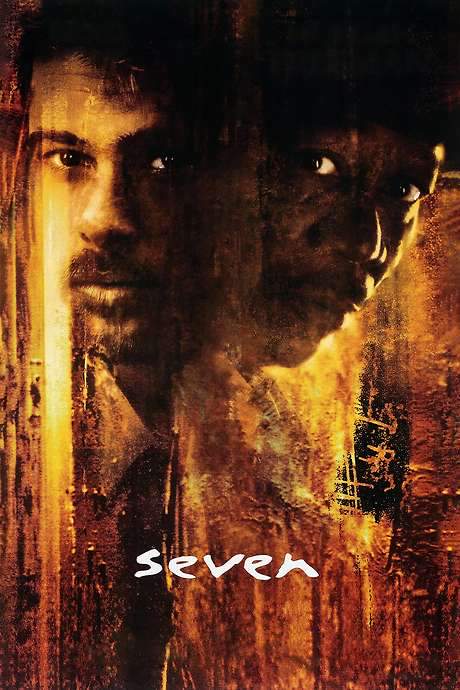
Detective Lieutenant [Morgan Freeman] Somerset is one week from retirement, and he is partnered with Mills, a young, hot-headed, idealistic detective who recently relocated to the city with his wife, [Gwyneth Paltrow] Tracy. The two men could not be more different in temperament or outlook, yet they share a stubborn dedication to justice in a city roiled by violence and corruption. The unnamed metropolis feels like a living puzzle, every alleyway and tenement whispering of crime, and Somerset carries the weight of experience, while Mills brings a drive that sometimes borders on recklessness. Their uneasy bond becomes the quiet center of a case that will push them to the edge of both their professional limits and their personal beliefs.
On Monday, the pair investigate a bizarre and gruesome murder: an obese man who was forced to eat until his stomach ruptured. The scene is macabre and meticulously documented, with the word “gluttony” scrawled on a wall like a grim signature. The brutality is clinical, almost ritualistic, and it prompts Somerset to question whether this assignment is suitable for his last days on the force. His professional instinct tells him that they are dealing with something far more than random violence, but his request for reassignment—an attempt to shield himself from a case that feels both unspeakable and unsatisfying—meets stubborn resistance from the bureaucratic machine of the department. Mills, eager to prove himself, throws himself into the investigation with a mixture of zeal and fury, driven by a need to demonstrate his competence in a city that has never welcomed him with open arms.
The next day brings another dead end, and a second victim who has been deprived of a pound of flesh from his body. The crime scene is marked with the word “greed,” and the clues begin to cohere into a darker pattern. As the newspapers whisper about the case, Somerset and Mills press deeper into the mystery, following the threads to a third victim that appears to be the opposite of gluttony—a man who was emaciated, restrained to a bed, and left to suffer in a methodical, almost clinical way. Photographs reveal the victim was restrained for precisely one year, suggesting a long premeditation and an eerie, almost theatrical patience. Somerset’s intuition crystallizes the idea that the killings spring from the Christian concept of the seven deadly sins, a theory that fits the meticulous nature of the crimes and the way each scene seems to indict a particular vice.
A sense of uneasy camaraderie blossoms as Mills invites Somerset to share a quiet supper at Tracy’s apartment, a gesture meant to bridge the professional divide and ease the tension between the two men. Tracy, a woman who has just moved to the city, opens up about her unhappiness with the move and the looming pregnancy that has altered the fabric of her life. She wonders whether this new city is a place where she can raise a child, and her confession echoes past regrets that Somerset himself has carried for years—his decision to persuade a former partner to terminate a pregnancy and the ache that followed. He counsels Tracy with a rare gentleness, advising her to tell Mills about the pregnancy only if she intends to keep the child. The moment subtly reveals the emotional weight behind the investigative armor worn by the two men, and it foreshadows how the case will test every boundary they have built around themselves.
A sharp remark from Mills spurs Somerset to broaden their search into libraries and catalogs, looking for anyone who has checked out books related to the seven deadly sins. This leads them to the apartment of a man known only as John Doe. The unexpected return of the suspect, who incapacitates Mills with a tire iron and holds him at gunpoint, adds a jolt of danger to the pursuit. Doe shows an unsettling restraint in choosing to leave Mills alive, and he retreats into the night, leaving behind a staggering cache: stacks of money, hundreds of notebooks, and photographs that include images of Somerset and Mills themselves, as though Doe has been stalking them all along. The discovery intensifies the sense that the killer intends to communicate a broader message, a message about the ubiquity of sin and society’s apathy toward it. Doe also telephones the apartment to express his admiration for Mills, a chilling reminder of his ability to manipulate those around him.
By Saturday, the investigators confront the fourth victim, a prostitute who has been raped with a custom-made, bladed strap-on. The brutality of the crime underscores the lurid and dangerous depth of the sin they are pursuing, and the case tightens the pace of the investigation. The next day brings another shock: a model, the Pride victim, who has been facially disfigured by Doe and, unable to endure a life altered by violence, takes her own life. The sins, it seems, are not simply abstract moral categories but tangible wounds that tear at the fabric of individual lives.
When Doe surfaces again, he arrives covered in blood and surrenders, issuing a chilling ultimatum. He threatens to plead insanity at his trial, a gambit meant to deflect punishment, unless Mills and Somerset escort him to a hidden location where they will encounter the envy and wrath victims. As they travel, Doe speaks with a disturbing calm, insisting that God chose him to wake society to the pervasiveness of sin and the hardened indifference that people show toward it. He is utterly devoid of remorse, taking pleasure in his role as a catalyst for others’ fear and anger.
Doe guides them to a remote location far beyond the city’s edge, where a delivery van approaches under ominous circumstances. The driver’s instructions are to deliver a package to Mills at the exact moment the detectives arrive, a plan that fills Mills with dread as he confronts a sight he would rather forget. Doe, in a calculated confrontation, reveals that he embodies envy because he coveted Mills’s life with Tracy and implies that the package contains Tracy’s severed head. He pushes Mills toward wrath, telling him that Tracy begged for her life and that of her unborn child—an revelation that crushes Mills’s world and exposes the fragile line between justice and vengeance. Despite Somerset’s pleas and his own mounting horror, Mills is overwhelmed by grief and rage and shoots Doe dead, completing the killer’s meticulously crafted arc.
In the aftermath, Mills is removed from the scene, catatonic under the weight of what he has done, while Somerset—ever the observer and survivor—tells his captain that he will “be around.” The detective then speaks with the world-weariness of someone who has witnessed too much yet remains committed to some sense of duty. In a final voiceover, he quotes Ernest Hemingway, acknowledging the darker truth that the world is a fine place, and worth fighting for—the second part, at least, something he continues to believe even as the city’s shadows linger.
> Ernest Hemingway once wrote: "The world is a fine place, and worth fighting for." I agree with the second part.