Plot Explained Spoilers guaranteed!
Plot Explained

Browse by genre

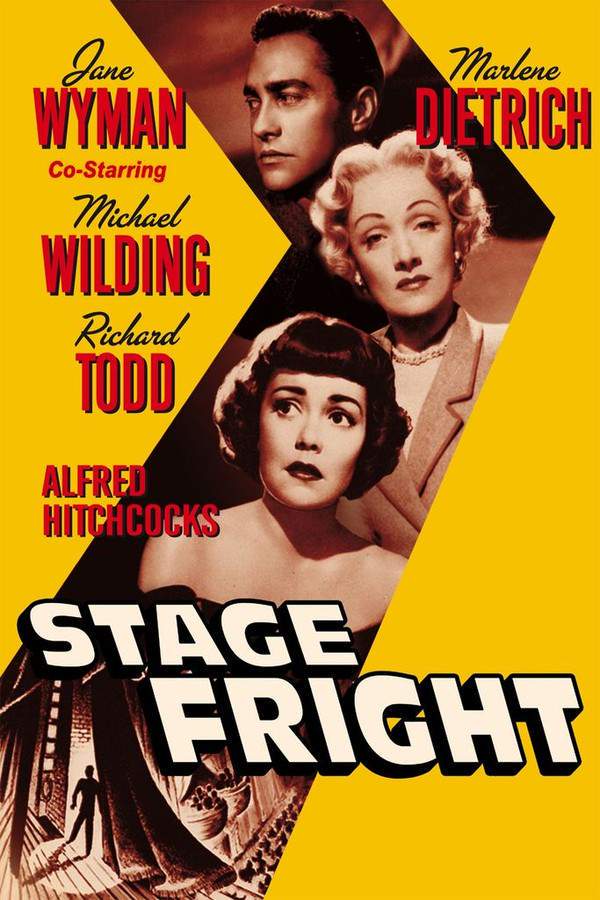
Stage Fright (1950) movie poster

Plot Summary

Stage Fright (1950) Plot Summary Explained

Release, runtime and language
1950 · 110 min · English
Directed by
Alfred Hitchcock
Starring
Kay Walsh, Richard Todd, Marlene Dietrich, Michael Wilding, Jane Wyman, Joyce Grenfell

A struggling actress finds herself embroiled in a dangerous situation when a friend is accused of murder. Determined to prove his innocence, she delves into the ruthless and deceptive world of show business. Her investigation reveals a complex web of corruption and deceit, forcing her to confront powerful enemies and navigate a perilous game where trust is a luxury she cannot afford.

On this page (7)
  1. 1 Where to watch
  2. 2 What happens: full plot
  3. 3 Plot questions answered
  4. 4 Movie threads
  5. 5 Movies like Stage Fright
  6. 6 Categories
  7. 7 Every angle

Where to watch

Where to Watch Stage Fright (1950)

Where can you watch Stage Fright? Stream, rent or buy it in the US, including on Darkroom, Amazon Video and Apple TV Store: current JustWatch availability with up-to-date prices.

Streaming availability powered by JustWatch

Full plot summary · contains spoilers

What Happens in Stage Fright: Full Plot Summary

The whole story of Stage Fright (1950) explained, from the opening scene to the final frame: every key event, every twist and what it all adds up to. Read it as a quick recap before the sequel, to check a scene you missed, or to finally understand what really happened.

Eve Gill, portrayed by Jane Wyman, is a passionate aspiring actress attending The Royal Academy of Dramatic Arts. During a rehearsal, her world is turned upside down when she is unexpectedly visited by her friend, the troubled actor, Richard Todd, who is in a state of panic. He reveals that he is entangled with the flamboyant stage actress and singer, Marlene Dietrich, who has just become embroiled in a chilling murder case. According to Jonathan, Charlotte has committed an unspeakable act—killing her husband during a heated argument.

Dressed in a bloodstained gown and desperate for help, she lured Jonathan to her home under false pretenses, and he unwittingly found himself in the midst of a grisly crime scene where Mr. Inwood was deceased. He tells Eve that rather than turn Charlotte over to the authorities, he attempted to conceal the horrific event by staging a burglary gone wrong. However, in his panic, he was spotted by Charlotte's maid, Kay Walsh, leaving him a wanted man with the police hot on his trail.

Eve’s affection for Jonathan compels her to provide sanctuary, whisking him away to a coastal hideout linked to her father, Alastair Sim. Though the Commodore initially harbors doubts about Jonathan’s culpability—especially after detecting that the blood on Charlotte’s dress appears to be smeared intentionally—he finds himself embroiled in a web of deception and intrigue. Despite the chaos, he ultimately destroys the dress in a fit of rage.

Determined to uncover the truth and save Jonathan, Eve takes matters into her own hands. She deceives Nellie Goode into feigning illness, allowing Eve to adopt the disguise of a Cockney maid named “Doris Tinsdale” and infiltrate Charlotte’s household. During her undercover mission, she crosses paths with the handsome Detective Inspector Michael Wilding, who finds himself drawn to Eve. The tension escalates as Eve navigates her charade as a maid while attempting to extract information from the inspector about his investigation.

As the story unfolds, Eve invites Inspector Smith to tea at her home, where her father inadvertently hints that Jonathan has vacated their coastal haven. Meanwhile, Charlotte returns to the stage, her musical performance overshadowed by her tumultuous personal life. She is secretly sought out by Jonathan, who implores her to escape with him. Yet, Charlotte is reluctant to abandon her career for a fugitive, all while carrying on a hidden affair with her manager, Hector MacGregor.

Eve, still disguised as Doris, continues her mission to aid Jonathan, who ultimately hides in her family’s London home. Although he expresses gratitude for her support, Eve’s affections begin to shift towards Inspector Smith, complicating her loyalties even further. When the truth of her masquerade is revealed by Nellie, Eve resorts to bribery to ensure her cover remains intact.

The complexity heightens when the Commodore orchestrates a scene during a charity garden party featuring Charlotte; he enlists the help of a child with a doll dressed in a bloodstained gown to unsettle her. This act backfires, leading to Inspector Smith’s growing suspicion of Eve’s true identity.

In a climactic confrontation, both Eve and Smith unite in a ruse intended to draw a confession out of Charlotte, with microphones set to capture the evidence. As Charlotte admits her involvement in the crime, tension mounts when Jonathan's presence is uncovered, and chaos ensues as Eve erupts in hysteria, which creates a window for Jonathan to flee.

However, in a shocking turn of events, Jonathan confesses to Eve that he indeed killed Mr. Inwood, manipulated by Charlotte to pave the way for her affair with Freddie. Realizing that she has been living a lie, Eve struggles to persuade Jonathan to surrender as his unstable mind spirals out of control. In a desperate bid, she aids him in his escape, only to lock him away from the police to prevent any further carnage.

The dramatic conclusion unfolds as Jonathan becomes ensnared in the collapsing safety curtain of the stage, leading to an intense final act that reverberates with tragedy. The story culminates with Eve and Inspector Smith exiting the theatre, grappling with the haunting aftermath of their harrowing experience.

Last updated: January 19, 2025 at 18:49

Was this helpful?

Plot questions answered

Stage Fright Plot Explained: Your Questions Answered

The questions people ask most about Stage Fright (1950): what happens in the confusing scenes, why the characters do what they do, the twists, hidden details and what the ending means. Each answer contains spoilers.

Q1

Why did Jonathan help Charlotte after finding her husband's body?

Jonathan helped Charlotte because he was in love with her. When Charlotte came to him wearing a bloodstained dress after allegedly killing her husband during an argument, Jonathan chose to help her stage a burglary rather than turn her in. In his panic, he attempted to cover up the crime by making it look like a robbery gone wrong, but he was spotted by the maid Nellie Goode, making him a wanted man.

Foreshadowing: Early in the film, Eve notes that Jonathan is 'troubled' and has a secret attraction to her, hinting at his reckless emotional decisions.

  • jonathan cooper
  • charlotte inwood
  • cover up
  • murder
  • bloodstained dress
Q2

Why was the blood on Charlotte's dress smeared intentionally?

The Commodore noticed that the blood on Charlotte's dress appeared smeared rather than splattered, suggesting it was applied deliberately after the murder to frame someone or create a dramatic scene. This inconsistency made him suspect that Charlotte might be manipulating events rather than being a genuine killer in the heat of passion.

Foreshadowing: The Commodore's observation about the smeared blood early in the film foreshadows Charlotte's manipulative nature.

  • charlotte inwood
  • bloodstained dress
  • comdore gill
  • smeared blood
  • evidence
Q3

Why did Eve's feelings shift from Jonathan to Inspector Smith?

Eve initially helped Jonathan out of affection and loyalty, but as she spent time working undercover as a maid, she grew closer to Inspector Smith. Their interactions during her infiltration, combined with Smith's integrity and the stress of her situation, caused her feelings to genuinely develop toward him. By the time Jonathan's true involvement in the murder was revealed, Eve's attraction to Smith had become genuine.

Foreshadowing: The timeline shows Eve meeting Smith while undercover and then inviting him to tea, indicating a growing connection parallel to her investigation.

  • eve gill
  • inspector smith
  • jonathan cooper
  • romance
  • feelings shift
Q4

How did Charlotte manipulate Jonathan into killing her husband?

Charlotte manipulated Jonathan by getting him to commit the murder for her, clearing the way for her affair with her manager Hector MacGregor. When Jonathan confesses to Eve in the final confrontation, he reveals that Charlotte deliberately manipulated him into killing Mr. Inwood so she could be free to pursue her relationship with Freddie without the complication of her husband.

Foreshadowing: Throughout the film, Charlotte is shown carrying on a hidden affair with her manager while refusing to escape with Jonathan, suggesting her priorities were self-serving.

  • charlotte inwood
  • jonathan cooper
  • manipulation
  • murder
  • affair
  • hector macgregor
Q5

Why did the Commodore destroy the blood-stained dress?

The Commodore destroyed the dress in a fit of rage, showing his emotional investment in the situation and his desire to eliminate the incriminating evidence. His destruction of the dress also removed a potential piece of evidence that could have helped prove what actually happened that night.

Foreshadowing: The Commodore's decisive action to destroy the dress early demonstrates his protective nature toward his daughter and willingness to take risks.

  • comodore gill
  • bloodstained dress
  • evidence
  • destruction
  • cover up
Q6

How did Eve manage to go undercover as a maid in Charlotte's household?

Eve deceived Nellie Goode into feigning illness, then adopted the disguise of a Cockney maid named 'Dors Tinsdale' to infiltrate Charlotte's household. She successfully bribed Nellie to take leave, allowing her to take the maid's place and gather information about the murder while working undercover.

Foreshadowing: Eve's acting training at The Royal Academy provides the foundation for her convincing disguise and performance as a maid.

  • eve gill
  • undercover
  • doris tinsdale
  • nellie goode
  • disguise
  • infiltration
Q7

What happened during the final confrontation at the theatre?

During the final confrontation, Eve and Smith set up a ruse with hidden microphones to draw a confession from Charlotte. When Charlotte admits her involvement, Jonathan's presence is uncovered. Eve creates a diversion in hysterics, allowing Jonathan to flee. Below the stage, Jonathan confesses to Eve that he was manipulated by Charlotte into killing her husband. As he tries to escape, he becomes caught in the theatre's collapsing safety curtain, leading to his tragic death.

Foreshadowing: The earlier garden party incident with the blood-stained doll already unnerved Charlotte, setting up her vulnerability to the final confession trap.

  • theatre
  • final confrontation
  • jonathan death
  • safety curtain
  • confession
  • charlotte inwood
Q8

Why did Eve help Jonathan escape and then lock him away from the police?

Eve was torn between her loyalty to Jonathan and the truth. When she aided his escape, she was still trying to protect him and prevent further violence. However, when his mental state became unstable and he threatened to harm others, she locked him away to protect the police and prevent any further carnage, demonstrating her difficult choice between love and justice.

Foreshadowing: Eve's conflicting loyalties throughout the film, balancing her feelings for Jonathan with her growing relationship with Smith, culminate in this impossible decision.

  • eve gill
  • jonathan cooper
  • escape
  • lock
  • police
  • mental state
Q9

What was the significance of the doll at the garden party?

The Commodore orchestrated a scene at a charity garden party where a child was given a doll dressed in Charlotte's blood-stained gown from the night of the murder. This was intended to unsettle Charlotte and potentially trigger a confession. The plan backfired somewhat, as it heightened Inspector Smith's suspicion of Eve's true identity rather than breaking Charlotte.

Foreshadowing: The Commodore's drastic measure shows his willingness to confront Charlotte directly, though his methods create new complications.

  • garden party
  • doll
  • bloodstained gown
  • comodore gill
  • charlotte inwood
  • confession plan
Q10

How did the hidden microphone setup help reveal the truth?

Eve and Smith set up a ruse where microphones were positioned to capture Charlotte's confession during their confrontation at the theatre. When Charlotte admitted her involvement in the events leading to her husband's death, the hidden recording provided evidence of her guilt, though the situation quickly escalated with Jonathan's presence being uncovered.

Foreshadowing: This plan follows from Eve's earlier infiltration efforts, using information gathered during her time as a maid to set the trap.

  • hidden microphone
  • confession
  • evidence
  • theatre
  • charlotte inwood
  • inspector smith
Q11

Why did Charlotte return to performing despite the murder investigation?

Charlotte returned to the stage because she prioritized her career above all else. Even when Jonathan confronted her and begged her to escape with him, she refused to abandon her West End musical. This obsession with her career is what led her to manipulate Jonathan into killing her husband in the first place, so she could continue her affair with her manager unhindered.

Foreshadowing: Charlotte's relentless pursuit of her career is established early, showing her character will do anything to maintain her position in show business.

  • charlotte inwood
  • stage career
  • west end
  • musical
  • murder investigation
  • priority
Q12

How did Nellie Goode discover Eve's true identity?

Nellie Goode discovered Eve's deception when the truth of her masquerade was revealed. Upon discovering Eve's true identity, Nellie threatened to expose her, but Eve successfully bribed her to maintain her silence, allowing her cover to remain intact despite the close call.

Foreshadowing: Eve's initial success in bribing Nellie to take leave creates the opportunity for her infiltration but also leaves a loose end that nearly exposes her.

  • nellie goode
  • eve gill
  • disguise revealed
  • bribery
  • exposure
  • cover blown

Movie threads

More Movies Like Stage Fright, by Mood & Story

Curated lists built around what makes Stage Fright tick: the same mood, the same kind of story or the same emotional payoff. Each list explains why these movies belong together.

Thrillers with undercover investigations like in Stage Fright

When an ordinary person must pretend to be someone they're not to uncover the truth. If you enjoyed the high-stakes tension of Stage Fright's undercover operation, you'll find similar movies here. These stories feature protagonists infiltrating dangerous or deceptive environments, from criminal underworlds to cutthroat industries, where trust is scarce and every move could be their last.

  • suspenseful
  • deceptive
  • anxious
  • tense
  • dangerous
  • methodical
  • Tone: tense, deceptive, anxious
  • Pacing: steady, methodical
Why these movies?

The story pattern: The narrative follows a character who voluntarily or by circumstance assumes a false identity to infiltrate a group or organization. The plot unfolds as they gather clues while navigating the social dynamics of their target, leading to a tense climax where their cover is threatened and the true villains are exposed.

Why they belong together: Movies are grouped here based on the shared central premise of an undercover investigation, which creates a specific type of suspense. They typically blend mystery, character vulnerability, and a tense, often steady-paced plot that builds towards a perilous and revealing finale.

Noir mysteries in show business settings like Stage Fright

Crime stories set in alluring worlds with a somber, morally complex resolution. Fans of Stage Fright will appreciate these movies that blend the suspense of a murder mystery with the deceptive glamour of a specific world, such as entertainment or high society. The stories often feature a cynical view of human nature and conclude with a complex, bittersweet feeling rather than a clean victory.

  • suspenseful
  • dramatic
  • melancholic
  • cynical
  • glamorous
  • corrupt
  • Tone: tense, dramatic, melancholic
  • Pacing: steady, unfolding
Why these movies?

The story pattern: The narrative pattern involves a crime that exposes the hypocrisy and moral decay thriving beneath the surface of a beautiful or artistic world. The protagonist's quest for truth forces a confrontation with this dual nature, leading to an ending where the mystery is solved, but the price paid leaves a lasting, melancholic shadow over the characters.

Why they belong together: These movies are grouped by their shared atmosphere: a tense, dramatic mood generated by the contrast between a glamorous facade and a dark reality. They also share a specific emotional arc that builds to a bittersweet conclusion, blending the satisfaction of resolution with the weight of tragedy.

If you liked this

Movies Like Stage Fright

Similar movies to Stage Fright: the same genre, themes or kind of story. Each one comes with its own plot summary, timeline and ending explained.

Browse all movie summaries

Categories

Movie Lists Featuring Stage Fright

Stage Fright appears in these hand-built movie categories. Each one groups movies by a specific mood, theme or story type, with their plot summaries and endings explained.

View all movie categories

Every angle

Stage Fright (1950) Explained: Plot, Timeline & Characters

Everything about Stage Fright in one place: what happens in the plot summary, the timeline in chronological order, the characters and meaning and a spoiler-free summary. What's After the Movie adds the cast, box office and post-credit scenes.

Coming soon on iOS and Android

The Plot Explained Movie Summary App

Plot summaries, endings explained and timelines on your phone. Catch up on any movie in minutes, save your favorites and never miss a twist again.

Be the first to know when we launch. Your email stays private, always.

Learn more about the app