Plot Explained Spoilers guaranteed!
Plot Explained

Browse by genre

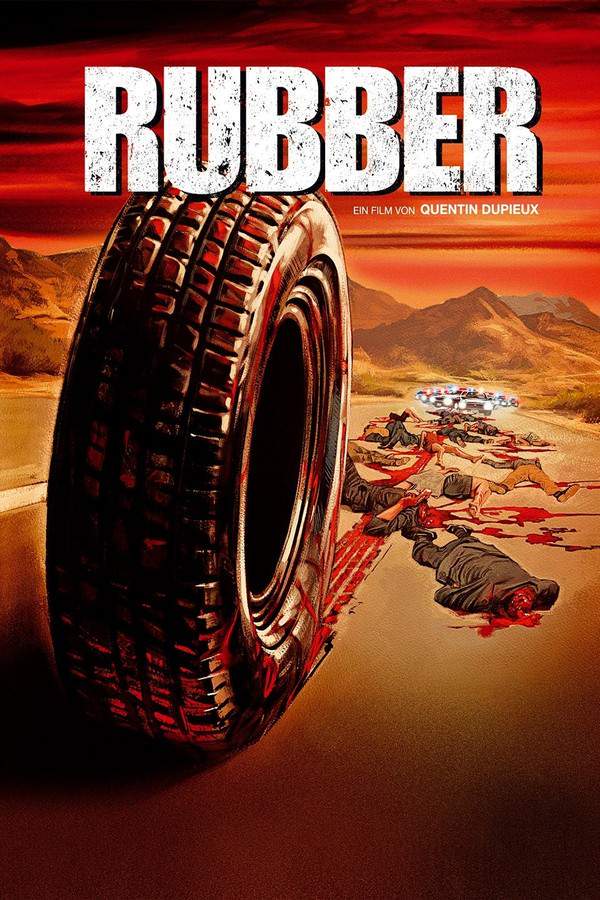
Rubber (2011) movie poster

Timeline

Rubber (2011) Timeline Explained – Every Event in Order

Release, runtime and language
2011 · 85 min · English
Loading streaming availability…
Directed by
Quentin Dupieux

In the desolate desert, a tire mysteriously comes to life and develops a deadly ability to kill anything in its path. Initially targeting small animals and inanimate objects, the sentient tire, named Robert, soon sets his sights on humans. His destructive journey leads him to an enigmatic woman who becomes the focus of his attention. As he rolls through the harsh landscape, Robert leaves a trail of chaos and devastation, becoming an unlikely agent of destruction.

On this page (6)
  1. 1 Where to watch
  2. 2 Events in order (14)
  3. 3 Timeline questions answered
  4. 4 Movie threads
  5. 5 Movies like Rubber
  6. 6 Every angle
Loading streaming availability…

14 events in order · contains spoilers

Rubber Timeline: Events in Chronological Order

Every key event of Rubber (2011) in order, scene by scene, with when and where it takes place. Use it to untangle flashbacks, time jumps and parallel storylines, to refresh your memory before the sequel or to find the exact scene you are thinking of.

  1. An Unexpected Gathering

    In an arid California desert, a group of people gathers to watch a peculiar 'film'. Sheriff Chad points out the randomness of life and cinema, setting the tone for the film which is meant to celebrate the absurdity of existence.

    Where
    California desert
  2. The Awakening of Robert

    In the late 1990s, a tire named Robert inexplicably comes to life in the desert. Initially, it struggles to learn basic movements but soon progresses to crushing objects around it, showcasing its newfound powers.

    When
    Late 1990s
    Where
    California desert
  3. Exerting Power

    After mastering rolling, Robert encounters a series of objects including a plastic water bottle, a scorpion, and an impermeable glass bottle. Ultimately, it uses its telekinetic abilities to shatter the glass bottle, displaying its developing capabilities.

    Where
    California desert
  4. An Attempt at Connection

    Robert encounters a woman driving by and tries to exert his powers on her vehicle. However, his attempts only result in her car stalling momentarily when a truck accidentally runs over him, disrupting the connection.

    Where
    California desert
  5. A Fatal Encounter

    After the truck incident, Robert continues his spree of chaos by exploding a pied crow. He then confronts the truck driver, using his powers to blow up the man's head in a demonstration of his lethal new skills.

    Where
    California desert
  6. The Motel Room Incident

    In a nearby desert town, Robert finds the woman from earlier at a motel. After observing her through an open door, he eventually enters her room, where he is discovered by the motel maid and reacts by killing her.

    Where
    Motel in desert town
  7. Sheriff Investigation

    Sheriff Chad arrives at the motel to investigate the recent murders connected to Robert. His unique role as both narrator and participant adds a surreal layer to the chaotic events unfolding around him.

    Where
    Motel
  8. Failed Poison Plot

    The accountant attempts to end the 'film' early by poisoning the audience with a turkey. However, one audience member in a wheelchair refrains from eating, surviving the plot while chaos unfolds around them.

    Where
    Audience gathering location
  9. The Tire Hunt Begins

    After witnessing Robert's killings, Chad mobilizes the police in pursuit of the rampaging tire. Tensions rise as they hunt for Robert, unaware of the impending chaos that lies ahead.

    Where
    Desert town
  10. Destruction and Regret

    While evading capture, Robert comes across a group burning tires. The film fast-forwards three days, revealing the aftermath of a series of murders attributed to the tire's rampage through the town.

    Where
    Desert town
  11. The Final Confrontation

    Chad attempts to destroy Robert by rigging a mannequin with dynamite, hoping to lure Robert into a fatal trap. However, when Robert complies and explodes the mannequin, the dynamite fails to detonate, leading to Chad’s frustration.

    Where
    Desert town
  12. The Showdown

    In a moment of desperation, Chad decides to confront Robert directly, using a shotgun to kill the tire. He then gives the defeated tire to the surviving man in a wheelchair, setting off a new chain of bizarre events.

    Where
    Desert town
  13. A Surprising Turn

    As the man in a wheelchair receives the tire, a tricycle emerges from the house and unexpectedly kills him. This shocking twist adds to the movie’s surreal nature, shifting focus away from Robert’s chaos.

    Where
    Desert town
  14. The Journey to Hollywood

    As the film culminates, the tricycle rolls down the road, initiating a march of other tires behind it. This surreal procession leads them all the way to Hollywood, closing the bizarre narrative of life and cinema.

    Where
    Road to Hollywood

Last updated: May 12, 2025 at 07:04

Was this helpful?

Timeline questions answered

Rubber Timeline Explained: Your Questions Answered

When does it happen, and why in that order? The questions people ask about the chronology of Rubber (2011): time jumps, flashbacks, cause and effect between scenes and the correct order of events, each answered with spoilers.

Q1

How does Robert the tire kill things?

Robert develops psychokinetic powers that allow him to make objects explode without physical contact. After failing to crush a glass beer bottle through weight alone, Robert vibrates intensely and shatters it. He then uses this ability to make a tin can and rabbit explode, and later blows up a truck driver's head. The power seems to grow stronger as the film progresses.

Foreshadowing: Robert's first display of power occurs when he shatters the glass bottle after struggling to crush it.

  • tire killing
  • exploding objects
  • psychokinesis
  • robert powers
  • telekinesis
Q2

Why does Robert become obsessed with the woman?

Robert first notices Roxane Mesquida driving past him in the desert. Despite his limited ability to affect her car, he becomes fixated on her and later tracks her down to a motel. The film presents this obsession as arbitrary, reflecting the 'no reason' theme that runs throughout the movie. His attraction appears random and unexplained, matching the film's absurd tone.

Foreshadowing: Robert encounters Roxane Mesquida's car early in the film and tries to use his powers on her vehicle.

  • robert obsession
  • roxane mesquida
  • motel woman
  • tire love interest
Q3

What is the purpose of the audience watching the film?

The audience watching the 'film' within the film serves as a meta-commentary on cinema itself. Sheriff Chad explicitly states that many cinematic moments happen for 'no reason,' and this audience represents viewers watching a movie. The accountant provides them binoculars and later tries to poison them with turkey, adding layers of commentary about audience participation and the arbitrariness of narrative choices.

Foreshadowing: Chad introduces the concept of 'no reason' when the audience first gathers, setting up the meta-narrative framework.

  • meta commentary
  • audience
  • fourth wall
  • cinema audience
  • barren desert audience
Q4

What does 'no reason' mean in the film?

The phrase 'no reason' is the film's central philosophical statement about life and cinema. Chad explains that just as things happen in movies without explanation, life itself is often arbitrary and meaningless. The tire coming to life and killing people has no explanation, it simply happens. This theme validates the randomness of the narrative as intentional rather than a plot hole.

Foreshadowing: Chad points out the randomness of cinematic moments early, establishing the thematic framework.

  • no reason
  • absurdity
  • theme
  • meaninglessness
  • arbitrariness
Q5

Why doesn't the dynamite explode when Robert destroys the mannequin?

Chad rigs a mannequin resembling Roxane Mesquida with dynamite to lure and kill Robert. When Robert tears off the mannequin's head in a rage, the dynamite fails to detonate. The film presents this as another instance of 'no reason', the trap simply fails for no explained cause, adding to the absurd, unpredictable tone.

Foreshadowing: Chad specifically rigs the dynamite to explode when the mannequin is destroyed.

  • dynamite fail
  • mannequin trap
  • chad plan
  • explosives failure
Q6

What is the significance of the tricycle at the end?

After Robert is killed, a tricycle emerges from the house and kills the surviving man in the wheelchair. The tricycle then leads other tires down the road toward Hollywood. This ending suggests a cyclical, meaningless continuation of violence, the tire's destruction doesn't end the pattern; it simply transfers to another object. It reinforces the theme that such events can happen to anyone or anything for no reason.

  • tricycle ending
  • hollywood tires
  • cycle of violence
  • ambiguous ending
  • final scene
Q7

Why does the accountant try to poison the audience?

The accountant, who provided binoculars to the audience, attempts to hasten the film's end by serving poisoned turkey dinner. This meta-action represents someone within the story trying to control or end the narrative. The poisoned turkey kills everyone except one man in a wheelchair who refuses to eat, adding another layer of absurd commentary on audience survival and narrative control.

  • accountant poison
  • turkey dinner
  • audience murder
  • film ending attempt
Q8

Why does the man in the wheelchair survive?

The man in the wheelchair is the only audience member who avoids eating the accountant's poisoned turkey. His refusal to eat saves his life, making him the sole survivor of that subplot. Later, Chad gives him the dead tire as a trophy, but the tricycle emerges and kills him anyway, demonstrating that survival in this film is arbitrary and temporary.

Foreshadowing: The accountant specifically offers turkey to all audience members including the wheelchair user.

  • wheelchair man survivor
  • poison turkey
  • audience member
  • sole survivor
Q9

Why does Chad give the dead tire to the man in the wheelchair?

After killing Robert with a shotgun, Chad hands the defeated tire to the surviving man in the wheelchair as if it were a trophy or prize. This act is deliberately bizarre and serves the film's absurdist tone. It sets up the final irony where the 'reward' for surviving leads directly to the man's death when the tricycle emerges.

  • chad gives tire
  • wheelchair trophy
  • dead tire
  • chad sheriff
Q10

Why does Robert kill the truck driver specifically?

After a truck accidentally runs over Robert while he's connected to Roxane Mesquida's car, the tire seeks revenge on the truck driver. Robert uses his psychokinetic powers to blow up the driver's head. This marks an escalation from animals to humans and demonstrates Robert's capacity for deliberate, targeted violence beyond mere self-defense or instinct.

Foreshadowing: The truck disrupts Robert's connection to Roxane Mesquida's car, causing Robert to fly into a rage.

  • truck driver death
  • robert revenge
  • head explosion
  • killing humans
Q11

Why does Robert kill the motel maid?

Robert enters Roxane Mesquida's motel room while she's showering and is discovered by a maid who finds him lying on the floor. In response, Robert kills the maid, adding another murder to his growing list. This killing shows Robert's willingness to eliminate anyone who interrupts or discovers him, regardless of threat level.

  • motel maid death
  • room discovery
  • robert murder
  • killing witness
Q12

What is the significance of the tire bonfire?

Robert encounters a group of people burning tires in the desert and stops to watch. This scene emphasizes the tire's identity and the absurdity of the situation, humans destroying his own kind while he continues his killing spree. The bonfire also allows the narrative to fast-forward three days to show the aftermath of Robert's murders.

  • tire bonfire
  • desert burning
  • robert watching
  • time jump

Movie threads

More Movies Like Rubber, by Mood & Story

Curated lists built around what makes Rubber tick: the same mood, the same kind of story or the same emotional payoff. Each list explains why these movies belong together.

Meta-Horror Satire and Self-Referential Movies like Rubber

Films that deconstruct horror tropes with a clever, self-aware sense of humor. Discover a collection of films that break the fourth wall and cleverly deconstruct genre tropes, similar to the meta-narrative style of Rubber. These movies are perfect for viewers who enjoy self-aware horror-comedies, satirical commentary on cinema, and stories that playfully question the nature of storytelling itself.

  • self-referential
  • satirical
  • meta
  • bizarre
  • quirky
  • deadpan
  • Tone: whimsical, satirical, deadpan
  • Pacing: variable, with deliberate pauses
Why these movies?

The story pattern: Stories in this thread often feature a layered narrative structure, such as a 'film within a film' or characters who comment directly on the action. The plot serves as a vehicle for exploring themes of cinematic convention, audience expectation, and the arbitrariness of narrative, rather than solely focusing on a traditional, high-stakes conflict.

Why they belong together: These movies are grouped together because they share a distinct, self-referential tone that prioritizes witty commentary over straightforward horror. They use absurdity and deadpan humor to undercut tension, creating a shared vibe of intellectual playfulness and a celebration of the bizarre mechanics of storytelling.
Whimsically Absurd and Unpredictable Movies like Rubber

Quirky tales where logic is optional and the journey is delightfully strange. If you enjoyed the quirky, illogical charm of Rubber, you'll love these films that celebrate whimsical absurdity. This list features movies with unpredictable plots, bizarre characters, and a light-hearted embrace of the strange, perfect for fans of unique, vibe-driven storytelling.

  • absurd
  • quirky
  • bizarre
  • unpredictable
  • whimsical
  • surreal
  • Tone: whimsical, quirky, bizarre
  • Pacing: variable, meandering
Why these movies?

The story pattern: The narrative pattern here is less about a tight, causal plot and more about a series of eccentric encounters or events. The protagonist, often an unusual or inanimate object given life, embarks on a journey that feels more like a surreal dream than a traditional story, leading to an ambiguous or cyclical conclusion.

Why they belong together: These films are connected by their shared commitment to a whimsical and absurd mood. They prioritize creating a peculiar, memorable feeling over emotional depth or high stakes, resulting in a viewing experience that is intellectually stimulating, gently humorous, and consistently surprising.

If you liked this

Movies Like Rubber

Similar movies to Rubber: the same genre, themes or kind of story. Each one comes with its own plot summary, timeline and ending explained.

Browse all movie summaries

Every angle

Rubber (2011) Explained: Plot, Timeline & Characters

Everything about Rubber in one place: what happens in the plot summary, the timeline in chronological order, the characters and meaning and a spoiler-free summary. What's After the Movie adds the cast, box office and post-credit scenes.

Coming soon on iOS and Android

The Plot Explained Movie Summary App

Plot summaries, endings explained and timelines on your phone. Catch up on any movie in minutes, save your favorites and never miss a twist again.

Be the first to know when we launch. Your email stays private, always.

Learn more about the app