Plot Explained Spoilers guaranteed!
Plot Explained

Browse by genre

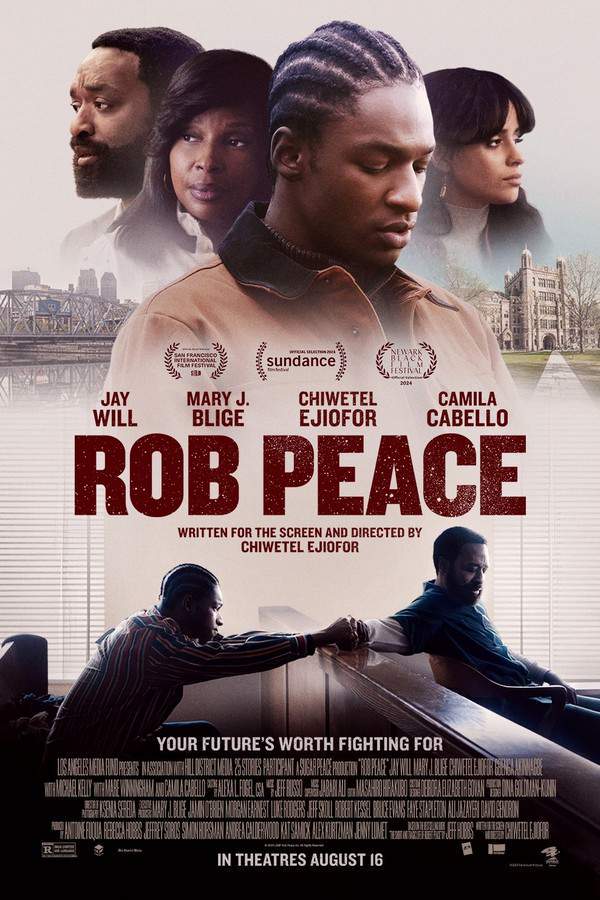
Rob Peace (2024) movie poster

Plot Summary

Rob Peace (2024) Plot Summary & Ending Explained

Release, runtime and language
2024 · 1 h 59 m · English
Echo score 63
JustWatch #4,817 52
Starring
Chiwetel Ejiofor, Gbenga Akinnagbe, Michael Kelly, Mare Winningham, Mary J. Blige, Juan Castano

Jay Will, a young man of exceptional intelligence, struggles to reconcile his father’s difficult history with his own aspirations. Supported by his mother, he confronts the challenges of love, family, and the pursuit of redemption while working to secure his father’s release from prison. This poignant drama explores themes of justice and the enduring power of familial bonds.

On this page (9)
  1. 1 Where to watch
  2. 2 What happens: full plot
  3. 3 Plot questions answered
  4. 4 How it ends
  5. 5 The book behind the movie
  6. 6 Movie threads
  7. 7 Movies like Rob Peace
  8. 8 Categories
  9. 9 Every angle

Where to watch

Where to Watch Rob Peace (2024)

Where can you watch Rob Peace? Stream, rent or buy it in the US, including on Netflix, Netflix Standard and Amazon Video: current JustWatch availability with up-to-date prices.

Streaming availability powered by JustWatch

Full plot summary · contains spoilers

What Happens in Rob Peace: Full Plot Summary

The whole story of Rob Peace (2024) explained, from the opening scene to the final frame: every key event, every twist and what it all adds up to. Read it as a quick recap before the sequel, to check a scene you missed, or to finally understand what really happened.

In 1987, seven-year-old DeShaun Douglas lives with his mother, Jackie, in a predominantly African American neighborhood of East Orange, New Jersey, when his father Skeet Douglas is arrested for the murders of two women. Although Skeet maintains his innocence, a jury convicts him three years later, sentencing him to life in prison. To shield Shaun from the stigma of his father’s crime, Jackie makes a difficult choice and renames him Rob Peace, preserving a nod to his father’s first name while giving him a fresh start.

A gifted student, Rob enters the prestigious St. Benedict’s Preparatory School in nearby Newark in 1994. He excels academically, balancing demanding coursework with chores at home and odd jobs to help his family, all while quietly shouldering the weight of Skeet’s imprisonment. The drive to create a better future for himself—and perhaps to secure Skeet’s exoneration—colors every decision he makes. Then, in 1998, Rob uncovers a legal loophole: a sympathetic judge finds that the delay before Skeet’s trial violated his right to a speedy hearing. Skeet is released, though the victory is short-lived, as the prosecution quickly appeals and the decision is overturned, forcing Skeet back behind bars.

Rob is accepted at Yale University, with St. Benedict’s covering his tuition. There he thrives as a science major, forging friendships across racial lines and navigating the complexities of campus life, including occasional racial tensions. He also continues to conceal the true burden on his shoulders—the ongoing prison status of his father. A breakthrough comes when Professor Durham notices Rob’s talent and invites him to work in the graduate laboratory. She grants him access to the facilities at all hours and eventually offers to back his postgraduate ambitions with a strong recommendation, a rare and meaningful boost for someone from his background.

Meanwhile, Rob’s private life evolves as he opens up to his girlfriend, Naya. She reminds him that his responsibility to his father does not define him, encouraging him to pursue his own path and happiness even as Skeet’s fate remains uncertain. In 2001, Skeet reveals he is dying of brain cancer, a revelation that adds urgency to Rob’s choices. To pay for experimental treatment and legal help, Rob, with the help of his high school friends Curtis Gamble and Tavarus Heston, begins selling marijuana on campus, leveraging equipment from the laboratory to strengthen the product. The venture grows, but Naya rails against Rob’s risky turn, doubting the possibility of Skeet’s innocence while fearing for Rob’s future.

A campus security sweep turns up nothing, and Rob is allowed to graduate, though the administration withdraws the recommendation that could have helped him pursue postgraduate studies. Naya prepares to leave for Rio de Janeiro to work with her mother, signaling a turning point in Rob’s life as he faces the consequences of his choices without the safety net of formal support.

As years pass, Rob confronts Skeet in a hospital visit, asking him directly whether he killed the women. Skeet, deeply hurt by Rob’s doubt, refuses to answer directly, leaving the truth unresolved for the moment. Some time after Skeet’s death, old friends hint that the evidence about the murder weapon was fabricated and that the police pressured witnesses into silence, casting doubt on the case’s integrity and adding layers of moral ambiguity to Rob’s memories of his father.

By 2004, Rob, Curtis, and Tav embark on a project to rejuvenate East Orange by buying, renovating, and selling abandoned houses. The venture flourishes for a time, but the 2008 subprime mortgage crisis hits hard, wiping out debts and dreams alike. Tav is left devastated, his finances in tatters, while Rob devises a secret plan to stay afloat—turning marijuana into a stealthy retail operation to cover debts and keep the family afloat. The web of choices tightens around him, culminating in a violent culmination: one of their dealers betrays them to a gang, and Rob is shot and killed, while Curtis manages to escape.

Through Rob’s education, relationships, and attempts to do right by his family, the story traces a long arc of ambition, resilience, and the heavy costs of both legal and personal battles. The narrative weaves together the weight of a father’s possible innocence, a son’s relentless pursuit of opportunity, and a community shaped by systemic pressures, all culminating in a haunting reminder of how history—even when it’s not fully known—continues to shape lives long after the facts have settled.
Last updated: August 25, 2026 at 00:23

Was this helpful?

Plot questions answered

Rob Peace Plot Explained: Your Questions Answered

The questions people ask most about Rob Peace (2024): what happens in the confusing scenes, why the characters do what they do, the twists, hidden details and what the ending means. Each answer contains spoilers.

Q1

Why did Jackie rename her son from DeShaun to Rob Peace?

Jackie renamed her son to protect him from the social stigma attached to Skeet's murder conviction. By changing his name from DeShaun Douglas to Rob Peace, she gave him a fresh start in a new environment, though the new first name 'Rob' still echoed his father's first name as a quiet acknowledgment of their bond. The name Peace symbolized the stability and protection she wanted for him going forward.

Foreshadowing: The very choice of 'Peace' as a surname hints at the lasting absence of peace that Skeet's imprisonment will bring to the family, even after the name change.

  • jackie
  • deshaun
  • rob peace
  • name change
  • east orange
  • stigma
Q2

How was Skeet Douglas temporarily released from prison?

Rob uncovered a legal loophole in his father's case: a sympathetic judge ruled that the three-year delay between Skeet's 1987 arrest and his 1990 trial violated Skeet's constitutional right to a speedy hearing. The judge ordered Skeet's release, but the prosecution quickly appealed the decision, and an appeals court overturned it, sending Skeet back to prison to serve the remainder of his life sentence.

Foreshadowing: Rob's discovery of the loophole foreshadows his later decision to use his own intelligence and connections to fight for Skeet, even at great personal cost.

  • skeet douglas
  • speedy trial
  • loophole
  • appeal
  • conviction
  • prison release
Q3

Why did Rob hide his father's imprisonment while at Yale?

Rob concealed Skeet's imprisonment to avoid being defined by his father's murder conviction, especially in predominantly white academic and social spaces where racial assumptions and stigma could limit his opportunities. He also wanted to protect what remained of his father's reputation and keep his own path focused on academic and professional advancement.

Foreshadowing: Rob's habit of secrecy about his family is established early at St. Benedict's and becomes the pattern he carries into every new environment.

  • rob peace
  • yale
  • secrecy
  • stigma
  • father
  • prison
Q4

Why did Rob start selling marijuana at Yale?

In 2001, Skeet revealed he was dying of brain cancer, which created an urgent financial need for experimental treatment and continued legal help. To raise the money, Rob, Curtis, and Tavarus began selling marijuana on campus, and Rob used access to the graduate laboratory to strengthen the product. The venture was a direct response to his father's failing health and his inability to secure legitimate funding fast enough.

Foreshadowing: Professor Durham's earlier trust in giving Rob after-hours lab access is the very access he later exploits for the drug operation.

  • rob peace
  • marijuana
  • yale
  • drug dealing
  • brain cancer
  • curtis
  • tavarus
Q5

Why did Professor Durham withdraw her recommendation for Rob?

Although no drugs were found during the campus security sweep, Yale's administration grew wary of Rob and pushed him toward graduation rather than postgraduate study. Professor Durham honored the institution's position and pulled back the recommendation she had previously offered, which stripped Rob of the formal academic pathway he had been counting on. The decision was tied to institutional risk rather than a direct accusation against Rob personally.

Foreshadowing: Durham's gradual withdrawal mirrors the slow erosion of every support system Rob tries to build.

  • professor durham
  • yale
  • recommendation
  • postgraduate
  • graduation
  • administration
Q6

Why did Rob confront Skeet about the murders in the hospital?

After years of carrying the weight of Skeet's case and risking everything to prove his innocence, Rob needed the truth to make sense of his sacrifices. Directly asking Skeet whether he killed the two women was Rob's attempt to resolve the ambiguity that had shaped his entire life. Skeet, hurt by his son's doubt, refused to answer, leaving the question open and deepening Rob's inner conflict.

Foreshadowing: Naya's earlier suggestion that Rob's loyalty may be misplaced plants the seed of doubt that surfaces during the hospital visit.

  • rob peace
  • skeet
  • hospital
  • confrontation
  • murder
  • innocence
  • doubt
Q7

Was there evidence that Skeet was actually innocent?

After Skeet's death, old acquaintances hinted to Rob that the evidence around the murder weapon had been fabricated and that police had pressured witnesses into silence or false statements. These suggestions cast serious doubt on the integrity of the original 1990 conviction, but no formal exoneration is ever shown in the film. The story deliberately leaves Skeet's guilt unresolved, framing the ambiguity itself as a source of trauma for Rob.

Foreshadowing: The 1998 speedy-trial victory, which hinged on procedural error, foreshadows the deeper possibility that the case against Skeet was flawed in substance, not just process.

  • skeet douglas
  • innocence
  • murder weapon
  • fabricated evidence
  • witness pressure
  • conviction
Q8

Why did the East Orange housing venture collapse?

Rob, Curtis, and Tavarus had been buying, renovating, and reselling abandoned homes in East Orange to revitalize the community, and the project was succeeding through 2004. The 2008 subprime mortgage crisis caused banks to call in their loans and wiped out the equity they had built, devastating Tavarus financially and leaving the partners with heavy debt. The collapse exposed how vulnerable their reinvestment strategy was to forces outside their control.

Foreshadowing: The project relied on continuous credit access, an early sign of how exposed the partners were to the broader financial system.

  • east orange
  • real estate
  • subprime mortgage crisis
  • housing
  • rob peace
  • curtis
  • tavarus
Q9

How was Rob Peace killed?

After the housing venture collapsed, Rob secretly restarted a marijuana retail operation to cover the remaining debts. One of their dealers was pressured by a rival gang and betrayed the location of the operation. The gang tracked Rob down, and Rob was shot and killed, while Curtis narrowly managed to escape. His death closes the arc of a life spent trying to lift his family out of one crisis only to be pulled into another.

Foreshadowing: Naya's earlier warning that Rob's choices were putting his future at risk directly anticipates the danger that ultimately claims him.

  • rob peace
  • death
  • shooting
  • gang
  • drug dealing
  • betrayal
  • curtis
Q10

Why did Rob go back to selling drugs after the housing crash?

The 2008 subprime mortgage crisis wiped out the housing venture and left Rob, Curtis, and Tavarus deep in debt, with Tavarus particularly devastated. To cover the financial damage and keep his family afloat, Rob turned the marijuana distribution network back into a retail operation, this time secretly and under pressure from rival gangs. It was a desperate attempt to buy time, not a return to the earlier campus-era hustle.

Foreshadowing: Rob's earlier success at Yale selling marijuana foreshadowed his ability to restart the operation quickly when he needed it most.

  • rob peace
  • mortgage crisis
  • debt
  • drug dealing
  • east orange
  • tavarus
  • curtis
Q11

Why did Naya doubt Skeet's innocence?

Naya watched Rob sacrifice his academic future, his safety, and their relationship to support a man convicted of double murder, and she could not reconcile that devotion with the possibility of guilt. She feared Rob was building his entire identity around a potentially false premise and wanted him to pursue his own life rather than his father's freedom. Her doubt was not cruelty but a refusal to let Rob disappear into someone else's war.

Foreshadowing: Naya's reluctance to embrace Rob's mission foreshadows the growing emotional distance that leads her to plan a move to Rio de Janeiro.

  • naya
  • skeet
  • innocence
  • rob peace
  • doubt
  • relationship
  • rio de janeiro
Q12

Why was St. Benedict's Preparatory School so important to Rob?

St. Benedict's in Newark gave Rob a rigorous academic environment that recognized his talent and protected him from the limited expectations of his neighborhood. The school also covered his Yale tuition later, making higher education financially possible. Beyond academics, it was the first institution that treated Rob as a future scholar rather than a stereotype, setting the trajectory for everything that followed.

Foreshadowing: The scholarship promise made by St. Benedict's is what later enables Rob to reach Yale, where the central conflicts of his adult life unfold.

  • st benedicts prep
  • newark
  • scholarship
  • yale
  • rob peace
  • education
Q13

What does the ending of Rob Peace imply about the justice system?

Rob's death, combined with the unresolved question of Skeet's guilt and the hints of fabricated evidence, frames the story as a critique of how the justice system and the drug trade disproportionately destroy young Black men, even those of exceptional talent. The film suggests that brilliance, discipline, and good intentions are not enough to escape the structural pressures of race, class, and incarceration. The bleak ending is meant to leave viewers unsettled rather than comforted, asking what could have changed the outcome.

Foreshadowing: The renaming of DeShaun to Rob Peace at the start is the first signal that a 'fresh start' is an illusion the film is preparing to challenge.

  • rob peace
  • ending explained
  • justice system
  • race
  • class
  • systemic pressure
  • tragedy

Ending explained

What Happens at the End of Rob Peace?

How Rob Peace (2024) ends, in short: the final scene, the last twist and what it means for the characters. The full ending explained, with every spoiler, lives on its own page.

Read the full ending explained

Rob Peace’s story is a tragic reflection of a talented young man caught in a system that continually works against him. Despite his incredible intellect, Rob's journey is marred by circumstances beyond his control. As he struggles to navigate the complexities of his community, family, and dreams, he ultimately finds himself trapped in a cycle of violence and despair. His efforts to do good—through creating affordable housing and pursuing education—are overshadowed by the harsh realities of economic collapse and systemic oppression. When Rob falls back into the world of crime to provide for his loved ones, he is ultimately betrayed by the violence and gangs that dominate his neighborhood. Tragically, Rob is shot and killed just as he is planning to move toward a better future, with dreams of reuniting with Naya and furthering his education. His death is a heartbreaking reminder of how the systemic barriers faced by Black communities can snuff out brilliance and hope before they have a chance to flourish. In the end, Rob’s memory is honored by his community, with his picture displayed as an inspiration for others to break free from the cycle of despair and aim for brighter futures. His life, full of promise and struggle, underscores the brutal reality that even the most gifted individuals can be victims of a broken system that never truly values them.

Rob Peace ending explained in full

Movie threads

More Movies Like Rob Peace, by Mood & Story

Curated lists built around what makes Rob Peace tick: the same mood, the same kind of story or the same emotional payoff. Each list explains why these movies belong together.

Systemic injustice dramas like Rob Peace

Biographical stories of individuals battling forces far larger than themselves. Explore biographical dramas with a steady pace, heavy emotional weight, and bittersweet or bleak endings, where real-life figures confront wrongful conviction, racial injustice, and systemic pressure. Movies like Rob Peace in this thread offer poignant, character-driven portraits of ambition colliding with an unforgiving world.

  • haunting
  • determined
  • somber
  • resilient
  • reflective
  • oppressive
  • Tone: bittersweet, somber, reflective
  • Pacing: steady, chronological, deliberate
Why these movies?

The story pattern: Films in this thread typically follow a real or real-inspired protagonist whose intelligence, ambition, and moral compass place them at odds with institutions that were never designed to protect them. The narrative moves chronologically through formative stages, building up small victories (education, career milestones, community impact) while the shadow of an unjust system looms. The central question often remains unresolved: guilt or innocence, accountability or systemic cruelty. The ending rarely delivers clean triumph, instead leaving the audience with ambiguity, loss, or a haunting sense that the protagonist's effort mattered even if the outcome did not.

Why they belong together: These films are grouped together because they share a consistent emotional architecture: a determined central figure, a steady and accessible pace, deeply felt personal stakes, and an unflinching look at how race, class, and the justice system shape individual destinies. They tend to be heavy, somber, and reflective rather than sensational, using biographical detail to humanize systemic critique.

Family burden and loss stories like Rob Peace

Stories where love and inherited trauma pull a life in opposite directions. Discover movies like Rob Peace that explore father-son relationships strained by imprisonment, wrongful conviction, or inherited trauma. These bittersweet and often bleak dramas follow characters whose drive to save a parent or heal a family becomes the defining arc of their lives, with emotional weight that stays with you long after the credits.

  • melancholic
  • haunting
  • tragic
  • resilient
  • reflective
  • somber
  • Tone: melancholic, bittersweet, tragic
  • Pacing: steady, character driven, intimate
Why these movies?

The story pattern: Films in this thread trace a protagonist whose identity is shaped by a parent's incarceration, mistake, or absence. The story follows their attempt to reconcile love for family with the public and private shame of that legacy, often pulling them into morally ambiguous choices (drug dealing, financial risk, quiet compromise) in order to keep a family afloat. Redemption is pursued but rarely fully achieved, and endings tend toward tragedy, unresolved grief, or a somber acceptance that some wounds do not close. The structure is intimate and character-focused, with the parent often remaining absent or unreachable, which keeps the emotional tension alive throughout.

Why they belong together: These films share a distinctive emotional throughline: a young or developing protagonist whose brilliance and ambition are continually redirected by the gravitational pull of family trauma. They tend to mix tenderness with grief, hope with resignation, and pair steady character-driven pacing with heavy emotional weight. The unresolved or bleak endings are a defining feature, not an afterthought.

If you liked this

Movies Like Rob Peace

Similar movies to Rob Peace: the same genre, themes or kind of story. Each one comes with its own plot summary, timeline and ending explained.

Browse all movie summaries

Categories

Movie Lists Featuring Rob Peace

Rob Peace appears in these hand-built movie categories. Each one groups movies by a specific mood, theme or story type, with their plot summaries and endings explained.

View all movie categories

Every angle

Rob Peace (2024) Explained: Plot, Ending, Timeline & Characters

Everything about Rob Peace in one place: what happens in the plot summary, the timeline in chronological order, the characters and meaning, the ending explained and a spoiler-free summary. What's After the Movie adds the cast, box office and post-credit scenes.

Coming soon on iOS and Android

The Plot Explained Movie Summary App

Plot summaries, endings explained and timelines on your phone. Catch up on any movie in minutes, save your favorites and never miss a twist again.

Be the first to know when we launch. Your email stays private, always.

Learn more about the app