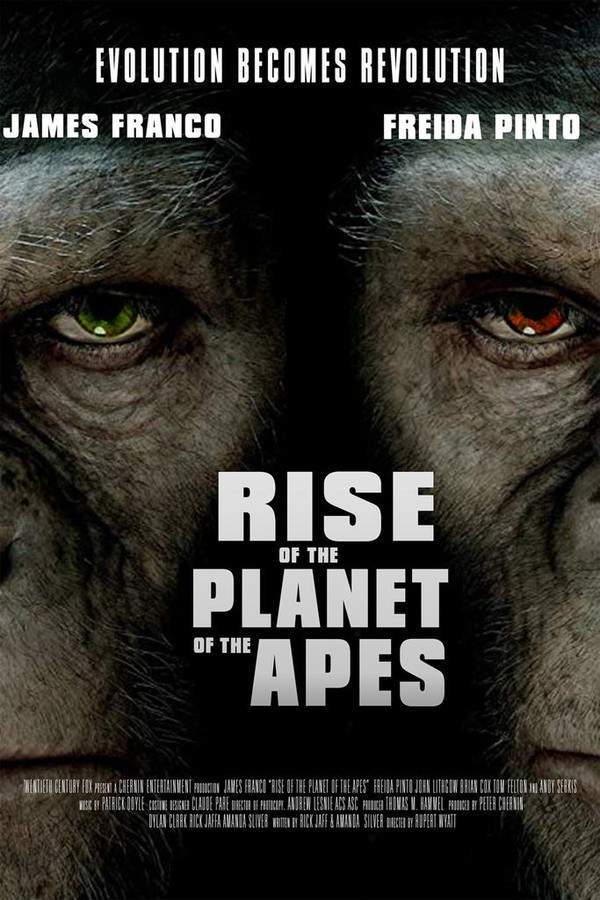
Rise of the Planet of the Apes

Rise of the Planet of the Apes

JustWatch#5,05521

Year: 2011

Runtime: 110 min

Language: English

Director: Rupert Wyatt

Budget: $93M

ActionAdventureSci-Fi

Driven by a desire to cure his father’s Alzheimer’s, biologist Will Rodman develops a promising experimental drug. Unexpectedly, the serum grants extraordinary intelligence to a chimpanzee named Caesar. As Caesar grows, his intellect and strength increase, leading him to question his place in the world and the treatment he receives. This sets in motion a series of events that challenge humanity's control and explore themes of freedom, prejudice, and the future of coexistence.

Where to Watch Rise of the Planet of the Apes?

Find where to stream, rent, or buy Rise of the Planet of the Apes (2011) in the US with current JustWatch availability, up-to-date pricing, and platform listings for subscription, rental, and digital purchase options.

Warning: spoilers below!

Haven’t seen Rise of the Planet of the Apes yet? This summary contains major spoilers. Bookmark the page, watch the movie, and come back for the full breakdown. If you're ready, scroll on and relive the story!

Rise of the Planet of the Apes (2011) – Full Plot Summary & Ending Explained

Read the complete plot breakdown of Rise of the Planet of the Apes (2011), including all key story events, major twists, and the ending explained in detail. Discover what really happened, and what it all means.

In the vibrant city of San Francisco, pharmaceutical chemist Will Rodman embarks on a groundbreaking mission at Gen-Sys, a state-of-the-art biotechnology firm, to find a cure for Alzheimer’s disease. The heart of his research revolves around ALZ-112, an innovative viral-based drug showing immense promise in enhancing intelligence. The experiment takes an extraordinary turn when administered to a female chimpanzee named Bright Eyes, resulting in a significant increase in her cognitive capabilities. Yet, tragedy looms as the now-intelligent Bright Eyes breaks free from her cage, causing chaos before her unfortunate end. This incident prompts Will’s superior, Steven Jacobs, to shut down the project, leading to the euthanization of the other chimpanzees. However, in the midst of this calamity, Will and his assistant Robert Franklin discover an astonishing fact: Bright Eyes had given birth to a baby male chimpanzee, which sets off a chain of events that will change everything.

Over time, Will decides to adopt this orphaned chimp, naming him Caesar. He dedicates himself to studying Caesar, and within three years, Caesar emerges as a highly intelligent creature capable of communicating through sign language. During this period, Will’s personal life also flourishes as he develops a romantic bond with primatologist Caroline Aranha. The trio embarks on a memorable trip to the breathtaking Muir Woods National Monument, allowing Caesar to explore freely amidst the towering redwoods.

In a heartfelt moment, Will chooses to treat his father, Charles, with ALZ-112 in hopes of restoring his cognitive function. Although the treatment initially seems successful, its effects soon diminish as Charles’ Alzheimer’s progresses, rendering him resistant to the drug’s benefits.

Fast forward five years, and Caesar has transformed into a formidable adult. He begins to grapple with the realities of his existence and the circumstances of his creation as Will shares his origins with him. Meanwhile, Charles’ condition deteriorates, endangering his memories and sense of self.

A critical incident unfolds when the increasingly confused Charles is confronted by an aggressive neighbor, Douglas Hunsiker. In a moment of protective instinct, Caesar intervenes, leading to a confrontation that lands him in an ape shelter after injuring Hunsiker. Here, Caesar meets Maurice, a former circus orangutan who can also communicate in sign language, and together they begin to forge relationships within this new setting.

As Caesar adapts, he gains allies like Buck, a courageous gorilla, and eventually claims leadership among the apes. However, tension escalates when Will uncovers Jacobs’ plans to create an even more powerful version of ALZ-112, referred to as ALZ-113. The urgency of the situation grows when Charles’ health worsens and Franklin accidentally suffers the dire consequences of exposure to ALZ-113.

In a moment of clarity and resolve, Will resigns from Gen-Sys, refusing to be part of what he predicts will be a disastrous series of tests. As Caesar looks ahead, his determination for freedom and self-discovery intensifies. The stage is set for a dramatic clash between the intelligent apes and the forces that seek to dominate them.

As events spiral out of control, the lifeless body of Franklin is ominously found at Will’s doorstep, signaling the impending chaos. Caesar, portrayed by Andy Serkis, stands firm in his newfound strength. The once-submissive chimp now takes charge of his fate, stealing ALZ-113 canisters from Will’s home. With his enhanced intellect, Caesar empowers his fellow apes, igniting a surge toward liberation.

As the apes navigate the urban terrain, they orchestrate the escape of Koba and their counterparts held captive, including those in the San Francisco Zoo. This unshackling of intelligent primates sends the city into upheaval, leading to a stunning showdown on the Golden Gate Bridge. In a noble act of bravery, Buck sacrifices himself to disable a police helicopter, while Koba pushes another chopper, with Jacobs inside, into the depths of the San Francisco Bay.

Amidst the resolution found in the redwood forest, Will desperately tries to convince Caesar to forsake his independence and return to the familiarity of home. However, the point of no return has been reached. The apes have awakened to their true existence, marking a new chapter in their journey. In a tender moment, Caesar embraces Will, affirming that he has discovered his true home within the towering trees.

As the narrative unfolds dramatically, Hunsiker, now infected with the lethal ALZ-113 virus, unknowingly sets off on a plane from San Francisco International Airport, with the potential to unleash a global pandemic. Humanity is faced with the dire repercussions of their own arrogance as they confront the evolution of intelligence within the ape kingdom.

Last updated: November 21, 2024 at 11:30

Was this helpful?

Rise of the Planet of the Apes (2011) Plot Questions Answered – Summary FAQ

Explore frequently asked questions about Rise of the Planet of the Apes (2011) with spoiler-rich answers covering the full plot summary, major story beats, character motivations, hidden details, and ending meaning. This movie summary FAQ helps explain confusing scenes, plot twists, and narrative decisions in clear, searchable detail.

Q1

Why did Bright Eyes attack after receiving ALZ-112?

A.

Bright Eyes attacked because the ALZ-112 dramatically increased her cognitive abilities, but she was still kept in a cage. The sudden surge of intelligence combined with confinement caused her to panic and lash out. She wasn't malicious, she was overwhelmed and frightened by her new awareness and inability to escape.

The film hints at her enhanced intelligence when she demonstrates unusual alertness before the attack.

bright eyesalz-112chimp attackintelligence serum
Q2

Why did Will decide to adopt Caesar?

A.

Will adopted Caesar because he felt responsible for the chimp's existence, Bright Eyes was part of his research, and she died during the chaos. Additionally, Caesar was the offspring of the first successfully enhanced chimp, making him invaluable to Will's research and personal connection to the project.

Will's discovery of Caesar during the chaos establishes his emotional investment from the start.

will rodmancaesar adoptionresearchresponsibility
Q3

Why did ALZ-112 work on Bright Eyes but not on Will's father?

A.

ALZ-112 worked on Bright Eyes because she was a young, healthy chimpanzee whose brain could readily adapt to the viral vector's effects. Will's father Charles had advanced Alzheimer's, his brain had already suffered significant damage. The drug initially improved his condition but couldn't reverse the extensive neural degeneration already present.

The film shows Charles responding initially, suggesting the drug works on undamaged neural tissue.

alz-112alzheimer's treatmentcharlesbrain function
Q4

Why did Caesar attack Douglas Hunsiker?

A.

Caesar attacked Hunsiker because he was protecting his grandfather Charles, who was confused and vulnerable. Hunsiker was aggressively confronting the disoriented Charles in the driveway. Caesar's protective instinct override his usual restraint, leading to the violent confrontation that resulted in Caesar being sent to the ape shelter.

Earlier scenes show Caesar's deep bond with Charles and his growing awareness of protecting his family.

caesardouglas hunsikerattackprotectionape shelter
Q5

Why did Will quit his job at Gen-Sys?

A.

Will resigned because he discovered Steven Jacobs was planning to create ALZ-113, a more powerful and dangerous version of the intelligence drug. After witnessing Franklin's fatal exposure to ALZ-113, Will realized the company would proceed with human trials regardless of the consequences, and he refused to be complicit in what he knew would be disastrous.

Franklin's exposure to ALZ-113 and subsequent death directly triggers Will's decision to leave.

will resignsgen-sysstevan jacobsalz-113franklin death
Q6

How did Robert Franklin die?

A.

Franklin died from exposure to ALZ-113, the more potent successor to ALZ-112. During his work at Gen-Sys, Franklin accidentally came into contact with the aerosolized form of the new serum. The stronger drug caused rapid neurological deterioration, leading to his death, his body was later found at Will's doorstep as a grim warning.

The film builds tension around ALZ-113's dangers before Franklin's exposure scene.

robert franklinalz-113deathexposuregen-sys
Q7

Why did Caesar decide to free the other captive apes?

A.

Caesar freed the other apes after learning about Jacobs' plan to create ALZ-113 and after witnessing the brutal treatment of apes in the shelter and zoo. He realized that more intelligent apes would inevitably be created and subjected to the same exploitation. By freeing them, he gave them a chance at freedom before humans could capture them again.

Caesar's experiences in the ape shelter, particularly seeing Koba in captivity, harden his resolve for rebellion.

caesarape liberationkobazoo escaperebellion
Q8

Why did Buck sacrifice himself on the Golden Gate Bridge?

A.

Earlier scenes show Buck's bravery and loyalty to Caesar as he becomes one of his fiercest protectors.

buckgolden gate bridgesacrificehelicopterape battle
Q9

Why did Caesar choose the redwoods instead of returning to Will?

A.

Caesar chose the redwoods because he realized his true home was with his own kind, living freely in nature. While he loved Will, Caesar understood that staying with humans would mean living in captivity again. The redwoods represented freedom and a new beginning for all intelligent apes, he couldn't turn his back on his species now that they had awakened.

The Muir Woods trip early in the film plants the idea of the redwoods as Caesar's ideal home.

caesarredwoodsfreedomhomewillchoice
Q10

Why is Douglas Hunsiker leaving on a plane important at the end?

A.

Hunsiker was infected with the lethal ALZ-113 virus. His plane departure from San Francisco International Airport means he could spread the virus globally, starting a pandemic. The film ends with humanity facing the consequence of its own creation, the same intelligence-enhancing virus that gave apes freedom may now kill billions of humans.

Franklin's death from ALZ-113 establishes the virus's lethality to humans before Hunsiker's exposure.

hunsikerplanealz-113 viruspandemicendingglobal threat
Q11

Why did Koba push the helicopter with Jacobs inside?

A.

Koba pushed the helicopter into the bay because he recognized Jacobs as the man responsible for the cruel experiments that harmed him and other apes. Unlike Caesar, who showed mercy, Koba harbored deep hatred toward the humans who tortured him. His act of vengeance killed Jacobs, demonstrating the darker side of the ape uprising.

Earlier scenes show Koba's scarred body and trauma from captivity, fueling his desire for revenge.

kobajacobshelicopterrevengeviolenceape uprising
Q12

Why was Caesar sent to an ape shelter instead of being put down?

A.

Caesar was sent to the ape shelter because his case was considered a special situation, authorities recognized he was unusually intelligent and could communicate through sign language. The shelter was a more controlled environment to study and contain him rather than simply euthanize him, which aligned with Gen-Sys's interests in continuing to observe his development.

Will's connection to Caesar and his research value protected him from immediate euthanasia.

caesarape sheltercaptivityprisoncontainment
Q13

How did Caesar become the leader of the apes?

A.

Caesar became leader through a combination of his superior intelligence, communication ability, and demonstrated courage. He earned respect by standing up to the shelter's abusive keeper, protecting other apes like Maurice and Buck, and organizing their collective escape. His intelligence allowed him to strategize, while his willingness to risk himself for others solidified his status as the apes' leader.

His early ability to communicate through sign language and his protective actions toward other apes established his leadership potential.

caesarleadermauricebuckape shelterleadershipescape
Mobile App Preview

Coming soon on iOS and Android

The Plot Explained Mobile App

From blockbusters to hidden gems - dive into movie stories anytime, anywhere. Save your favorites, discover plots faster, and never miss a twist again.

Sign up to be the first to know when we launch. Your email stays private, always.

Explore Movie Threads

Discover curated groups of movies connected by mood, themes, and story style. Browse collections built around emotion, atmosphere, and narrative focus to easily find films that match what you feel like watching right now.

Movies with Intelligent Rebellions Like Rise of the Planet of the Apes

Stories where a new consciousness rises to challenge its masters for freedom.If you enjoyed the ape uprising in Rise of the Planet of the Apes, explore more movies where oppressed groups or artificially intelligent beings fight for their freedom. These sci-fi and action stories feature tense conflicts, themes of prejudice, and thought-provoking challenges to authority.

rebellioustenseurgentthought-provokingoppressivetragichopeful

Narrative Summary

This thread follows a pattern where a subjugated group—be it robots, animals, or a marginalized people—develops the capacity to resist. The story builds from a state of oppression to a climactic struggle for autonomy, exploring the costs of freedom and the blurred lines between right and wrong.

Why These Movies?

Movies are grouped here for their shared focus on a rebellion born from intelligence, not just brute force. They share a dark, urgent tone, high-stakes action, and a deep exploration of themes like freedom, prejudice, and the consequences of playing god.

Bittersweet Sci-Fi Stories About Consequences Like Rise of the Planet of the Apes

Groundbreaking scientific ambition leads to profound and costly unintended outcomes.For viewers who liked the ethical dilemmas in Rise of the Planet of the Apes, this list features movies where scientific hubris has bittersweet outcomes. These stories blend heavy emotional weight with speculative science, exploring the cost of playing god and the ambiguous line between triumph and tragedy.

sombertragicthought-provokingurgenthopefulbittersweetethically complex

Narrative Summary

The narrative pattern centers on a scientific breakthrough, often driven by personal motives like curing a disease, which sets off an irreversible chain of events. The protagonist achieves their goal, but at a great cost, leaving the world permanently changed in a way that is both hopeful and somber.

Why These Movies?

These movies are united by their exploration of the 'Pandora's Box' trope in science fiction. They share a dark tone, heavy emotional weight, a variable pacing that builds tension, and a conclusive ending that feels bittersweet—a mix of success and sobering loss.

Unlock the Full Story of Rise of the Planet of the Apes

Don't stop at just watching - explore Rise of the Planet of the Apes in full detail. From the complete plot summary and scene-by-scene timeline to character breakdowns, thematic analysis, and a deep dive into the ending - every page helps you truly understand what Rise of the Planet of the Apes is all about. Plus, discover what's next after the movie.

Rise of the Planet of the Apes Timeline

Track the full timeline of Rise of the Planet of the Apes with every major event arranged chronologically. Perfect for decoding non-linear storytelling, flashbacks, or parallel narratives with a clear scene-by-scene breakdown.

Rise of the Planet of the Apes Timeline

Characters, Settings & Themes in Rise of the Planet of the Apes

Discover the characters, locations, and core themes that shape Rise of the Planet of the Apes. Get insights into symbolic elements, setting significance, and deeper narrative meaning - ideal for thematic analysis and movie breakdowns.

Characters, Settings & Themes in Rise of the Planet of the Apes

Rise of the Planet of the Apes Spoiler-Free Summary

Get a quick, spoiler-free overview of Rise of the Planet of the Apes that covers the main plot points and key details without revealing any major twists or spoilers. Perfect for those who want to know what to expect before diving in.

Rise of the Planet of the Apes Spoiler-Free Summary

More About Rise of the Planet of the Apes

Visit What's After the Movie to explore more about Rise of the Planet of the Apes: box office results, cast and crew info, production details, post-credit scenes, and external links - all in one place for movie fans and researchers.

More About Rise of the Planet of the Apes