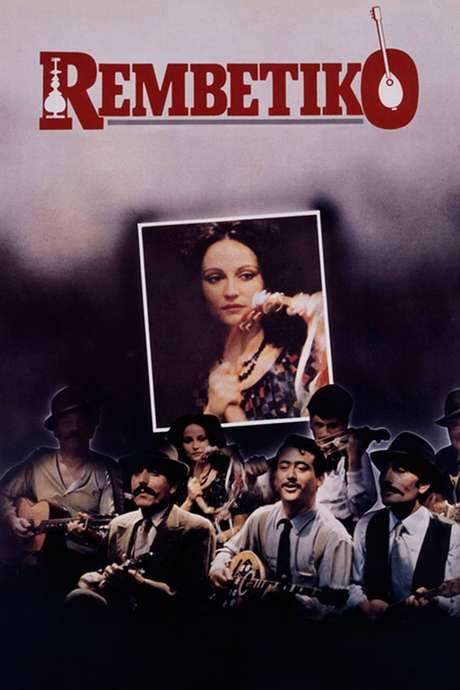
Year: 1983
Runtime: 110 mins
Language: Greek
Set in the early decades of the 20th century, the film portrays a community of Rembetes—Greek singers and musicians whose folk style is the country's counterpart to the blues. Their lives and music are observed through the eyes of a young female vocalist, who serves as the story’s narrator and guide.
Warning: spoilers below!
Haven’t seen Rembetiko yet? This summary contains major spoilers. Bookmark the page, watch the movie, and come back for the full breakdown. If you're ready, scroll on and relive the story!
Trace every key event in Rembetiko (1983) with our detailed, chronological timeline. Perfect for unpacking nonlinear stories, spotting hidden connections, and understanding how each scene builds toward the film’s climax. Whether you're revisiting or decoding for the first time, this timeline gives you the full picture.
Last updated: October 09, 2025 at 14:28
Find frequently asked questions about the Rembetiko (1983) timeline, including chronological order, nonlinear jumps, cause-and-effect links, and scene sequence clarifications. This timeline FAQ helps explain when key events happen, how moments connect, and why the story unfolds in that specific order.
Marika was deported from Smyrna around 1924 when she was about seven years old, as part of the large-scale population exchange between Greece and Turkey following the Greco-Turkish War. The city and region had become destabilized, and thousands of Greeks were forced to leave their ancestral homeland. This displacement would later shape her artistic sensibility and the emotional weight of her music.
During the 1930s, Marika's father killed her mother in a violent domestic incident. The film presents this as a traumatic turning point that shatters Marika's family and forces her to navigate danger at a young age. This tragedy plants the seeds of resilience that would later inform her career as a performer who transformed personal pain into music.
Rosa was a rival singer at the club where Marika performed. She died by suicide following a performance, and this tragedy reverberated through the venue. The incident became a catalyst for Marika's rising fame, as the public's mourning of Rosa created an opening for Marika to gain attention and momentum in the music scene.
Yorgos, Marika's childhood friend and performance partner, was exiled for political reasons that extended beyond the confines of the nightclub world. His departure forced Marika and Babis to leave their original venue and move to other clubs, continuing their musical journey without him.
Although Marika harbored strong romantic feelings for Babis, their relationship remained strained throughout the decades. Their bond was tested by time, war, and shifting loyalties as Greece endured upheaval before and after World War II. Despite their deep professional partnership, personal harmony between them remained elusive, complicated by circumstance and the demands of their careers.
During the World War II era, Marika made the difficult decision to send her daughter to a convent school, hoping to provide her with safety or a better future amid the chaos of war and personal turmoil. The decision reflects the desperate measures artists took to protect their families during Greece's turbulent wartime period.
Matina was a younger singer who rose to prominence after World War II, capturing both Babis's attention and a significant share of the spotlight. When Marika returned to Greece from America, she found herself unexpectedly supplanted by this new rival. Matina's emergence signaled a changing landscape in Greek popular music and forced Marika to confront questions of aging, relevance, and the passing of an era.
On the night of her planned reunion concert, Marika was stabbed in the stomach and died from her wounds. The film presents this as a tragic and ceremonial ending to her life. The specific identity of her killer and the motive are not extensively detailed in the summary, but the violent death marks a devastating conclusion to a career spent turning personal pain into song.
Rembetiko is a Greek folk music style that emerged in the early 20th century, often described as Greece's counterpart to the blues. It originated among displaced populations and urban poor, expressing themes of poverty, exile, love, and hardship. The film follows performers who embody this musical tradition, with Marika's career serving as a window into the cultural significance of rembetiko throughout Greece's turbulent decades.
Marika embarked on a tour of America during the World War II era, an outward journey that represented both professional opportunity and escape from the conflict consuming Greece. The American tour marked a significant chapter in her career, though it came with intimate costs borne at home, including separation from her daughter and the life she left behind.
Scholars debate whether the film is loosely based on the life of Marika Ninou, a celebrated Greek singer, with Babis possibly representing Vasilis Tsitsanis in a composite portrait rather than a strict biographical account. The film makes deliberate departures from documented history, particularly in events after World War II and the dynamics of who accompanied Ninou on her American journey. The narrative prioritizes emotional and artistic beats over literal chronology.
Discover curated groups of movies connected by mood, themes, and story style. Browse collections built around emotion, atmosphere, and narrative focus to easily find films that match what you feel like watching right now.
Epic, soulful films tracing the painful lives of musicians and artists.For viewers who appreciated the soulful tragedy of Rembetiko, this list features movies like it that explore the painful, passionate lives of musicians and artists. These similar biographical dramas use art as a lens for grief, loss, and resilience against a backdrop of historical upheaval.
Stories in this thread typically span decades, following an artist's rise against a harsh world, with their talent providing both escape and further suffering. The arc is often a downward spiral or a bittersweet legacy, where artistic triumph is shadowed by profound personal loss.
Movies are grouped here for their shared focus on the artist's life as a source of both beauty and despair, a consistently melancholic tone, and a narrative structure that uses art to process trauma and historical change.
Sweeping stories where personal tragedy is entwined with political upheaval.If you liked Rembetiko's portrayal of personal grief amidst political chaos, explore these similar movies. This collection features sweeping historical dramas where characters grapple with displacement, loss, and survival, mirroring the heavy, melancholic feel of Rembetiko's decades-spanning narrative.
The narrative pattern follows characters across a significant period of history, using their personal struggles—displacement, loss of loved ones, cultural erosion—to illuminate larger political events. The journey is one of endurance rather than victory, marked by a steady accumulation of sorrow.
These films share a high emotional weight, a melancholic tone, and a core theme of how political upheaval irrevocably scars individual lives. They are united by a steady pacing that allows for a deep, immersive, and ultimately heartbreaking experience.
Don't stop at just watching - explore Rembetiko in full detail. From the complete plot summary and scene-by-scene timeline to character breakdowns, thematic analysis, and a deep dive into the ending - every page helps you truly understand what Rembetiko is all about. Plus, discover what's next after the movie.
Read a complete plot summary of Rembetiko, including all key story points, character arcs, and turning points. This in-depth recap is ideal for understanding the narrative structure or reviewing what happened in the movie.
Discover the characters, locations, and core themes that shape Rembetiko. Get insights into symbolic elements, setting significance, and deeper narrative meaning - ideal for thematic analysis and movie breakdowns.
Discover movies like Rembetiko that share similar genres, themes, and storytelling elements. Whether you’re drawn to the atmosphere, character arcs, or plot structure, these curated recommendations will help you explore more films you’ll love.
Rembetiko (1983) Plot Summary & Movie Recap
Rembetiko (1983) Scene-by-Scene Movie Timeline
Rembetiko (1983) Spoiler-Free Summary & Key Flow
Movies Like Rembetiko – Similar Titles You’ll Enjoy
Music (2024) Ending Explained & Film Insights
The Weeping Meadow (2004) Ending Explained & Film Insights
Melodrama? (1980) Detailed Story Recap
Parangelia! (1980) Movie Recap & Themes
Remedy (1983) Film Overview & Timeline
Eleni (1985) Story Summary & Characters
The Photograph (1986) Movie Recap & Themes
Acropol (1996) Complete Plot Breakdown
The Trip (1962) Complete Plot Breakdown
Rom (1989) Detailed Story Recap
The Hurdy-Gurdy (1955) Detailed Story Recap
The Apaches of Athens (1930) Full Summary & Key Details
DJ Ahmet (2025) Plot Summary & Ending Explained
A Lady In Bouzoukia (1968) Detailed Story Recap
Vassiliki (1997) Full Summary & Key Details