














Plot Explained Spoilers guaranteed!
Plot Explained

Browse by genre

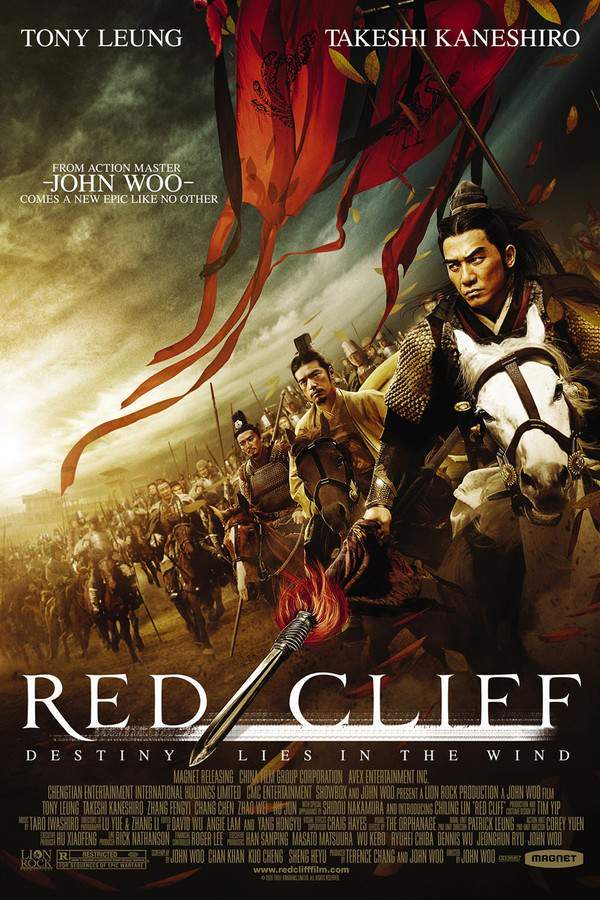
Red Cliff (2009) movie poster

Timeline

Red Cliff (2009) Timeline Explained – Every Event in Order

Release, runtime and language
2009 · 146 min · Chinese
JustWatch #2,976 4
Directed by
John Woo
Starring
Tony Leung Chiu Wai, Takeshi Kaneshiro, Fengyi Zhang

During the late Eastern Han Dynasty, General Cao Cao seeks to conquer all of China. To oppose him, warlords Liu Bei and Sun Quan forge an alliance, uniting their forces. Guided by the brilliant strategist Zhuge Liang and the skilled warrior Zhou Yu, they prepare for a monumental clash. The ensuing conflict becomes an epic struggle for survival, demanding unwavering courage and shaping the future of the empire.

On this page (7)
  1. 1 Where to watch
  2. 2 Events in order (15)
  3. 3 Timeline questions answered
  4. 4 The book behind the movie
  5. 5 Movie threads
  6. 6 Movies like Red Cliff
  7. 7 Every angle

Where to watch

Where to Watch Red Cliff (2009)

Where can you watch Red Cliff? Stream, rent or buy it in the US, including on Amazon Prime Video, Philo and Kanopy: current JustWatch availability with up-to-date prices.

Streaming availability powered by JustWatch

15 events in order · contains spoilers

Red Cliff Timeline: Events in Chronological Order

Every key event of Red Cliff (2009) in order, scene by scene, with when and where it takes place. Use it to untangle flashbacks, time jumps and parallel storylines, to refresh your memory before the sequel or to find the exact scene you are thinking of.

  1. The Flight of the Peasants

    In the Autumn of 208 AD, a significant number of 100,000 peasants led by their commander Liu Bei find themselves in a desperate situation. They are fleeing from a formidable million-man army under the command of Cao Cao, seeking a safe refuge.

    When
    Autumn 208 AD
    Where
    Great River
  2. Seeking Alliance

    The desperate peasants seek refuge with Sun Quan, the leader of the southern territories. This meeting is critical as both factions realize they must unite against the overwhelming force of Cao Cao if they are to survive the impending invasion.

    Where
    Southern Territories
  3. Cao Cao's Naval Strategy

    Cao Cao prepares to invade the south, intending to completely annihilate Liu Bei and Sun Quan's forces. His plans include deploying a massive naval fleet, escalating the tensions between the factions to critical levels.

    Where
    Cao Cao's Camp
  4. The Grand Battle Strategy

    Strategists Zhuge Liang and Zhou Yu formulate a bold strategy to defeat Cao Cao's naval fleet by setting his 10,000 ships ablaze. Their plan relies on manipulating the North Wind to ensure their victory through clever deception.

    Where
    Red Cliffs
  5. Battle of Changban

    As Cao Cao's forces advance, they engage in the Battle of Changban, where chaos reigns and the valiant warriors stall for time to protect civilians. Notable heroes like Zhuge Liang and Zhao Yun exhibit extraordinary combat skills.

    When
    Summer 208 AD
    Where
    Changban
  6. Zhao Yun's Heroic Rescue

    Zhao Yun, displaying unwavering loyalty, enters the fray to save Liu Bei's family. Despite the chaos, he manages only to rescue Liu's infant son, showcasing both his bravery and the dire situation of Liu Bei's family.

    Where
    Changban
  7. Diplomatic Efforts

    In a bid to unite against Cao Cao, Liu Bei's chief advisor Zhuge Liang embarks on a diplomatic mission to Eastern Wu to secure an alliance with Sun Quan. The negotiation involves complex political maneuvering and showcases Zhuge Liang's persuasive skills.

    Where
    Eastern Wu
  8. Formation of the Alliance

    Initially hesitant, Sun Quan is persuaded to engage in combat against Cao Cao. This pivotal moment is further influenced by a compelling tiger hunt with Zhou Yu and his sister, Sun Shangxiang, which strengthens their resolve.

    Where
    Eastern Wu
  9. Preparation for Conflict

    With the alliance secured, the troops of Liu Bei and Sun Quan gather to strategize for the imminent confrontation with Cao Cao. They aim to outmaneuver Cao Cao’s approaching army and hold their ground at the strategically important Red Cliff.

    Where
    Red Cliff
  10. Cao Cao's Defeat

    The allied forces strategically bait Cao Cao's vanguard into a trap, leading to a significant defeat for his advance troops. Despite the initial victory, Cao Cao sets up camp across from the allies, hinting at the escalating nature of the conflict.

    Where
    Cao Cao's Camp
  11. Spy Infiltration

    Sun Shangxiang successfully infiltrates Cao Cao's camp to gather critical intelligence, managing to navigate through enemy lines. Meanwhile, disease begins to spread among Cao Cao's forces, foreshadowing trouble for both sides.

    Where
    Cao Cao's Camp
  12. A Devious Maneuver

    In a twisted strategy, Cao Cao sends corpses to the allied camp to spread disease, attempting to break their morale. This desperation serves to escalate the tensions as the plague begins to affect the allied army's strength.

    Where
    Allied Camp
  13. Zhuge Liang's Clever Tactics

    Zhuge Liang devises a remarkable plan to gather 100,000 arrows using straw boats, which raises suspicion among Cao Cao's own commanders, leading to their executions. His cunning and strategic mind prove crucial for the allied forces.

    Where
    Cao Cao's Camp
  14. The Climactic Battle

    With the favorable South-East Wind at their backs, the allied forces launch a fierce assault against Cao Cao's fleet. A decisive battle ensues, marked by considerable losses but culminating in a major victory for Liu Bei and Sun Quan.

    Where
    Red Cliffs
  15. A Foreboding Victory

    The battle concludes with Cao Cao's navy in ruins, as the allied forces push forward on land. Despite their triumph, an air of tension remains as they confront Cao Cao, leaving a warning for him to never return, full of unresolved fears and future conflicts.

    Where
    Red Cliffs

Last updated: November 07, 2024 at 23:17

Was this helpful?

Timeline questions answered

Red Cliff Timeline Explained: Your Questions Answered

When does it happen, and why in that order? The questions people ask about the chronology of Red Cliff (2009): time jumps, flashbacks, cause and effect between scenes and the correct order of events, each answered with spoilers.

Q1

Why did Sun Quan agree to form an alliance with Liu Bei against Cao Cao?

Sun Quan was initially hesitant to commit to the alliance due to the overwhelming strength of Cao Cao's million-man army. His perspective shifted after two key events: Zhuge Liang's persuasive arguments about the necessity of resistance, and a tiger hunt with Zhou Yu and his sister Sun Shangxiang that strengthened their resolve to fight. The tiger hunt served as a symbolic moment demonstrating martial readiness and familial unity, convincing Sun Quan that his forces were prepared for battle.

Foreshadowing: The alliance formation was foreshadowed early when Liu Bei's forces fled to the southern territories seeking Sun Quan's protection.

  • sun quan
  • liu bei
  • alliance
  • zhuge liang
  • war strategy
Q2

How did Zhuge Liang obtain 100,000 arrows for the allied forces?

Zhuge Liang devised a clever ruse using straw boats. He ordered the construction of boats disguised with straw men and sailed them toward Cao Cao's camp during a foggy morning. Suspecting an attack, Cao Cao's forces bombarded the boats with arrows, believing they were carrying soldiers. The arrows stuck into the straw, allowing Zhuge Liang's men to collect approximately 100,000 arrows without direct combat. This tactic showcased his strategic ingenuity and provided the allied forces with much-needed weaponry.

Foreshadowing: This event heightened Cao Cao's suspicion about the loyalty of his newly defected naval commanders.

  • zhuge liang
  • 100000 arrows
  • straw boats
  • strategy
  • weaponry
Q3

Why did Cao Cao execute his own commanders Cai Mao and Zhang Yun?

Cao Cao was manipulated by Zhuge Liang's arrow-gathering scheme into doubting the loyalty of Cai Mao and Zhang Yun, who had recently defected from the southern warlords to join his navy. After witnessing the suspicious ease with which Zhuge Liang obtained arrows, Cao Cao questioned whether Cai Mao and Zhang Yun had secretly aided the enemy. This paranoia, fueled by Zhou Yu's separate scheme to eliminate the commanders, led Cao Cao to order their executions, weakening his own naval leadership at a critical moment.

Foreshadowing: The execution of these experienced naval commanders severely compromised Cao Cao's ability to command his fleet effectively.

  • cai mao
  • zhang yun
  • execution
  • cao cao
  • defection
Q4

Why did Cao Cao chain his battleships together, and was this a mistake?

Cao Cao's naval commanders suggested chaining the battleships together to prevent the excessive rocking motion that troubled soldiers unfamiliar with sea travel. This made the massive fleet more stable and manageable for land-based troops. However, this decision became catastrophic when the allied forces launched their fire attack. The chained ships could not disperse, turning the entire fleet into a single, vulnerable target. The chained configuration prevented escape and amplified the destruction caused by the fire, making it one of the pivotal strategic errors in the battle.

Foreshadowing: Zhou Yu and Zhuge Liang had specifically planned their attack around exploiting this vulnerability.

  • chained ships
  • cao cao navy
  • fire attack
  • battle strategy
Q5

Why was the South-East wind so crucial for the allied forces at Red Cliffs?

The South-East wind was essential because the allied forces planned to launch a fire attack against Cao Cao's fleet. Fire spreads rapidly when the wind blows toward the enemy's position, carrying flames directly into the chained ships. Zhuge Liang had accurately predicted that a South-East wind would arise at the critical moment, allowing the fire to sweep across Cao Cao's entire naval fleet. Without this specific wind direction, the fire attack would have blown back toward the allied forces or failed to achieve its devastating effect.

Foreshadowing: The allied forces waited for precise weather conditions before launching their assault, demonstrating the importance of timing in ancient naval warfare.

  • south east wind
  • fire attack
  • zhuge liang
  • red cliffs
  • naval battle
Q6

What was the Eight Trigrams Formation that Sun Shangxiang used against Cao Cao?

The Eight Trigrams Formation (Bagua Zhen) was an ancient Chinese military formation designed to trap and confuse enemy forces. Sun Shangxiang led a light cavalry unit that baited Cao Cao's advance troops into entering this formation, which had been set up by the allied forces at Red Cliffs. Once inside, the trapped soldiers found it impossible to navigate the complex pattern, resulting in a decisive defeat for Cao Cao's vanguard. This early victory boosted allied morale while demonstrating their tactical superiority.

Foreshadowing: This formation demonstrated the allied forces' sophisticated military capabilities before the main battle.

  • eight trigrams formation
  • sun shangxiang
  • bagua
  • cavalry
  • trapped army
Q7

How did the disease spread through Cao Cao's army and what impact did it have?

Typhoid fever swept through Cao Cao's massive army while camped near the river, killing numerous soldiers. In a desperate strategic move, Cao Cao sent the infected corpses to the allied camp, attempting to spread the disease and weaken enemy forces. The plague eventually reached the allied army, causing morale to plummet and leading Liu Bei to withdraw his forces temporarily. This biological warfare tactic demonstrated Cao Cao's willingness to use any means necessary, though it ultimately failed to prevent his defeat at Red Cliffs.

Foreshadowing: The disease weakened both sides but disproportionately affected Cao Cao's forces due to the unsanitary conditions of his massive camp.

  • plague
  • typhoid
  • disease
  • cao cao
  • biological warfare
Q8

Why did Zhou Yu and the allied forces spare Cao Cao's life after the battle?

After the devastating defeat at Red Cliffs, Zhou Yu confronted the fleeing Cao Cao and chose not to kill him, instead delivering a warning never to return. This decision reflected both practical and strategic reasoning: killing the Han Dynasty's Chancellor could have created political chaos and made Zhou Yu appear as a traitor to the empire. Additionally, a live Cao Cao would likely return to seek revenge, providing ongoing motivation for the allied forces to remain united. The mercy also demonstrated the honor-bound nature of warlord politics, where enemies were often spared for future diplomatic leverage.

Foreshadowing: The concluding scene with Zhou Yu and Zhuge Liang exchanging thoughtful reflections hints at the long-term consequences of this decision.

  • zhou yu
  • cao cao
  • mercy
  • defeat
  • alliance
Q9

What was the significance of Sun Shangxiang's infiltration into Cao Cao's camp?

Sun Shangxiang undertook a dangerous spy mission to gather critical intelligence from within Cao Cao's massive camp. Her infiltration provided the allied forces with essential information about Cao Cao's troop conditions, naval preparations, and the timing of potential attack windows. This intelligence proved invaluable when determining when to launch the final assault. Additionally, her successful return with information boosted allied morale at a crucial moment when disease had weakened their forces. Her role demonstrated that women participated actively in the military strategy of the era.

Foreshadowing: The intelligence she gathered directly informed the decision to launch the fire attack during the South-East wind.

  • sun shangxiang
  • spy
  • infiltration
  • camp
  • intelligence
Q10

What was the nature of the rivalry between Zhuge Liang and Zhou Yu?

While both strategists worked toward the common goal of defeating Cao Cao, Zhuge Liang and Zhou Yu harbored separate agendas. Zhou Yu sought to eliminate Cao Cao's naval commanders (Cai Mao and Zhang Yun) to strengthen Eastern Wu's position, while Zhuge Liang wanted the same commanders dead to prevent future threats to Liu Bei's territory. Each tried to manipulate the other into carrying out the elimination, creating a tense political dynamic within the alliance. Despite this rivalry, they ultimately cooperated effectively, with Zhuge Liang's arrow scheme inadvertently serving Zhou Yu's interests by raising suspicions that led to the commanders' execution.

Foreshadowing: This rivalry highlighted the underlying tension between the Liu Bei and Sun Quan factions, even as they fought together.

  • zhuge liang
  • zhou yu
  • rivalry
  • strategy
  • alliance politics
Q11

Why did Zhao Yun only manage to rescue Liu Bei's infant son during the Battle of Changban?

During the chaotic Battle of Changban, Zhao Yun ventured into the midst of Cao Cao's advancing army specifically to rescue Liu Bei's family, who had become separated during the desperate flight. After an intense search through the chaos, Zhao Yun located Liu Bei's infant son (Liu Shan) and managed to bring the child to safety. However, he was unable to find or rescue Liu Bei's wife or other family members, who were lost in the confusion of the massive refugee exodus. This heroic act cemented Zhao Yun's legendary reputation for unwavering loyalty, though it came with the painful inability to save the entire family.

Foreshadowing: The rescue of Liu Shan established a character who would play significant roles in subsequent Three Kingdoms narratives.

  • zhao yun
  • liu shan
  • rescue
  • changban
  • battle
Q12

Why did Liu Bei withdraw his forces when the plague reached the allied camp?

When the disease spread from Cao Cao's corpses reached the allied army, Liu Bei made the difficult decision to withdraw his forces from the main camp. This withdrawal was driven by practical military considerations: the plague was decimating troop morale and combat effectiveness, and keeping his forces in close proximity to the infected camp risked losing his entire army. Liu Bei retreated with his soldiers to recover and regroup, leaving Zhuge Liang to continue assisting Eastern Wu. This strategic withdrawal demonstrated Liu Bei's pragmatic approach to military leadership, prioritizing the preservation of his core fighting force.

Foreshadowing: The withdrawal created a temporary vulnerability that made the eventual victory more costly for the remaining allied forces.

  • liu bei
  • withdrawal
  • plague
  • army
  • strategy

Movie threads

More Movies Like Red Cliff, by Mood & Story

Curated lists built around what makes Red Cliff tick: the same mood, the same kind of story or the same emotional payoff. Each list explains why these movies belong together.

Epic Strategic War Movies like Red Cliff

Grandiose historical conflicts where detailed strategy decides the fate of nations. For viewers seeking movies like Red Cliff, this thread gathers epic historical war films defined by grand strategy and pivotal battles. Discover similar stories of military genius, large-scale warfare, and the tense, heavy atmosphere of nations at war, where every decision carries immense weight.

  • epic
  • strategic
  • tense
  • grandiose
  • battling
  • historical
  • Tone: tense, grandiose, urgent
  • Pacing: steady, methodical build-up
Why these movies?

The story pattern: These narratives typically follow opposing forces, often with a clear underdog, building methodically towards a climactic confrontation. The plot structure hinges on strategic gambits and counter-moves, making the intellectual battle as compelling as the physical one. The story unfolds through the perspectives of leaders and strategists, emphasizing the burden of command.

Why they belong together: These films are grouped together by their shared focus on large-scale historical warfare driven by strategic planning. They create a specific vibe of high-stakes intellectual and military tension, a steady pacing that builds towards epic battles, and a heavy emotional weight derived from the consequences of war.

Movies with Bittersweet Endings like Red Cliff

Stories where success comes at a profound and sobering personal or collective cost. If you liked the heavy, poignant conclusion of Red Cliff, this thread highlights movies with bittersweet endings. Find films where victory is achieved but at a great cost, exploring themes of sacrifice and the sobering aftermath of conflict in war dramas and historical epics.

  • bittersweet
  • melancholic
  • heavy
  • solemn
  • triumphant yet tragic
  • reflective
  • Tone: bittersweet, melancholic, heavy
  • Pacing: steady, character-driven
Why these movies?

The story pattern: The narrative pattern involves characters striving for and achieving a critical goal, only for the resolution to reveal the heavy toll of their struggle. The ending acknowledges the success but emphasizes what was lost—lives, innocence, ideals—creating a complex emotional payoff that is neither wholly happy nor purely tragic.

Why they belong together: These films are united by their shared emotional arc, culminating in a bittersweet resolution. They balance triumph with tragedy, creating a specific, heavy mood that lingers after the credits. The experience is defined by this particular blend of narrative fulfillment and emotional soberness.

If you liked this

Movies Like Red Cliff

Similar movies to Red Cliff: the same genre, themes or kind of story. Each one comes with its own plot summary, timeline and ending explained.

Browse all movie summaries

Every angle

Red Cliff (2009) Explained: Plot, Timeline & Characters

Everything about Red Cliff in one place: what happens in the plot summary, the timeline in chronological order, the characters and meaning and a spoiler-free summary. What's After the Movie adds the cast, box office and post-credit scenes.

Coming soon on iOS and Android

The Plot Explained Movie Summary App

Plot summaries, endings explained and timelines on your phone. Catch up on any movie in minutes, save your favorites and never miss a twist again.

Be the first to know when we launch. Your email stays private, always.

Learn more about the app