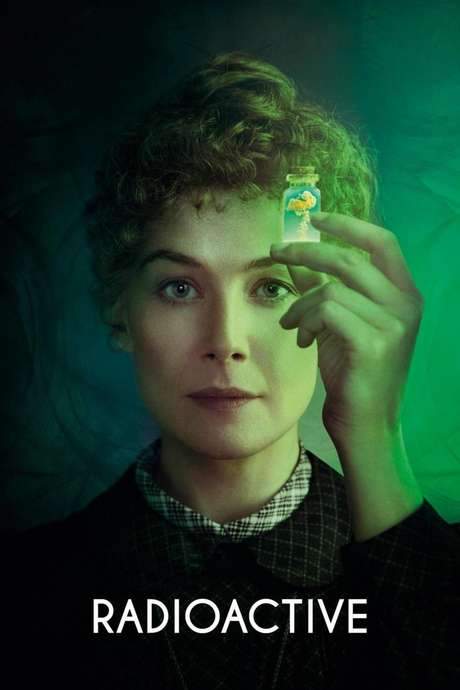
Timeline
Radioactive (2019) Timeline Explained – Every Event in Order
- Release, runtime and language
- 2019 · 111 mins · English
- Echo score 63
- Loading streaming availability…
- Directed by
- Marjane Satrapi
- Starring
- Corey Johnson, Aneurin Barnard, Sam Riley, Jennifer White, Simon Russell Beale, Rosamund Pike
- Budget
- $20M
A look at the life of Marie Curie, the pioneering physicist and chemist who conducted groundbreaking research on radioactivity. The film explores her remarkable scientific achievements and the profound impact of her discoveries alongside her husband, Pierre. Their work with radium revolutionized the 20th century, forever changing science and medicine, while also revealing the personal sacrifices and challenges they faced.
On this page (5)
15 events in order · contains spoilers
Radioactive Timeline: Events in Chronological Order
Every key event of Radioactive (2019) in order, scene by scene, with when and where it takes place. Use it to untangle flashbacks, time jumps and parallel storylines, to refresh your memory before the sequel or to find the exact scene you are thinking of.
-
Marie Collapses in Her Laboratory
In 1934, Marie Curie collapses while working in her laboratory in Paris. As she is rushed to the hospital, her life flashes before her eyes, and she begins to remember the key events of her past.
- When
- 1934
- Where
- Paris, France
-
Rejection and a Shared Laboratory
Marie is repeatedly rejected for research funding due to her blunt attitude, one she has in common with Pierre Curie. Their mutual conflict with the leading academic authorities leads Marie to share a laboratory with Pierre, beginning their famous scientific partnership.
- When
- 1893
- Where
- Paris, France
-
Love, Marriage, and Family
Before making their groundbreaking discoveries, Marie and Pierre fall in love and marry. The couple has two children together, building a family life while continuing their scientific work side by side.
-
The Discovery of Polonium and Radium
Marie discovers the elements polonium and radium and announces the discovery of radioactivity, revolutionizing the fields of physics and chemistry. Radium is soon used in a series of commercial products, making the Curies world-famous.
-
The Séance
Pierre takes Marie to a séance where radium is used in an attempt to contact the dead. Marie disapproves of spiritualism and the idea of an afterlife, still grieving the death of her mother in Poland.
-
The Nobel Prize in Physics Controversy
Pierre rejects the Légion d'honneur for failing to nominate Marie alongside him and insists that they jointly share their Nobel Prize in Physics. However, Marie becomes agitated when Pierre accepts the Prize in Stockholm without her by his side.
- Where
- Stockholm, Sweden
-
The Death of Pierre Curie
Pierre becomes increasingly sick with anemia as a result of his research. He is then tragically trampled to death by a horse and cart, leaving Marie without her partner both in life and in science.
-
Radium's Deadly Toll
Marie initially dismisses concerns that her discovered elements are toxic. However, increasing numbers of people begin dying from serious health conditions after exposure to radium, revealing the dark consequences of her discovery.
-
Affair and Press Scandal
Depressed after Pierre's death, Marie begins an affair with her colleague Paul Langevin. Although she receives Pierre's professorship at the Sorbonne, the French nationalist press reports the details of the affair and she is harassed by xenophobic mobs because of her Polish origins.
- Where
- Paris, France
-
Desperate to Contact Pierre
Marie returns to the house where the séance had taken place and tearfully begs her friend Loie Fuller to try using radium to contact Pierre. Overcome with grief, she is willing to believe in the afterlife she once rejected.
-
Winning the Nobel Prize in Chemistry
When Marie is awarded the Nobel Prize in Chemistry in 1911, the committee instructs her not to travel to Stockholm due to the scandal surrounding her. She defies their instructions, and at her award ceremony she receives a standing ovation from the entire audience.
- When
- 1911
- Where
- Stockholm, Sweden
-
X-Rays on the Western Front
When World War I begins, Marie's daughter Irene convinces her to run an X-ray unit on the Western Front. The unit is used to determine whether amputation is needed for wounded soldiers, bringing medical imaging directly to the battlefield.
- When
- 1914
- Where
- Western Front
-
Irene and Frédéric Joliot
Irene begins dating Frédéric Joliot, whom Marie initially disapproves of because of the couple's joint research into induced radioactivity. Marie asks Irene not to take part in Frédéric's future work on the subject due to possible effects on her health, but Irene does not heed her mother and together they operate the X-ray machine on the Western Front.
-
Visions of the Future and Final Farewell
As Marie dies, she sees visions of the future impact of her discoveries, including external beam radiotherapy at a hospital in Cleveland in 1956, the atomic bombings of Hiroshima and Nagasaki, a nuclear bomb test in Nevada in 1961, and the Chernobyl disaster in 1986. She then awakens in a hospital room, where Pierre arrives and the two leave the hospital together.
- When
- 1934
-
Legacy and the Solvay Conference
Before the film's credits, the Curies' accomplishments are detailed: their mobile unit X-rayed more than a million men during the war, saving countless lives, and their research would be used to create radiotherapy. The film's last image is a photograph of Marie Curie at the 1927 Solvay Conference alongside celebrated physicists such as Albert Einstein.
Last updated: October 09, 2026 at 15:48
Timeline questions answered
Radioactive Timeline Explained: Your Questions Answered
When does it happen, and why in that order? The questions people ask about the chronology of Radioactive (2019): time jumps, flashbacks, cause and effect between scenes and the correct order of events, each answered with spoilers.
Q1 Why does Marie Curie see visions of future events before dying in Radioactive?
As Marie collapses in her laboratory in 1934 and is rushed to the hospital, the film intercuts her fading life with flash-forwards to external beam radiotherapy in 1956, the atomic bombings of Hiroshima and Nagasaki, a nuclear bomb test in Nevada in 1961, and the Chernobyl disaster in 1986. These visions represent the long-term, unintended consequences of her discovery of radioactivity, showing both its medical benefits and its capacity for destruction. The film frames her death as a moment of reckoning in which she witnesses the full legacy of her work.
Foreshadowing: Early in the film, radium's commercial popularity is shown almost immediately after its discovery, subtly setting up the idea that its impact will spread far beyond the laboratory.
- marie curie visions
- flash-forwards radioactie movie
- legacy of radioactivity film
Q2 How did Pierre Curie die in the movie?
Pierre Curie becomes increasingly sick with anemia as a result of prolonged exposure to radioactive materials during his research. His weakened physical state leaves him unable to avoid a horse and cart, which tramples him to death. His death illustrates how the same radium that earned the Curies worldwide fame was simultaneously destroying their bodies from within.
Foreshadowing: Earlier scenes show Pierre handling radioactive materials without any protective equipment, establishing how vulnerable he and Marie both are to the substances they study.
- pierre curie death
- horse and cart accident
- anemia from radiation
Q3 Why did Marie initially dismiss concerns that radium was toxic?
After announcing the discovery of radioactivity, Marie Curie was so consumed by the scientific triumph and the wave of commercial products being developed with radium that she minimized early warnings about its dangers. It is only after growing numbers of people begin dying from serious health conditions following exposure that the true cost of the discovery becomes undeniable. Her initial denial reflects how even the most brilliant scientists can be blind to the consequences of their own breakthroughs.
Foreshadowing: The séance scene hints at this blindness, showing radium being used frivolously to attempt to contact the dead without any awareness of its biological danger.
- radium toxicity
- radioactive dangers
- curie discovery consequences
Q4 Why does Marie disapprove of the séance in the film?
When Pierre takes Marie to a séance where radium is used in an attempt to contact the dead, she strongly disapproves of spiritualism and the idea of an afterlife. Her rejection stems partly from her scientific worldview and partly from the unresolved grief she still carries over her mother's death in Poland. The séance offends both her rationalism and her sense that the dead cannot be reached.
Foreshadowing: The film notes that the séance introduces the idea of contacting Pierre after his eventual death, setting up Marie's later tearful return to the same house.
- marie curie seance
- spiritualism radioactivity
- afterlife rejection
Q5 Why did Marie Curie begin an affair with Paul Langevin?
After Pierre's sudden death, Marie falls into a deep depression that leaves her emotionally vulnerable. Her affair with Paul Langevin, a fellow scientist and colleague, grows out of that grief rather than any calculated decision. The relationship exposes her to public humiliation when the French nationalist press publishes the details, framing her as a foreign woman corrupting a Frenchman.
Foreshadowing: After Pierre's death, Marie is shown isolated in her laboratory with no scientific or emotional partner, planting the conditions for the affair.
- marie langevin affair
- depression after pierre
- curie romantic scandal
Q6 Why does Marie beg Loie Fuller to use radium to contact Pierre?
Grief-stricken and alone, Marie returns to the house where the earlier séance had taken place and tearfully asks her friend Loie Fuller to try again to contact Pierre using radium. This moment marks a complete reversal of her earlier rejection of spiritualism, showing that her scientific rationality cannot withstand the weight of losing Pierre. Her willingness to embrace the very ideas she once mocked underscores how broken she has become.
Foreshadowing: Her firm rejection of the séance earlier in the film makes her later plea to Loie Fuller all the more devastating as a turning point in her grief.
- marie curie grief
- contacting pierre
- loie fuller seance
Q7 Why did Marie Curie defy the Nobel committee and travel to Stockholm in 1911?
When Marie is awarded the Nobel Prize in Chemistry in 1911, the committee instructs her not to travel to Stockholm because of the scandal surrounding her affair with Langevin. She ignores the instruction and attends the ceremony in person, where the entire audience rises in a standing ovation. Her defiance is an assertion that her scientific identity cannot be erased by personal scandal, and the audience's reaction confirms that the world still recognizes her as one of the greatest scientists of her era.
Foreshadowing: Her earlier agitation when Pierre accepted the Nobel Prize in Physics without her shows how much being present for recognition matters to her.
- nobel prize chemistry 1911
- marie curie stockholm
- defiance of nobel committee
Q8 Why does Marie disapprove of Irene's relationship with Frédéric Joliot?
Marie initially disapproves of her daughter Irene dating Frédéric Joliot because the couple are conducting joint research into induced radioactivity, a field Marie knows intimately to be hazardous. She asks Irene not to take part in Frédéric's future work on the subject because of possible effects on her health. Ironically, the Joliot-Curies would go on to discover artificial radioactivity in 1935 and win their own Nobel Prize, validating the research Marie tried to protect Irene from.
Foreshadowing: Marie's own struggle with aplastic anemia and Pierre's death from radiation-induced illness are direct warnings she passes on to Irene.
- irene joliot curie
- induced radioactivity research
- marie disapproves daughter
Q9 Why did Marie Curie run X-ray units on the Western Front during World War I?
When World War I begins in 1914, Marie's daughter Irene convinces her to set up mobile X-ray units on the Western Front to help field surgeons determine whether wounded soldiers required amputation. The choice is a deliberate application of Marie's discoveries to a humanitarian crisis, transforming her abstract scientific work into a direct tool for saving lives. According to the film, the units X-rayed more than a million men during the war.
Foreshadowing: Marie's earlier interaction with radioactivity's destructive potential makes her choice to redirect it toward healing a deeply meaningful turning point.
- x-ray units western front
- world war i curie
- petite curie mobile radiology
Q10 What is the meaning of the film's ending?
After Marie's visions of Hiroshima, Nagasaki, the Nevada test, and Chernobyl, she awakens in a hospital room and sees Pierre, who has come to take her away with him. The sequence reframes her death not as a pure loss but as a dreamlike reunion with her scientific partner and husband. The film then closes on the real-life photograph of Marie Curie attending the 1927 Solvay Conference alongside Albert Einstein and other celebrated physicists, cementing her place among the defining minds of the twentieth century.
Foreshadowing: Marie's earlier rejection of the afterlife and her later desperate plea to contact Pierre through radium converge in this final reunion.
- radioactive movie ending
- marie reunion pierre
- solvay conference 1927
Q11 Why was Marie Curie harassed by mobs during the Langevin affair scandal?
When the French nationalist press published the details of Marie's affair with Paul Langevin, she became the target of xenophobic mobs who resented her as a Polish-born woman occupying a prestigious French academic position. Even though she had received Pierre's professorship at the Sorbonne through legitimate scientific merit, the scandal fused personal and national prejudice against her. The harassment reflects both the gender politics of the era and the hostility directed at foreign-born intellectuals in early twentieth-century France.
Foreshadowing: Her earlier rejection for funding due to her attitude had already marked her as an outsider to the French academic establishment.
- marie curie xenophobia
- polish born scientist
- langevin scandal france
If you liked this
Movies Like Radioactive
Similar movies to Radioactive: the same genre, themes or kind of story. Each one comes with its own plot summary, timeline and ending explained.










Every angle
Radioactive (2019) Explained: Plot, Timeline & Characters
Everything about Radioactive in one place: what happens in the plot summary, the timeline in chronological order, the characters and meaning and a spoiler-free summary. What's After the Movie adds the cast, box office and post-credit scenes.
- Radioactive Plot Summary What happens, from the first scene to the last, every twist included.
- Radioactive Characters & Themes Who is who, where it takes place and what the movie really means.
- Radioactive Spoiler-Free Summary What it is about and whether it is worth watching, without spoilers.
- Radioactive on What's After the Movie Cast and crew, box office, post-credit scenes and more.
Coming soon on iOS and Android
The Plot Explained Movie Summary App
Plot summaries, endings explained and timelines on your phone. Catch up on any movie in minutes, save your favorites and never miss a twist again.
Be the first to know when we launch. Your email stays private, always.
Learn more about the app