Plot Explained Spoilers guaranteed!
Plot Explained

Browse by genre

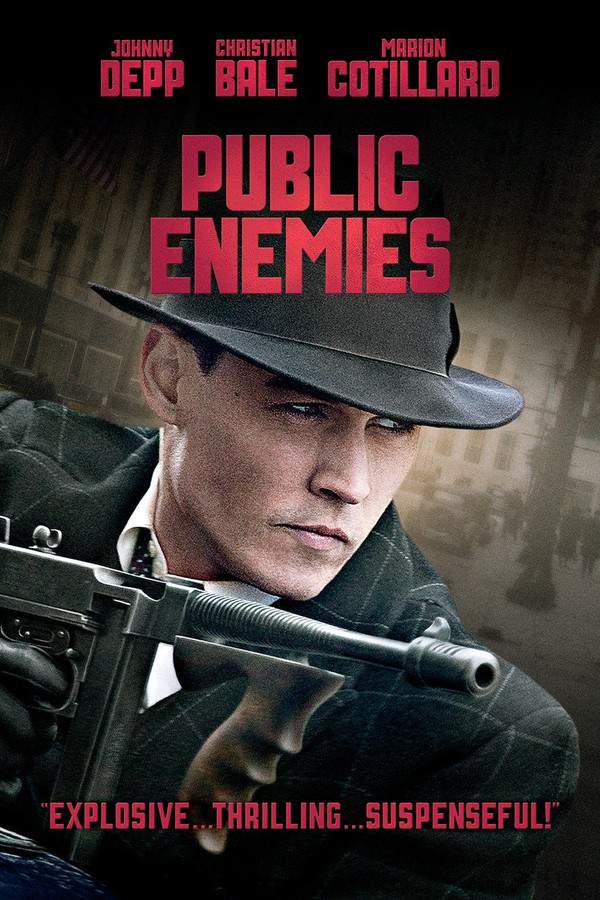
Public Enemies (2009) movie poster

Plot Summary

Public Enemies (2009) Plot Summary Explained

Release, runtime and language
2009 · 140 min · English
Directed by
Michael Mann
Starring
Christian Bale, Johnny Depp
Budget
$100M

During the 1930s, notorious bank robber John Dillinger becomes a folk hero with his audacious crimes and captivating personality. As he and his gang pull off daring heists, Dillinger gains a loyal following and widespread admiration. However, FBI Director J. Edgar Hoover sees him as a dangerous threat and brands him Public Enemy Number One, initiating a relentless pursuit that becomes a pivotal moment in the history of law enforcement.

On this page (6)
  1. 1 Where to watch
  2. 2 What happens: full plot
  3. 3 Plot questions answered
  4. 4 Movie threads
  5. 5 Movies like Public Enemies
  6. 6 Every angle

Where to watch

Where to Watch Public Enemies (2009)

Where can you watch Public Enemies? Stream, rent or buy it in the US, including on Amazon Video, Apple TV Store and Fandango At Home: current JustWatch availability with up-to-date prices.

Streaming availability powered by JustWatch

Full plot summary · contains spoilers

What Happens in Public Enemies: Full Plot Summary

The whole story of Public Enemies (2009) explained, from the opening scene to the final frame: every key event, every twist and what it all adds up to. Read it as a quick recap before the sequel, to check a scene you missed, or to finally understand what really happened.

The movie begins in 1933, showcasing the notorious bank robber John Dillinger, who is brought to the Indiana State Prison under the guise of a prisoner transfer alongside his partner John "Red" Hamilton (played by Jason Clarke). There, Dillinger and several gang members, including Charles Makley (Christian Stolte), Harry Pierpont (David Wenham), Ed Shouse (Michael Vieau), Homer Van Meter (Stephen Dorff), and Walter Dietrich (James Russo), orchestrate a daring escape with guns smuggled into the prison. This results in a chaotic shootout as Dillinger reveals his identity, using the element of surprise to overpower the guards. In an intense moment, one of the gang members, enraged, fatally beats a guard, leading to further violence as the escape unfolds.

Meanwhile, in East Liverpool, Ohio, Melvin Purvis and his team of FBI agents track Pretty Boy Floyd (Channing Tatum). In a thrilling chase through an apple orchard, Purvis demonstrates his sharpshooting skills by fatally wounding Floyd, marking a significant step in the manhunt for Dillinger.

As Dillinger's gang finds refuge in Chicago, corrupt cop Martin Zarkovich (John Michael Bolger) assures them of protection from the Mafia. Dillinger soon encounters Anna Sage (Branka Katic), a close associate, leading to alliances that prove crucial in their criminal activities.

The narrative shifts to a bold bank robbery in Racine, Wisconsin, where Dillinger and his cohorts don overcoats and bowler hats to blend in. Tension mounts as Dillinger threatens the bank manager while Makley empties the teller cages. Outside, lookout Van Meter remains vigilant, but soon, chaos erupts as police arrive, resulting in a violent shootout as the robbers escape.

In Washington, D.C., amidst a backdrop of frustration, J. Edgar Hoover (Billy Crudup) seeks to escalate the Bureau's campaign against crime, assigning Purvis to spearhead the operation against Dillinger, proclaiming a 'War on Crime.'

Romance blossoms as Dillinger meets Billie Frechette (Marion Cotillard), capturing her heart despite his notorious past. However, their love story is fraught with tension as Purvis's relentless pursuit intensifies. Following a failed ambush at a hotel, Dillinger's cunning escapes continue to leave law enforcement in his dust.

The film unfolds with further heists and escapades, illustrating the gang's reckless lifestyle. Dillinger's daring and charm are pitted against the growing pressure from law enforcement, including key players like Charles Winstead (Stephen Lang). Each heist is laced with palpable danger as Dillinger's illicit activities draw increasing attention.

The climax leads to a dramatic moment in a movie theater showing "Manhattan Melodrama." As Dillinger and his companions leave, they are ambushed by Purvis and his agents. The confrontation culminates in a deadly shootout, resulting in Dillinger being severely wounded. His last words, uttered with poignant emotion, are relayed through Winstead to Billie Frechette: > "Tell Billie for me, 'Bye bye Blackbird.'"

In the aftermath, the film poignantly details the fates of its characters—Purvis's eventual disillusionment and tragic demise, alongside Frechette's later life in Wisconsin. The story encapsulates the thrill and danger of a life on the edge, leaving audiences shaken by the relentless and tragic pursuits of outlaw life.

Last updated: November 08, 2024 at 02:34

Was this helpful?

Plot questions answered

Public Enemies Plot Explained: Your Questions Answered

The questions people ask most about Public Enemies (2009): what happens in the confusing scenes, why the characters do what they do, the twists, hidden details and what the ending means. Each answer contains spoilers.

Q1

How did John Dillinger escape from Indiana State Prison?

Dillinger orchestrated a daring escape while being transferred to Indiana State Prison in 1933. He and several gang members, including Charles Makley and Harry Pierpont, had smuggled guns into the prison. During the transfer, Dillinger revealed his identity and used the element of surprise to overpower the guards. The escape devolved into chaos when one gang member fatally beat a guard, leading to a violent shootout that allowed Dillinger and his men to flee.

  • prison escape
  • Indiana State Prison
  • Dillinger gang
  • Makley
  • Pierpont
Q2

Who killed Pretty Boy Floyd?

FBI Agent Melvin Purvis killed Pretty Boy Floyd in East Liverpool, Ohio. During an intense chase through an apple orchard, Purvis demonstrated his sharpshooting skills and fatally wounded Floyd. This successful kill marked a significant achievement in Purvis's career and established him as Hoover's top man for the growing manhunt against Dillinger.

Foreshadowing: The film opens with parallel action showing both Dillinger's escape and Purvis's hunt, establishing them as opposing forces.

  • Pretty Boy Floyd
  • Melvin Purvis
  • apple orchard
  • FBI
  • floyd death
Q3

Why did J. Edgar Hoover assign Melvin Purvis to hunt Dillinger?

J. Edgar Hoover assigned Purvis to spearhead the operation against Dillinger because Purvis had already proven himself by successfully eliminating Pretty Boy Floyd. Frustrated by the Bureau's inability to contain the wave of bank robberies, Hoover escalated his campaign and declared a 'War on Crime,' specifically targeting Dillinger as Public Enemy Number One. Purvis was Hoover's most effective agent, and the assignment was meant to demonstrate the FBI's new aggressive approach to organized crime.

  • J. Edgar Hoover
  • Melvin Purvis
  • FBI
  • Waron Crime
  • assignment
Q4

How did the FBI find Dillinger at the movie theater?

The FBI tracked Dillinger to the Biograph Theater in Chicago where he was watching 'Manhattan Melodrama' with his companions. While the summary doesn't detail the exact tip-off, Anna Sage, Dillinger's associate, had been providing information to law enforcement, and the FBI had been closely monitoring his movements and connections. Purvis and his agents set up an ambush outside the theater, resulting in the deadly confrontation that ended Dillinger's life.

  • movie theater ambush
  • Biograph Theater
  • Manhattan Melodrama
  • Chicago
  • Purvis
Q5

What did Dillinger mean by his last words 'Bye bye Blackbird'?

Dillinger's last words were 'Tell Billie for me, 'Bye bye Blackbird.'' The phrase is a reference to the jazz standard 'Bye Bye Blackbird,' a song about loss and departure. Dillinger used it as a poignant farewell to his lover Billie Frequette, whom he called his 'Blackbird.' The message was relayed through FBI Agent Charles Winstead to Frequette, serving as a tragic final goodbye from the dying outlaw to his beloved.

  • last words
  • Bye Bye Blackbird
  • Billie Frechette
  • jazz song
  • farewell
Q6

What happened to Billie Frechette after Dillinger's death?

After Dillinger was killed in 1934, Billie Frechette continued living in Wisconsin. The film notes she later lived out her life in the state, remaining connected to the legacy of her brief but intense romance with the infamous bank robber. She never publicly spoke much about her relationship with Dillinger, preferring a private life away from the spotlight that had surrounded their forbidden romance.

  • Billie Frechette
  • Wisconsin
  • aftermath
  • Dillinger lover
Q7

Why did Anna Sage become an informant against Dillinger?

Anna Sage was a close associate of Dillinger in Chicago who supported his criminal operations. While the specific motivations aren't detailed in the summary, Sage's cooperation with the FBI was instrumental in leading authorities to Dillinger's location at the theater. Her betrayal enabled Purvis to set up the ambush that killed Dillinger, though her exact reasons for turning informant remain ambiguous, was it pressure from law enforcement, personal gain, or something else entirely.

  • Anna Sage
  • informant
  • Chicago betrayal
  • FBI tip
Q8

Why did Dillinger pursue a relationship with Billie Frechette despite the danger?

Despite his notorious criminal lifestyle and constant pursuit by the FBI, Dillinger met Billie Frechette and romance blossomed between them. Their love story was fraught with tension as Purvis's relentless pursuit intensified, putting constant pressure on their relationship. Dillinger's attraction to Frechette appeared genuine, showing a softer side to the infamous robber beyond his criminal persona. However, their relationship also made him more vulnerable, as his visits to her provided another vector for law enforcement to track his movements.

  • Billie Frechette
  • romance
  • love story
  • Dillinger relationship
Q9

Why did Melvin Purvis become disillusioned with the FBI after the manhunt?

After successfully hunting down Dillinger and other Public Enemies like Pretty Boy Floyd and Baby Face Nelson, Purvis experienced a troubling shift in perspective. The film explores his eventual disillusionment with the FBI, suggesting that the cost of his success, the violent deaths, the moral compromises of the manhunt, and perhaps the treatment of those involved, left him deeply conflicted. Purvis eventually left the Bureau under difficult circumstances, his hero status overshadowed by personal and professional turmoil.

  • Melvin Purvis
  • FBI disillusionment
  • aftermath
  • career end
Q10

What was J. Edgar Hoover's 'War on Crime' in the film?

J. Edgar Hoover's 'War on Crime' was his aggressive campaign to elevate the FBI's role in combating organized crime during the Depression era. Frustrated by the Bureau's limited authority and effectiveness, Hoover sought to transform the FBI into a powerful federal law enforcement force. By targeting high-profile criminals like Dillinger and declaring him Public Enemy Number One, Hoover aimed to demonstrate the FBI's necessity and expand its powers, making the manhunt a cornerstone of his institutional ambition.

  • War on Crime
  • J. Edgar Hoover
  • FBI expansion
  • Public Enemy Number One
Q11

Why did John Dillinger become a folk hero in the 1930s?

Dillinger became a folk hero due to his audacious bank robberies, daring escapes (including the famous 'wooden pistol' escape from Crown Point jail), and charismatic personality that captivated the public imagination during the Great Depression. His attacks on banks, Institutions that had foreclosed on countless farms and homes, resonated with a population suffering economically. The media portrayed him as a Robin Hood figure, and his good looks and charm furthered his legend, creating a stark contrast between the glamorous outlaw and the stodgy lawmen pursuing him.

  • folk hero
  • Depression era
  • bank robber
  • public enemy
  • media legend

Movie threads

More Movies Like Public Enemies, by Mood & Story

Curated lists built around what makes Public Enemies tick: the same mood, the same kind of story or the same emotional payoff. Each list explains why these movies belong together.

Charismatic Outlaw Stories like Public Enemies

The gripping, high-stakes chase of a magnetic criminal marching towards an inevitable end. If you enjoyed the tragic chase of John Dillinger in Public Enemies, you'll find similar movies here. These films focus on magnetic antiheroes, high-stakes criminal pursuits, and somber endings, capturing the tension and emotional weight of a charismatic figure's inevitable downfall.

  • charismatic
  • doomed
  • tense
  • gritty
  • melancholic
  • relentless
  • Tone: tense, melancholic, bleak
  • Pacing: fast, relentless
Why these movies?

The story pattern: The narrative typically follows a clear rise-and-fall structure, charting the protagonist's ascent through audacious acts and growing notoriety, which is met with an equally powerful and systematic opposition. The central conflict is a cat-and-mouse game that escalates in intensity, leading to a climax that emphasizes the futility of their struggle against an immovable system.

Why they belong together: These movies are grouped by their shared focus on a compelling central figure whose charm contrasts with their destructive path. They blend fast-paced action with heavy emotional stakes, creating a tense, gritty, and ultimately melancholic mood centered on a doomed individual.

Relentless Manhunt Thrillers like Public Enemies

Gripping cat-and-mouse chases where the hunter and hunted are locked in a fatal dance. For viewers who loved the FBI's obsessive hunt in Public Enemies, this section features similar movies with tense, fast-paced manhunts. These stories are defined by their high stakes, gritty action, and the relentless pressure of a life-or-death chase, offering a similar gripping and desperate vibe.

  • tense
  • relentless
  • gritty
  • fast-paced
  • desperate
  • action-packed
  • Tone: tense, gritty, desperate
  • Pacing: fast, unyielding
Why these movies?

The story pattern: The plot is driven by a linear, straightforward chase that forms the backbone of the story. It unfolds through a series of close calls, violent confrontations, and strategic advancements from both sides. The structure maintains a constant state of urgency, with the pacing and tension steadily increasing until the final, often violent, confrontation.

Why they belong together: Movies in this thread share a core DNA of relentless pacing and high tension. They are united by the central motif of the pursuit itself, creating a consistent vibe of desperation, grit, and palpable stakes that keeps viewers on the edge of their seats.

If you liked this

Movies Like Public Enemies

Similar movies to Public Enemies: the same genre, themes or kind of story. Each one comes with its own plot summary, timeline and ending explained.

Browse all movie summaries

Every angle

Public Enemies (2009) Explained: Plot, Timeline & Characters

Everything about Public Enemies in one place: what happens in the plot summary, the timeline in chronological order, the characters and meaning and a spoiler-free summary. What's After the Movie adds the cast, box office and post-credit scenes.

Coming soon on iOS and Android

The Plot Explained Movie Summary App

Plot summaries, endings explained and timelines on your phone. Catch up on any movie in minutes, save your favorites and never miss a twist again.

Be the first to know when we launch. Your email stays private, always.

Learn more about the app