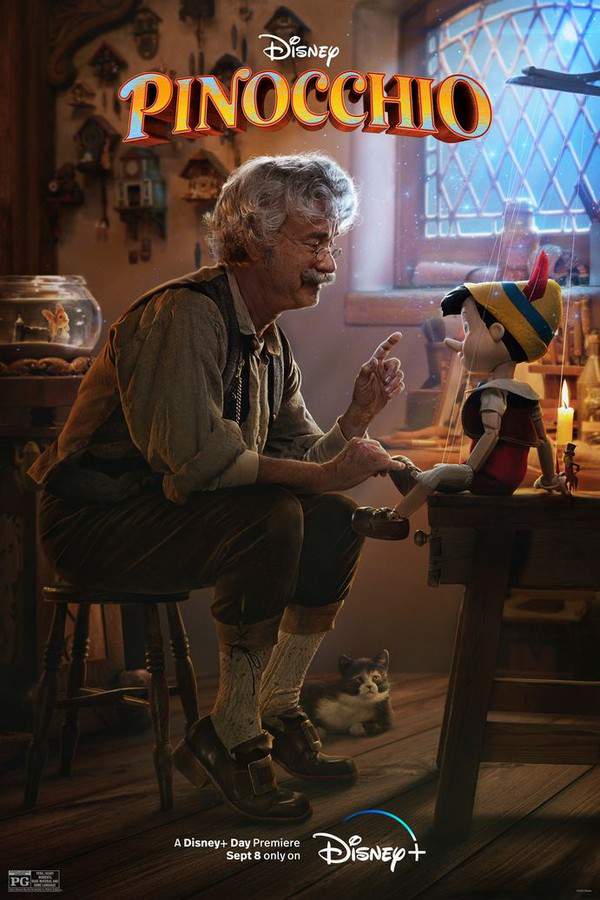
Geppetto, Howard Ryshpan, an elderly inventor who cherishes old‑world magic, creates Pinocchio, a robot designed to be his son. In the same city, the ambitious mayor Scamboli, Malcolm McDowell, plots to erase nature in favor of a gleaming, technology‑driven utopia. He dreams of turning the town into Scamboland, a kids‑only paradise where he can control every moment of fun and suppress anything that resembles freedom for children. The plan is part of a broader effort to seize the city’s power grid, a move that threatens both the natural world and the very idea of play.
That night, Geppetto and Spencer, Howie Mandel, a quirky penguin companion, work together to bring Pinocchio to life. But Scamboli has already cut the city mains to power his Grand Opening light show, forcing Geppetto to steal electricity to keep the dream of life from fading. A city‑wide outage follows, the lights go out, and children head home—but Pinocchio awakens, and with his awakening comes a magical intervention by Cyberina, Whoopi Goldberg, a fairy who governs the magic of turning dreams into reality but with a strict moral condition.
The next morning, Pinocchio walks to school with Spencer, meeting Zach, Cynthia, and Marlène, the mayor’s daughter who sees through Scamboli’s cynicism but is drawn into his grand design. Marlène challenges Pinocchio to an Imagination game hosted by Cyberina, where creativity is celebrated, but Pinocchio’s competitive drive leads him to steal Marlène’s medal after he believes he performed better. This petty act triggers a chain of choices that pull Pinocchio toward Scamboli’s orbit. In a fateful encounter, Pinocchio is captured by Scamboli’s robotic henchmen, Cabby and Rodo, and brought before the mayor, who is delighted by the potential he sees in a living toy; Pinocchio’s words, > Life would be great if kids were more like us, spark a chilling plan in Scamboli’s mind.
Scamboland officially opens as Pinocchio becomes a central attraction. When Geppetto tries to bring his son home, he is too late to stop Pinocchio’s spotlight moment—until Scamboli executes a new twist: he has Pinocchio perform as part of a spectacular show. In the chaos, Scamboli abducts Geppetto, proving that his version of progress comes at real human costs. Meanwhile, all of the city’s children board an ominous roller coaster ride called “A Whale of a Change,” which transfigures them into Scambobots—indistinguishable from real children but mind‑controlled by Scamboli’s scheme. Pinocchio, unsettled by the consequences, returns Marlène’s medal and grows closer to her, sharing a quiet night in her private garden, a moment of humanity in a place built to erase it.
The next morning, Marlène discovers that Scambobots have damaged her garden, a cruel reminder of the harm Scamboli’s plan has caused. Pinocchio’s laughter at Marlène’s loss exposes his complicity in the damage, and she withdraws from him, reclaiming distance from the friend she once hoped to trust. Pinocchio recognizes his mistake and sets out to find his father. Returning home, he discovers Spencer and, more chillingly, that Geppetto has been turned into a robot by Scamboli so the mayor can use him to eliminate Pinocchio. The pair steals a remote that controls the Scambobots, and a tense chase leads them to the Tunnel of Danger, where Scamboli tries to trap them in a series of deadly challenges.
Marlène arrives, offering help and courage, just as Scamboli deactivates her, threatening Pinocchio with a laser. Pinocchio shields himself with Marlène’s medal, and the laser reflects back, taking out Scamboli’s weapon in a symbolic reversal of power. In the ensuing struggle, Cabby accidentally hands Geppetto the master remote that controls all Scambobots, and he uses it to command the robots to target Scamboli. The mayor attempts a desperate escape in Cabby’s shuttle, but a Scambocop corners him and plunges him toward the space of the Whale ride below.
Pinned inside the whale, Pinocchio, Geppetto, Marlène, and Spencer work to reverse the transformation and restore the children to their human forms. Scamboli presses a final button to stop the process, but Pinocchio, determined to set things right, climbs into the ride’s inner workings and crafts a daring, self‑reflective plan—he tells lies about how great Scamboli is, hoping to buy time. His growing deception becomes a tool, but when the cart reopens and speeds forward, Scamboli is caught in the ride’s machinery, and Pinocchio finally accepts responsibility for his role in the catastrophe.
Overwhelmed by guilt, Pinocchio breaks down as Cyberina returns to witness his growth. He speaks of having learned the difference between right and wrong, and, in a moment of restored faith, Cyberina grants his wish in a transformative twist: Pinocchio becomes a real boy, and Geppetto is restored to human form. The city breathes again as Scamboli—now a robot—summons a last‑ditch threat. Yet Cyberina, aided by Cynthia’s magical “Funbrella,” brings back sunlight and life to the landscape, rejuvenating the plants that Scamboli had erased.
This ending fuses technology with humanity, underscoring that progress must harmonize with nature rather than replace it. The tale leaves readers with a hopeful note: the bonds between a devoted father, an earnest boy, a principled young ally, and a loyal penguin friend prove stronger than any machine, and even the most power‑hungry ambitions can be tempered by learning, responsibility, and kindness.