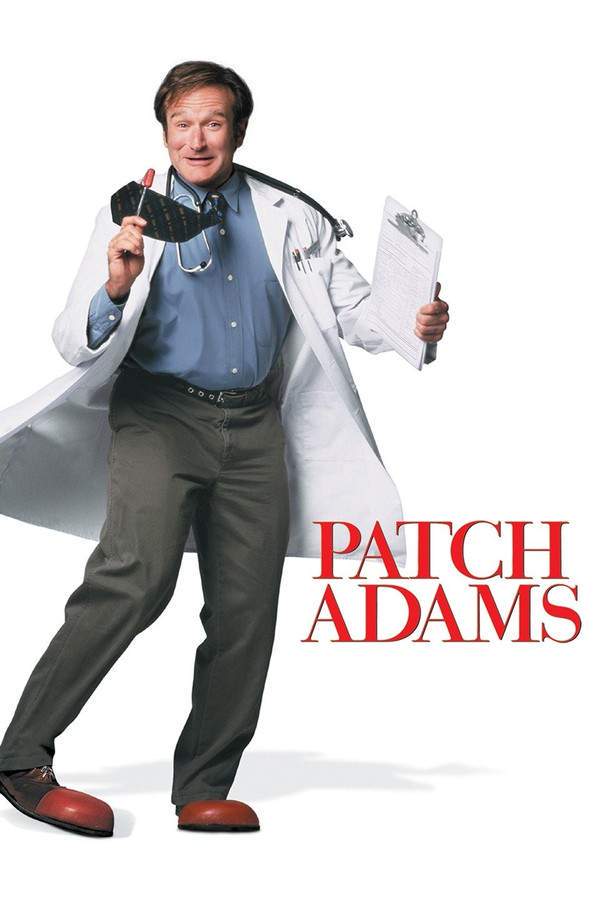
In 1969, Hunter 'Patch' Adams, Robin Williams after developing suicidal thoughts, admits himself to a mental institution. There, he discovers that humor and human connection can ease pain more effectively than traditional doctor-centered psychotherapy, giving him a renewed sense of purpose. This experience steers him toward a dream of becoming a medical doctor, and he leaves the facility with that goal in mind. Two years later, he enrolls at the Medical College of Virginia as its oldest first-year student, ready to challenge a system that often feels sterile and impersonal.
Adams quickly questions the school's approach to care, especially the way students are kept away from patients until their third year, and he clashes with the stern dean Walcott, who distrusts his unorthodox methods. His persistence earns him both friction and, eventually, a measure of respect as it becomes clear that his unconventional tactics frequently improve his patients' physical and mental well-being. At times, this friction lands him in trouble—he is expelled from the medical school, only to be reinstated when the results of his humane approach become undeniable.
During this turbulent period, he forms a close friendship with fellow student Carin Fisher and begins to sketch out his vision for a clinic rooted in humor, compassion, and patient autonomy. With the support of Arthur Mendelson, a wealthy former patient from the mental hospital, Adams purchases 105 acres (42 hectares) in West Virginia to build the Gesundheits! Institute—the sanctuary where the mission can grow. When the clinic finally opens, the team treats patients regardless of insurance status and stages lighthearted sketches to lift spirits while tending bodies.
The relationship between Adams and Fisher deepens into romance, and she confides a painful secret from her past—that she was molested as a child. He helps her see that healing can come through service to others, and inspired by this, Fisher volunteers to help a troubled patient, Lawrence "Larry" Silver. Tragedy strikes when Silver murders Fisher with a shotgun before taking his own life in a murder-suicide. Stunned and guilt-ridden, Adams grapples with the fragility of goodness in people. He confronts despair from a cliff, contemplating his own life, and asks for guidance from a higher power. A fluttering butterfly appears, symbolizing Fisher’s wish that she could turn into a butterfly and fly free; revitalized, he resolves to carry her memory forward through his work.
Walcott later uncovers that Adams has been running a clinic without a license and moves to expel him once more. In response, Adams takes his case to the state medical board, arguing that healing must address both spirit and body. Though the board finds his methods unconventional, they recognize the value of his humane approach and permit him to graduate, prompting a standing ovation from a packed room.
At the commencement ceremony, Adams earns his Doctor of Medicine degree, and, in a final, defiant moment of vulnerability and humor, bows to the professors and audience and reveals he is naked beneath his cap and gown, a symbolic gesture of honesty and authenticity that encapsulates his lifelong commitment to treating people with dignity, humor, and heart.