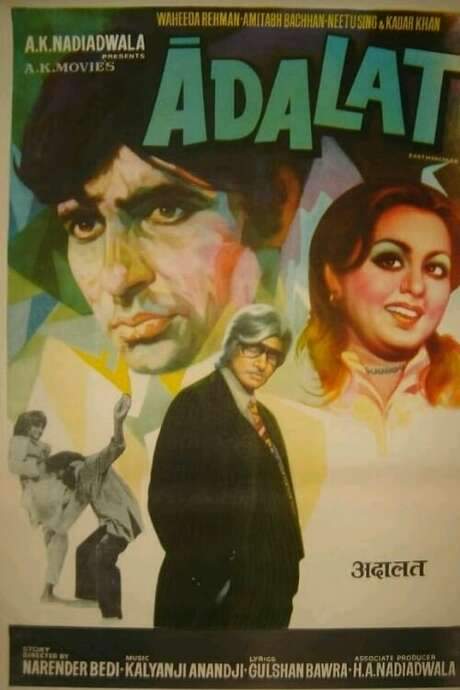
Razia Sultana is introduced at the very start of the story in a courtroom drama where the judiciary hands down a death sentence, sparked by a vow from a pregnant woman to enroll her stillborn son in the army and to name him Chakradhar. Time moves forward, and the young Chakradhar grows into a celebrated film star, a path that earns quiet disapproval from his mother. In the wings, a dedicated fan named Sheela Kaur watches with admiration and a crush on the charismatic performer. Amid this backdrop, Colonel Jitendra steps in with a bold idea—Major Jai Simha—presented as a concept and narrated with crisp clarity, setting the stage for a dual identity that will unfold later in the narrative.
Chakradhar embodies an improbable rise to fame that sits uneasily beside his mother’s worries, but his life takes a sharper turn when the film world intersects with duty and national pride. Jai Simha emerges as a figure of fierce patriotism, a man who defies disrespect toward the National Anthem and refuses to bow to ceremonial slights, even if it means publicly challenging powerful figures. His unyielding devotion to his country becomes a pillar of his persona, and he moves through life with a sense of purpose that borders on myth.
The plot pivots to a dramatic sequence at the wedding of Jai Simha’s junior Ramakrishna’s sister, Rajani. There, tragedy strikes as Ramakrishna dies and Rajani is abducted by the son of an ambitious MP known as Dadaji. Jai Simha races to the rescue, frees Rajani, and eventually they marry, a union that stitches together personal courage and political tension. But the legal system soon challenges him: a case is filed against Jai Simha by Dadaji, and Jai Simha must defend himself—emerging not guilty and issuing a stern warning to his political adversaries. This clash of personal courage and public politics further deepens Chakradhar’s immersion into the Jai Simha archetype, a transformation that the story emphasizes with quiet intensity.
As the narrative broadens, Jitendra introduces Chakradhar to Brigadier Siva Kumar and, to Chakradhar’s astonishment, he encounters a man who looks exactly like Jai Simha lying in a coma. The intrigue deepens when Major Jai Simha captures a dangerous terrorist, Afzal Gani. In a calculated move to secure Gani’s release, Gani’s faction abducts MP Dadaji, a schemer in league with the wrong side of power. Jai Simha orchestrates a daring rescue, using a ruse to misdirect the public gaze by implying that Razia Sultana is the MP’s daughter. The national accolades pour in for Jai Simha after the mission, culminating in the Maha Vir Chakra, yet behind the triumph, Razia Sultana secretly seizes the arrangement to free Afzal Gani, introducing a powerful complication to the case.
The country’s mood shifts as Jai Simha is branded a traitor and faces a harsh court-martial, ending up imprisoned. In a brutal turn, Afzal Gani schemes to annihilate Jai Simha’s family, and the terrorist manages a breakout from prison. A catastrophic blast at a school function becomes the turning point: Jai Simha diverts his path to shield his loved ones, paying a near-fatal price. He returns home gravely injured to find his family dead, with only Rajani alive, and collapses into a coma, leaving the nation to grapple with the tragedy.
Back in the present, Jitendra and Brigadier Siva Kumar enlist Jai Simha undercover, recruiting Chakradhar to clear Jai Simha’s name. Intelligence reveals a covert operative, Mohd Shafi, who is meant to provide crucial information about a larger conspiracy. The twist reveals that the man they trusted as a hero may not be what he seems, and Chakradhar accepts the mission with renewed resolve. However, the plan goes awry when Mohd Shafi is betrayed, handing a pen drive to Chakradhar and triggering suspicions that something deeper is at play.
Tragedy compounds as Jai Simha dies and Rajani dies on her husband’s lap, sealing the sorrow at the heart of the saga. Devotion to truth and justice drives Chakradhar to uncover the truth behind the deception, vowing to make the nation salute Jai Simha and to unmask Brigadier Siva Kumar as a renegade who has manipulated events from behind the scenes. In a climactic confrontation, Chakradhar captures the true culprits and demonstrates Jai Simha’s innocence before the judiciary, which then restores Jai Simha’s standing posthumously. With clarity restored, Chakradhar lays out his own mission: to accept the Param Vir Chakra on behalf of Jai Simha, who paid the ultimate price.
In the final act, the judiciary clears Chakradhar, and his mother watches with a quiet pride as the nation pauses to honor Major Jai Simha’s immortal sacrifice. The film closes on a solemn note, affirming the idea that courage, loyalty, and duty endure beyond the individual identities that momentarily define them, and that the memory of a true patriot remains a guiding beacon for the country.