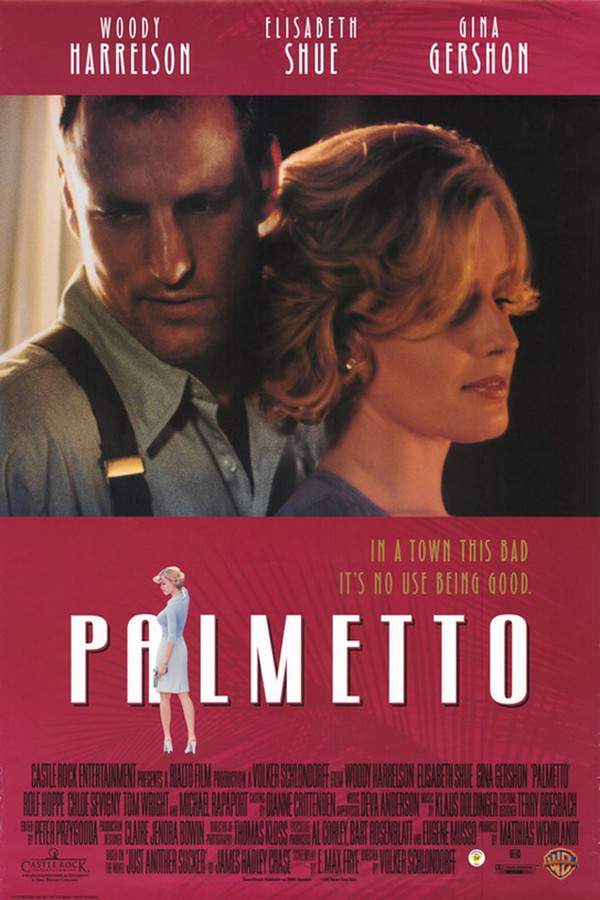
Harry Barber, Woody Harrelson, is a former Florida newspaper reporter who ends up in prison after being framed in a local corruption scandal. Before his arrest, he exposed widespread graft within Palmetto’s town government, and when he refuses a bribe meant to silence him, suspicious funds mysteriously appear in his bank account. The combination of blowback and the tainted money seals his fate, and he spends years behind bars until a former police officer’s testimony clears him and secures his release.
Back in Palmetto, he returns with his patient girlfriend Nina, Elisabeth Shue, who has waited for him through the uneasy years apart. Finding steady work elusive, he drifts between the local bar and the shadows of a town that still seems to owe him something while bitterness toward officials lingers in the air. The surface calm of his comeback is disrupted when he meets Rhea Malroux, Gina Gershon, the glamorous wife of the town’s wealthiest man, who tests his ambitions with a seductive proposal: help her and her daughter Odette pull off a fake kidnapping to extort $500,000, with Harry taking a 10 percent cut.
Temptation wins him over. Harry undertakes a careful vetting of the operation: he visits the Malroux mansion to confirm Rhea’s identity, arranges a private conversation with Rhea, and then meets Odette to ensure her involvement. After these checks, he agrees to participate, drawn by the promise of fast money and the thrill of the game. When Odette disappears as planned, the plot triggers the police interest, and a top detective—Harry’s brother-in-law—knows his background in journalism and asks him to help manage the press so investigators won’t derail the scheme. Harry becomes entangled in both the criminal plan and the police investigation, a precarious double life that heightens the stakes and the danger.
The turning point arrives when Harry returns to his bungalow to find Odette dead. He uses a secretly recorded negotiation with Rhea Malroux to attempt leverage, but Rhea responds with brutal cunning by dispatching her boyfriend to dispose of Odette’s body. The situation tightens further when the real Odette later turns up dead in Harry’s own home, throwing the investigation into a whirlwind of confusion and fear. The authorities close in on the truth, and Harry decides to cooperate with them, helping to unravel the conspiracy and bring the principal criminals to heel.
Confrontations unfold as Harry faces Rhea’s husband and lays out every facet of the scheme, only to discover a shocking twist: the woman posing as Rhea Malroux is not the real partner at all but the gardener in disguise. She and her boyfriend, Donnelly, orchestrate a grim payoff plan, kidnapping Harry and Nina from the Malroux residence with the aim of killing them by lowering them into a barrel of acid. Harry, equipped with a hidden recording device, signals the police just in time. Donnelly plunges into the acid, and the imposter is arrested, revealing the extent of the deception that surrounded the entire affair.
Yet the fallout is not simple absolution. Even though Harry helps capture the true criminals, he is arrested himself for his role in the kidnapping plot. He serves a brief sentence, and in a quiet, reflective turn, writes a novel inspired by his experiences, hoping the manuscript might someday make its way to the screen as a film. Through it all, the story remains a gritty meditation on justice, guilt, and the uneasy costs of trying to outwit a corrupt town.