Plot Explained Spoilers guaranteed!
Plot Explained

Browse by genre

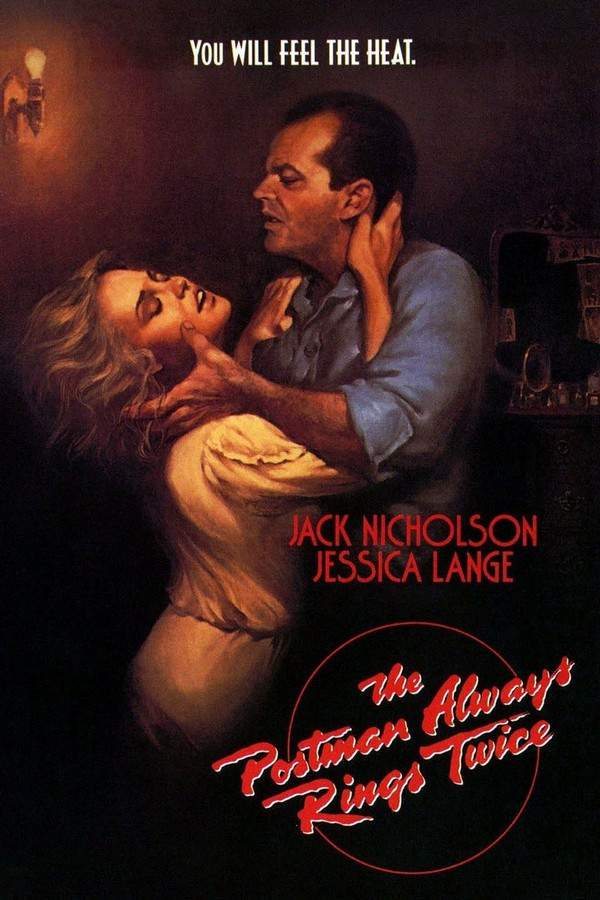
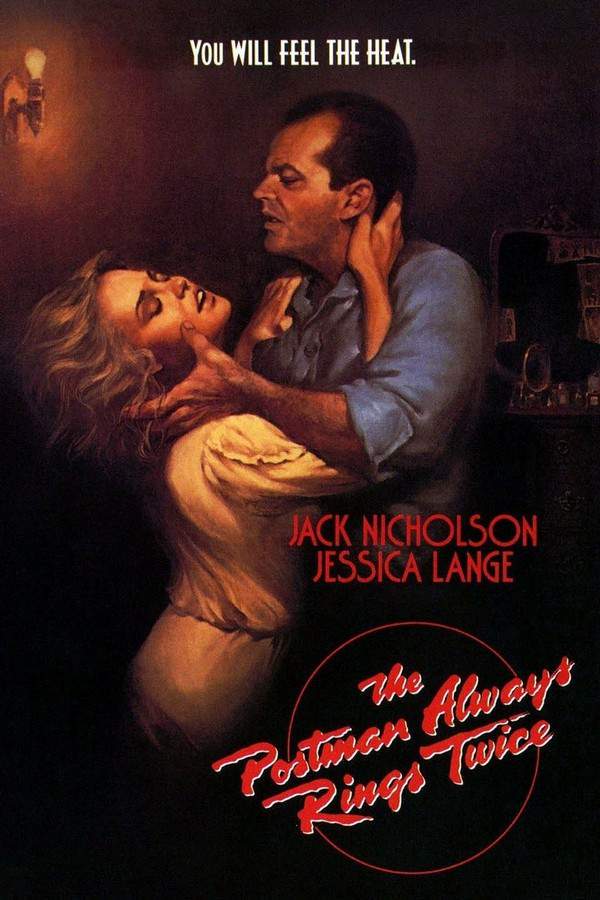
The Postman Always Rings Twice (1981) movie poster

Plot Summary

The Postman Always Rings Twice (1981) Plot Summary Explained

Release, runtime and language
1981 · 122 min · English
Directed by
Bob Rafelson
Starring
Jack Nicholson, Jessica Lange

Frank Chambers, a drifter, becomes involved in a dangerous situation after meeting Cora Papadakis and her husband at their roadside diner. A passionate and forbidden love affair develops between Frank and Cora, leading them to plot the husband's death. Their desperate scheme sets off a series of tragic consequences and escalating tensions, ultimately leading to a deadly confrontation where survival is uncertain.

On this page (7)
  1. 1 Where to watch
  2. 2 What happens: full plot
  3. 3 Plot questions answered
  4. 4 The book behind the movie
  5. 5 Movie threads
  6. 6 Movies like The Postman Always Rings Twice
  7. 7 Every angle

Where to watch

Where to Watch The Postman Always Rings Twice (1981)

Where can you watch The Postman Always Rings Twice? Stream, rent or buy it in the US, including on Apple TV Store, Fandango At Home and Google Play Movies: current JustWatch availability with up-to-date prices.

Streaming availability powered by JustWatch

Full plot summary · contains spoilers

What Happens in The Postman Always Rings Twice: Full Plot Summary

The whole story of The Postman Always Rings Twice (1981) explained, from the opening scene to the final frame: every key event, every twist and what it all adds up to. Read it as a quick recap before the sequel, to check a scene you missed, or to finally understand what really happened.

As the sun sets, casting a warm orange hue over a rustic landscape, Drifter Frank Chambers (Jack Nicholson) catches a ride with District Attorney Kyle Sackett. Their journey takes them to Twin Oaks, a quaint diner and service station tucked away in the hills outside Los Angeles. Little does Frank know, this seemingly ordinary stop will entangle him in a complex web of desire and betrayal. Under the scrutinizing gaze of the stern Nick Smith and his captivating young wife Cora (Jessica Lange), Frank becomes a resident of Twin Oaks, where he soon learns the intoxicating pull of forbidden love.

Cora, entrapped in a joyless marriage, yearns for a life beyond her current confining existence. When her gaze falls upon Frank, an undeniable spark ignites between them, leading to a clandestine romance. However, as their passion intensifies, so does Cora's sense of desperation. She seeks liberation, proposing an audacious plot to murder her husband,Nick, to claim Twin Oaks as their own. The plan involves Cora striking Nick with a sock filled with weighty ball-bearings, staged as an accidental fall in the bathtub. Their scheme, however, is derailed by an unanticipated visit from law enforcement and a playful cat's interference, setting off a chain of unforeseen events.

In the ensuing chaos, Cora decides to take decisive action by delivering a brutal blow to Nick, severely injuring him but somehow ensuring he survives. As Frank and Cora work side by side at Twin Oaks, their fleeting happiness fades quickly. A fateful meeting with a police officer reveals that Cora has been responsible for driving Nick home from the hospital, shattering any hopes Frank harbored for a future with her. Disillusioned and heartbroken, he resolves to leave behind his dreams of life with Cora.

Weeks slip by as Frank meanders through the vibrant city markets, still searching for signs of Cora and reminiscent of Twin Oaks. His wandering leads him back to the very same marketplace where Nick and Cora buy their groceries, where their eyes meet once again. A revelation hits, as Nick has been searching for Frank, urging him to return to Twin Oaks, declaring, > "something important's gonna happen tonight, and you're in on it." The atmosphere crackles with tension as their intertwined destinies approach a climactic moment under the night sky.

Frank's return to Twin Oaks stirs various emotions within Cora as the trio shares a fraught dinner. During this uneasy gathering, Nick announces his intention to leave the estate for northern Canada with Cora and her sick sister. As the evening unfolds, Cora's distress becomes palpable, and in the kitchen, Frank discovers her gripping a knife, threatening to harm herself. In a stunning turn of events, Frank agrees to eliminate Nick, drawing them into a perilous game of manipulation.

The next day, they set off for Santa Barbara, crafting a scheme to stage a drunken-driving incident. However, despite their careful planning, they finding themselves interrupted by Sackett's sudden arrival. Amidst the chaos, an argument ensues about who will drive, and on a desolate road, Frank seizes an opportunity to strike Nick down with brutal force, leading the car to plummet off the cliff. Yet, Frank finds himself caught in the aftermath, sustaining injuries that will linger painfully.

The District Attorney capitalizes on the turmoil, pressing murder charges against Cora to sever the bond between her and Frank. While this tactic initially seems effective, Cora's lawyer, Arthur Keats, skillfully thwarts the prosecutor's attempt to extract a full confession. Ultimately, Cora manages to negotiate a plea deal, admitting guilt to manslaughter and receiving probation.

The media frenzy surrounding Nick's death paradoxically boosts Twin Oaks' popularity. However, the tension between Frank and Cora simmers beneath the surface, ultimately boiling over into a marriage of convenience, meant to keep them from testifying against one another. When Cora leaves to care for her ailing mother, Frank finds solace in a brief affair with another woman.

Upon Cora's return, a private investigator named Kennedy attempts to blackmail her with a signed confession. In a fit of rage, Frank retaliates, violently confronting both Kennedy and his associate, reclaiming the damning evidence. A fierce discussion ignites between Frank and Cora over his infidelity, but they eventually find common ground and reconcile their differences.

As Cora reveals her pregnancy, speculating that their fresh start might balance the scales of the life they took from Nick, they share a tender moment at the beach, reigniting their love for one another. Yet, this serene interlude proves fleeting. Frank's reckless driving leads to a tragic accident, claiming Cora's life.

In the somber aftermath, Frank faces the grim reality of standing accused of Cora's death, the burden of his guilt weighing heavily on him. He confronts the harsh truth of his situation when visited by a priest who offers a compassionate ear, alongside Sackett, whose relentless pursuit of justice brings forth compelling evidence linking Frank to Nick's death. With a penetrating look, Sackett emphasizes the reality: resisting justice and grappling with Cora's tragic end will only entrap Frank in a continuous cycle of guilt and violence. Accepting the grim truth, Frank acknowledges that despite his innocence regarding Cora's death, his execution serves as a moral reckoning for the life he unjustly took from Nick— a poignant reminder of the unyielding consequences of one's actions.

Last updated: November 21, 2024 at 14:58

Was this helpful?

Plot questions answered

The Postman Always Rings Twice Plot Explained: Your Questions Answered

The questions people ask most about The Postman Always Rings Twice (1981): what happens in the confusing scenes, why the characters do what they do, the twists, hidden details and what the ending means. Each answer contains spoilers.

Q1

Why does Frank agree to kill Nick after initially refusing?

Frank initially refuses Cora's plea to kill Nick, but changes his mind after Nick announces he's taking Cora to northern Canada with her sick sister. This triggers Frank's desperation as he realizes he'll lose Cora forever. The threat of losing her, combined with the emotional tension of the dinner scene where Cora is visibly distressed and holds a knife to her own throat, pushes Frank to agree to the murder plot.

Foreshadowing: Earlier, Cora had proposed the murder plan during their affair, but Frank was hesitant, his change of heart is triggered by the realization that Cora will be taken away.

  • frank chambers
  • nick smith
  • cora papadakis
  • murder plot
  • motivation
Q2

Why does Cora drive Nick home from the hospital?

After Cora's brutal attack left Nick severely injured but alive, she made a calculated decision to care for him as a way to maintain her cover and avoid suspicion. By playing the devoted wife and driving him home from the hospital, she ensures that neither Frank nor anyone else will suspect her of the attack. This act simultaneously keeps her appearance of innocence intact while she continues her affair with Frank.

Foreshadowing: Cora has already shown she's capable of violence and deception when she attacked Nick with the weighted sock, her hospital的行为 is an extension of this manipulation.

  • cora papadakis
  • nick smith
  • hospital
  • deception
  • cover up
Q3

Why does the District Attorney charge Cora with murder?

District Attorney Kyle Sackett deliberately charges Cora with Nick's murder to break apart her relationship with Frank. Sackett believes that by threatening Cora with capital murder charges, he'll force her to testify against Frank in exchange for a lighter sentence. This tactic is meant to separate the lovers and ensure one will turn on the other, making prosecution easier.

Foreshadowing: Sackett had given Frank a ride to Twin Oaks at the beginning, his interest in the case goes beyond justice and involves manipulating the romantic triangle.

  • kyle sackett
  • cora papadakis
  • murder charge
  • district attorney
  • prosecution
Q4

Why does the first murder attempt fail?

Cora's first attempt to kill Nick by striking him with a sock filled with ball-bearings in the bathtub fails due to two interruptions: law enforcement unexpectedly arrives at Twin Oaks, and a playful cat jumps onto the scene, causing chaos. These interruptions force Cora to abort the staged accident and delay their plan, giving Nick time to recover from the initial attack.

Foreshadowing: The cat appears earlier in the diner as a seemingly innocent detail, its interference at the critical moment underscores how their crime is cursed from the start.

  • murder attempt
  • cora papadakis
  • nick smith
  • failed plan
  • cat
Q5

Why does Frank marry Cora after Nick's death?

Frank and Cora marry as a practical arrangement rather than from genuine love. Both are afraid of testifying against each other in court, so marriage provides legal protection, spouses cannot be forced to testify against each other. Their relationship is fractured by guilt, trauma, and Frank's infidelity, making their marriage a prison of their own making rather than a romantic union.

Foreshadowing: Their affair began as a desperate escape from their circumstances, now their marriage becomes another cage formed by the same desperation.

  • frank chambers
  • cora papadakis
  • marriage
  • testimony
  • legal protection
Q6

Why is Frank executed for Cora's death when he's innocent of that crime?

Frank is executed for Cora's death as moral retribution for killing Nick, even though he's technically innocent of causing the car accident that killed her. The priest and Sackett make clear that Frank's execution serves as justice for the life he took from Nick, a poetic irony where the man who escaped legal consequences for murder finally faces execution for a death he didn't cause. It's the universe's balancing of the moral scales.

Foreshadowing: The story consistently punishes the characters for their crimes, Nick dies, Cora dies, and Frank's fate is sealed by the very murder he committed.

  • frank chambers
  • execution
  • cora papadakis
  • nick smith death
  • moral reckoning
Q7

What happens to Nick after the car accident?

Nick dies in the car accident staged by Frank and Cora. While Frank attacks Nick on the desolate road during their drunk-driving scheme, the struggle causes the car to plunge off the cliff. Nick's death is the result of this violent confrontation, not merely a staged accident, the murder is real and becomes the central crime for which Frank is later tormented.

Foreshadowing: The failed first attempt earlier in the film shows that their murder plots consistently spiral out of control, previewing how the car accident becomes a real killing.

  • nick smith
  • car accident
  • death
  • murder
  • frank chambers
Q8

Why does Kennedy the private investigator blackmail Cora?

Private investigator Kennedy obtains a signed confession from Cora regarding Nick's murder and uses it to blackmail her for money. The confession is damning evidence that could send both Cora and Frank to prison. Kennedy exploits their vulnerable position, their crime, their guilty consciences, and their financial situation, to extract money, until Frank violently confronts him and reclaims the confession.

Foreshadowing: The confession was likely signed during the legal proceedings, Kennedy's blackmail demonstrates that their crime continues to haunt them even after Nick's death.

  • kennedy
  • private investigator
  • blackmail
  • confession
  • cora papadakis
Q9

Why does Frank have an affair while Cora is away?

Frank has a brief affair with another woman while Cora is away caring for her sick mother. This occurs during a period when their relationship has already deteriorated, Frank is grappling with guilt over Nick's murder, the strain of their criminal past, and the transactional nature of their marriage. The affair represents Frank's emotional breakdown and his inability to maintain fidelity even in their troubled union.

Foreshadowing: Frank's nature as a drifter who never stays in one place foreshadows his inability to commit fully to Cora or their marriage.

  • frank chambers
  • affair
  • infidelity
  • cora papadakis
  • marriage problems
Q10

Why does Cora reveal her pregnancy at the beach?

Cora reveals her pregnancy to Frank at the beach as a desperate attempt at redemption and a fresh start. She hopes that the news of their child will help them finally escape their troubled past and build a legitimate life together. The beach scene represents a brief moment of hope and renewal before tragedy strikes, when Frank's reckless driving causes the accident that kills Cora and their unborn child.

Foreshadowing: The beach is the setting for their most vulnerable, hopeful moment, the tragedy that follows is inevitable given the film's dark, inescapable tone.

  • cora papadakis
  • pregnancy
  • beach
  • fresh start
  • hope
Q11

Why does Frank's reckless driving cause the fatal accident?

Frank's reckless driving leads to the accident that kills Cora, though it's presented as tragic carelessness rather than intentional harm. Overwhelmed by guilt, trauma, and perhaps subconscious self-destruction, Frank drives recklessly, a choice that results in the car crashing and killing Cora. The accident underscores the film's theme that their crimes have corrupted everything, including Frank's ability to protect the one person he claims to love.

Foreshadowing: Frank has consistently made dangerous, impulsive decisions throughout the film, from agreeing to murder to the violent attack on Nick, his reckless driving is the culmination of his destructive pattern.

  • frank chambers
  • car accident
  • cora papadakis
  • reckless driving
  • fatal accident
Q12

Why does Arthur Keats defend Cora in court?

Arthur Keats is Cora's lawyer who helps her secure a plea deal after she's charged with Nick's murder. Keats skillfully undermines the District Attorney's strategy to make Cora testify against Frank. He negotiates a plea deal where Cora admits to manslaughter rather than murder, receiving probation instead of prison time. Keats operates as a criminal defense attorney willing to use legal tactics to protect his client, though his motivations aren't purely altruistic, he's paid for his services.

Foreshadowing: The legal system in the film is portrayed as manipulated by powerful men (Sackett) and defended by cunning advocates (Keats), the courtroom becomes another battleground.

  • arthur keats
  • lawyer
  • cora papadakis
  • plea deal
  • court defense

Movie threads

More Movies Like The Postman Always Rings Twice, by Mood & Story

Curated lists built around what makes The Postman Always Rings Twice tick: the same mood, the same kind of story or the same emotional payoff. Each list explains why these movies belong together.

Fatalistic Doomed Romance movies like The Postman Always Rings Twice

When a passionate affair spirals into crime, sealing a tragic fate. If you liked the steamy, desperate affair leading to murder in The Postman Always Rings Twice, explore more movies about doomed lovers. These films feature illicit romances that trigger a crime, resulting in a tense, morally complex narrative with an inescapably tragic conclusion.

  • fatalistic
  • doomed
  • steamy
  • desperate
  • tense
  • tragic
  • Tone: dark, fatalistic, tense
  • Pacing: steady, deliberate
Why these movies?

The story pattern: The narrative follows a predictable, yet compelling, downward spiral: an intense romantic connection creates a desperate situation, forcing the characters to commit a heinous act. Despite their belief they can outsmart fate, external forces and their own guilt conspire to ensure their ultimate downfall, often through death or imprisonment.

Why they belong together: Movies in this thread are grouped by their shared core of a romance that is both the motivation for and the victim of a crime. They consistently deliver a dark, tense, and heavy emotional experience, underscored by a sense of fatalism where happiness is never a possible outcome.

Moral Reckoning Crime Thrillers similar to The Postman Always Rings Twice

Stories where a single criminal act unravels into inescapable consequences. Fans of The Postman Always Rings Twice will appreciate these similar crime thrillers centered on moral reckoning. These films explore the heavy consequences of a murder, focusing on the psychological unraveling and fatalistic justice that befalls the criminals, rather than a typical whodunit plot.

  • tense
  • fatalistic
  • anxious
  • claustrophobic
  • desperate
  • melancholic
  • Tone: dark, bleak, tense
  • Pacing: steady, methodical
Why these movies?

The story pattern: The plot is triggered by a decisive, immoral action—usually murder. The remainder of the story documents the gradual collapse of the perpetrators' world as their plan frays. The narrative structure is often about the irony of their punishment, where they are ultimately condemned not for the crime they got away with, but for a twist of fate that serves as poetic justice.

Why they belong together: These films are united by their thematic exploration of cause and effect in a moral universe. They share a dark, heavy tone and a steady pacing that builds dread, making the viewer a witness to an inevitable collapse rather than a solver of a puzzle.

If you liked this

Movies Like The Postman Always Rings Twice

Similar movies to The Postman Always Rings Twice: the same genre, themes or kind of story. Each one comes with its own plot summary, timeline and ending explained.

Browse all movie summaries

Every angle

The Postman Always Rings Twice (1981) Explained: Plot, Timeline & Characters

Everything about The Postman Always Rings Twice in one place: what happens in the plot summary, the timeline in chronological order, the characters and meaning and a spoiler-free summary. What's After the Movie adds the cast, box office and post-credit scenes.

Coming soon on iOS and Android

The Plot Explained Movie Summary App

Plot summaries, endings explained and timelines on your phone. Catch up on any movie in minutes, save your favorites and never miss a twist again.

Be the first to know when we launch. Your email stays private, always.

Learn more about the app