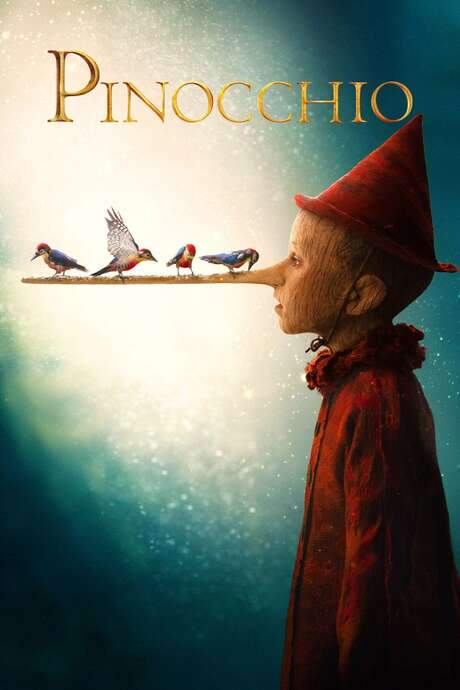
Aged woodcarver Geppetto creates a wooden puppet named Pinocchio, who miraculously comes to life. Eager for adventure, Pinocchio is easily tempted from the right path, encountering enchanting creatures and extraordinary sights. Along his journey, he makes both friends and enemies, all while yearning to become a real boy. Achieving this dream depends on him learning valuable lessons and changing his ways.
Find where to stream, rent, or buy Pinocchio (2019) in the US with current JustWatch availability, up-to-date pricing, and platform listings for subscription, rental, and digital purchase options.
Warning: spoilers below!
Haven’t seen Pinocchio yet? This summary contains major spoilers. Bookmark the page, watch the movie, and come back for the full breakdown. If you're ready, scroll on and relive the story!
Read the complete plot breakdown of Pinocchio (2019), including all key story events, major twists, and the ending explained in detail. Discover what really happened, and what it all means.
A poor Italian carpenter named Geppetto Roberto Benigni decides to carve a wooden puppet to travel the country and earn a living, hoping it might become a more helpful companion than a simple tool. He names the new creation Pinocchio Federico Ielapi, and when the puppet comes to life, Geppetto treats him as a son rather than a toy. A wise Talking Cricket Davide Marotta tries to offer guidance, warning Pinocchio about trouble and the consequences of lying, but the spirited puppet often ignores the advice and learns lessons the hard way. The first mistake is a reckless incident near the fireplace that burns Pinocchio’s feet, a blunder that prompts Geppetto to promise new feet if his boy will attend school and behave with care. The scene sets a gentle moral tension: the boy can choose duty or danger, and his future hangs on the choices he makes.
Pinocchio sets off toward school, buoyed by the hope of becoming a good pupil, but his curiosity and charm pull him toward a thriving puppet theatre that captivates him and his peers. He joins the other living puppets in a performance, and in the chaos of the show, his enthusiasm borders on mischief, disrupting the routine and drawing the ire of the theater’s master. Furious, Mangiafuoco Gigi Proietti confronts Pinocchio, locking him in his caravan and leaving town with a heavy heart for the moment. Pinocchio begs to return to his father, his urgency tempered by a newfound willingness to listen, and Mangiafuoco, moved by a spark of compassion, forgives him—though not before burning another puppet for firewood in the process. Pinocchio’s willingness to sacrifice for others—choosing to take the puppet’s place—reveals a change in him, and Mangiafuoco rewards the moment with five gold coins to bring back to Geppetto. The exchange becomes a catalyst, a test of honesty and loyalty that sets Pinocchio on a more perilous path homeward.
On his journey back, Pinocchio encounters the Fox and the Cat, two con artists who pretend to be disabled to prey on travelers. The Fox, a sly schemer, and the Cat, who feigns blindness, entice Pinocchio with the coins and tout a shortcut to wealth by sowing the money in the Field of Miracles, a magical place said to sprout wealth in the Land of the Barn Owl. Their plan is sly and dangerous: they deceive Pinocchio and disguise themselves as hooded assassins to trap him. Pinocchio, though unsure, hides the coins and tries to escape, but he is betrayed and mounted on a wooden tree as a grim trophy of their scheme. His cry for help is answered by a gentle, unexpected rescuer: a little girl—The Fairy with Turquoise Hair—who questions why a son of his own father would be wandering away from home or school. This girl, who arrives with a sense of quiet authority, becomes the turning point of Pinocchio’s moral journey. Embarrassed by his lies, Pinocchio’s nose grows longer, a tangible reminder of the harm his untruths have caused, and the Fairy is compelled to shorten it again, signaling a chance to choose honesty over deception.
Having learned a hard-won lesson, Pinocchio makes the homeward trek with a new resolve, only to discover that Geppetto has left in search of him, traveling overseas toward North America. The twist of waiting distance and longing adds a real ache to the story—the bond between father and son remains unbroken even when miles separate them. Pinocchio, determined to reunite with his father, sets out to find him, but fate takes him to treacherous seas where a shipwreck leaves him stranded on the Island of the Busy Bees. There, the Blue Fairy—now a grown woman—appears and promises to turn Pinocchio into a real boy if he studies, behaves, and embraces responsibility rather than exploiting escape routes from effort. The encounter deepens the sense that transformation depends on consistent effort, not luck or quick fixes. Pinocchio’s adventure shifts again when he goes to school and befriends Lucignolo Alessio Di Domenicantonio, a gregarious, rule-bending classmate who shows him a different path through discipline and curiosity.
Lucignolo leads Pinocchio toward the Land of Toys, a tempting realm where children indulge their desires without rules or adults. The Coachman—an enigmatic figure who orchestrates this diversion—draws them in for a day of carefree play, but the afterglow fades as the reality sinks in. After a long day, Pinocchio and Lucignolo discover they are turning into donkeys, a stark punishment for indulging in pure idleness. The Coachman sells Pinocchio to a distant circus, a harsh reminder of the costs of choices driven by temptation rather than growth. In a moment of peril and pain, Pinocchio notices the Fairy in the audience, trips, and wounds himself, a grim reminder of how danger often arises from recklessness. The ringmaster’s plan to drown him and use his skin as a drum is thwarted by the Fairy, who calls forth fishes to nibble away Pinocchio’s donkey skin and restore him to his human form, a mercy that underscores the power of mercy in the face of error.
The journey continues as Pinocchio swims again to find his father, only to be swallowed by a sea monster that is large, hungry, and dangerous. Inside the creature, Pinocchio discovers Geppetto alive and well, missing only the chance to escape until a severed asthma-laden moment allows them to slip out of the monster’s mouth and toward safety, with help from a large, friendly tuna. After this perilous escape, they find an abandoned house that becomes their makeshift home while Geppetto recovers from the ordeal. To heal his father’s illness, Pinocchio works for a local farmer, earning milk and learning the value of steady labor. Throughout this period, Pinocchio remains vigilant and kind, resisting the Fox and Cat’s old tricks and standing firm in his resolve to do right by those who care for him. The Fairy then grants Pinocchio his long-awaited wish, and with renewed purpose he returns home to show Geppetto that he has truly become a real boy.
Last updated: February 25, 2026 at 08:20
Explore frequently asked questions about Pinocchio (2019) with spoiler-rich answers covering the full plot summary, major story beats, character motivations, hidden details, and ending meaning. This movie summary FAQ helps explain confusing scenes, plot twists, and narrative decisions in clear, searchable detail.
The Fairy with Turquoise Hair causes Pinocchio's nose to grow whenever he tells a lie. This is a magical consequence that physically manifests his dishonesty. When Pinocchio lies about being a good student or wandering away from school, the nose grows longer as a visible punishment. The Fairy later shortens his nose as a reward for his honesty, reinforcing the story's central moral that truthfulness leads to redemption.
The Talking Cricket warned Pinocchio early about the consequences of lying, setting up this magical comeuppance.
Mangiafuoco gives Pinocchio five gold coins after the puppet offers to take another puppet's place in the fire. Moved by Pinocchio's selflessness and willingness to sacrifice himself for a stranger, Mangiafuoco not only forgives Pinocchio's mischief but rewards him with the coins to bring back to Geppetto. This moment serves as a test of Pinocchio's character, he passes by choosing others over himself.
Earlier, Pinocchio's reckless behavior at the theatre showed his mischievous side, making this act of sacrifice more meaningful as a turning point.
The Fairy with Turquoise Hair and the Blue Fairy are the same character. When Pinocchio first meets her as a child in the forest, she has turquoise hair. Later, when Pinocchio washes up on the Island of the Busy Bees, she appears as a grown woman with blue hair. She serves as Pinocchio's spiritual guide, helping him learn honesty and responsibility throughout his journey.
The Fairy's first appearance when Pinocchio is hung from the tree establishes her role as his protector and moral compass.
Pinocchio and Lucignolo transform into donkeys as punishment for spending an entire day indulging in carefree play at the Land of Toys without any responsibility or rules. The Coachman leads them to this realm of endless pleasure, and by evening, their indulgence manifests physically, they wake up as donkeys. This transformation is the story's consequence for choosing temporary fun over hard work and discipline.
Lucignolo's introduction as a rule-bending classmate who encourages skipping school foreshadows his role in leading Pinocchio toward temptation.
Inside the sea monster, Pinocchio discovers Geppetto is already trapped inside, having been swallowed earlier while searching for Pinocchio at sea. They are reunited in the creature's belly and manage to escape together by lighting a fire that makes the monster sneeze, allowing them to slip out through its mouth. A friendly tuna helps guide them to safety afterward.
Earlier text mentions Geppetto traveling overseas toward North America, setting up his presence at sea where the monster encounters him.
After escaping the sea monster, Pinocchio and Geppetto find an abandoned house where Geppetto is weak and ill from his ordeal. Pinocchio works for a local farmer every morning, earning milk to feed his recovering father. This marks Pinocchio's transformation from a reckless child into a responsible, selfless son who prioritizes his father's wellbeing over his own desires.
The Blue Fairy had earlier promised to turn Pinocchio into a real boy if he studied and behaved with responsibility, making this work a test of his commitment.
The Blue Fairy transforms Pinocchio into a real boy after he proves himself through honest, hardworking, and selfless behavior. Key requirements include studying diligently, resisting temptation (like the Fox and Cat's tricks), caring for his father by earning milk, and consistently choosing responsibility over pleasure. His transformation represents the culmination of learning the lessons the Fairy taught him throughout his journey.
The Fairy promised to grant his wish if he earned it through good behavior, and his actions throughout the story progressively prove his worthiness.
The Fox and Cat are con artists who trick Pinocchio by disguising themselves as hooded assassins. They convince him to plant his gold coins in the Field of Miracles, claiming it will grow into a money tree. Instead of wealth, they trap him and hang him from a tree to steal his coins. This event demonstrates how Pinocchio's naivety and desire for easy wealth make him vulnerable to manipulation.
Earlier, the Fox and Cat present themselves as disabled beggars, establishing their deceptive nature before the ambush.
Lucignolo disappears from the story after transforming into a donkey. While Pinocchio is rescued by the Fairy and restored to human form, Lucignolo's fate is never revealed, he is simply sold off by the Coachman along with other performing donkeys. His absence underscores the story's message that those who resist redemption face permanent consequences.
Lucignolo's rebellious nature and rejection of the Fairy's guidance foreshadow his lack of a rescue arc.
Geppetto leaves to search for Pinocchio after the puppet fails to return home. Learning that Pinocchio was tricked and hung from a tree, Geppetto sets off across the sea toward North America to find his lost son. This desperate search demonstrates his unconditional love and sets up their parallel journeys, Pinocchio searching for his father while Geppetto searches for him.
The Fairy questions why a son would wander from his father, hinting at Geppetto's impending departure to find Pinocchio.
The Fairy rescues Pinocchio at the circus when the ringmaster plans to drown him and use his skin as a drum. She calls forth fishes to nibble away the donkey skin, transforming Pinocchio back into a human boy. This intervention shows the Fairy's continued watch over Pinocchio and her belief in his capacity for redemption, even after his mistakes at the Land of Toys.
The Fairy had previously promised to help Pinocchio become a real boy if he behaved, establishing her ongoing investment in his fate.
Pinocchio is sold to the circus because the Coachman purchases lazy or naughty children who have transformed into donkeys at the Land of Toys, then resells them to various buyers. After Pinocchio injures himself at the circus, the ringmaster considers him worthless and plans to drown him to use his skin as a drum. This harsh fate underscores the consequences of giving in to idleness and mischief.
The Coachman's enigmatic role in transporting children to the Land of Toys establishes him as an antagonist who profits from children's poor choices.
Still wondering what the ending of Pinocchio (2019) really means? Here’s a spoiler-heavy breakdown of the final scene, major twists, and the deeper themes that shape the film’s conclusion.
In the film’s climax Pinocchio, his battered friend Spazzatura, and the grieving Geppetto are trapped inside the massive Dogfish that has swallowed them. Cricket, who has lived inside Pinocchio’s chest, devises a desperate escape: Pinocchio stretches his nose to poke the creature’s blowhole, forces the fish to sneeze, and they all burst out into open water. Their luck runs out when a hidden sea‑mine detonates, killing Pinocchio and sending his spirit to the limbo‑like realm of Purgatory.
There, a personified Death explains the cruel arithmetic of resurrection: each time someone dies, the waiting period in Purgatory lengthens exponentially. Pinocchio could return quickly enough to rescue Geppetto, but doing so would strip him of his magical immortality, condemning him to a mortal life. Ignoring the rule, he chooses to come back, saves his father, and then collapses once more, surrendering his endless existence for a single act of love.
The Wood Sprite, who originally granted Pinocchio life, arrives just as the tragedy unfolds. Seeing that Geppetto has now been forced to lose a child twice, she hesitates, but Cricket uses the single wish he was promised for caring for Pinocchio. He asks the Sprite to make Pinocchio truly alive. Rather than turning him into a flesh‑and‑blood boy, the wish gives him the gift of mortality: a finite, human‑like life.
From that point the story follows Pinocchio as he watches Geppetto age, become a grandfather, and eventually die, while his companion Spazzatura rebels against his tyrannical master and finds his own path. Cricket eventually leaves for the wider world, reflecting on whether Pinocchio’s death was ordinary or something beyond ordinary mortality. The film ends on a quiet, bittersweet note, suggesting that Pinocchio’s true transformation is not in becoming a perfect puppet‑boy, but in embracing the fragile, fleeting nature of human life—choosing self‑sacrifice, love, and humility over endless perfection.
Last updated: October 09, 2025 at 07:43
Discover curated groups of movies connected by mood, themes, and story style. Browse collections built around emotion, atmosphere, and narrative focus to easily find films that match what you feel like watching right now.
Charming stories where fantastical journeys teach clear and heartfelt lessons.If you enjoyed the blend of fantasy and morality in Pinocchio, you'll love these movies. Discover other films where magical adventures serve as heartwarming and instructive journeys, with similar light emotional weight and happy endings.
Narratives typically follow a naive protagonist on a journey where they are tempted or make mistakes, facing reversible but instructive consequences. The structure is often linear and cause-and-effect, building toward a clear moment of redemption where the protagonist learns a key lesson about honesty, bravery, or selflessness.
These movies share a specific tone that balances the wonder of fantasy with the clarity of a moral lesson. They feel cohesive because they maintain a light-hearted spirit even when tackling difficult choices, creating an experience that is both magical and meaningful.
Characters embark on extraordinary quests to fundamentally change who they are.Fans of Pinocchio's journey to become a real boy will enjoy these films about transformation. Find similar movies featuring a central character arc of growth and self-discovery, wrapped in fantastical adventures with heartfelt relationships.
The plot revolves around the protagonist's core desire to change their state of being. This external goal is achieved only after they complete an internal journey, learning the virtues or lessons that make them worthy of the transformation. The story often involves a guiding figure or a surrogate family relationship that supports their growth.
They are grouped by the powerful, emotionally resonant theme of transformation driven by personal growth. The shared narrative arc—from longing, through trial, to earned change—creates a deeply satisfying and hopeful viewing experience that connects with universal desires.
Don't stop at just watching - explore Pinocchio in full detail. From the complete plot summary and scene-by-scene timeline to character breakdowns, thematic analysis, and a deep dive into the ending - every page helps you truly understand what Pinocchio is all about. Plus, discover what's next after the movie.
Track the full timeline of Pinocchio with every major event arranged chronologically. Perfect for decoding non-linear storytelling, flashbacks, or parallel narratives with a clear scene-by-scene breakdown.
Discover the characters, locations, and core themes that shape Pinocchio. Get insights into symbolic elements, setting significance, and deeper narrative meaning - ideal for thematic analysis and movie breakdowns.
What really happened at the end of Pinocchio? This detailed ending explained page breaks down final scenes, hidden clues, and alternate interpretations with expert analysis and viewer theories.