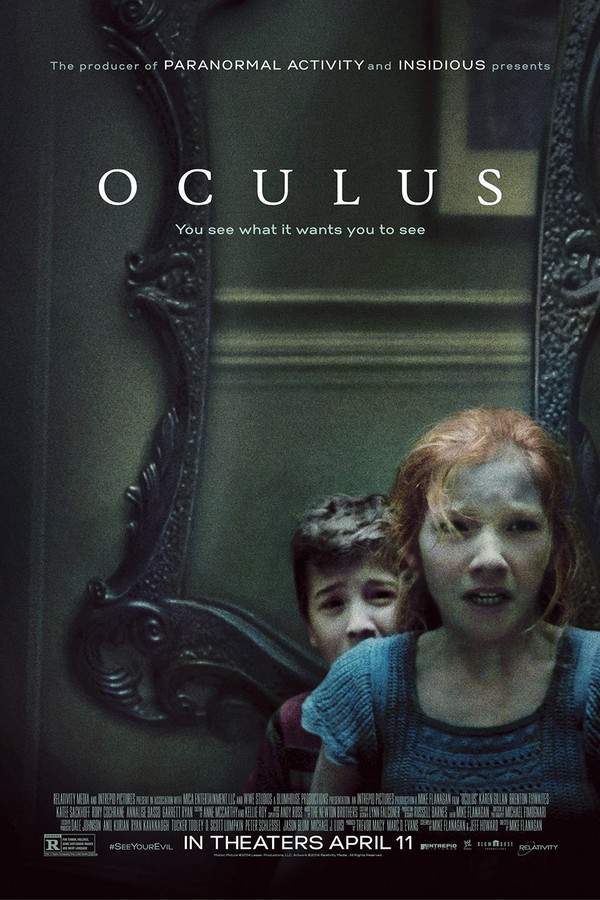
The film interweaves two timelines—present day and a long-ago past—using parallel flashbacks to reveal a haunted history centered on a mysterious mirror. The story traces how a single object can bend perception, fuel paranoia, and trap a family in a cycle of fear and violence, all while building a tense atmosphere through careful, methodical detail.
In 2002, a software engineer named Alan Russell moves into a new house with his wife Marie, their 10-year-old son Tim, and 12-year-old Kaylie, Karen Gillan. As a decorative choice for his office, Alan buys an antique mirror that seems innocent at first but gradually exerts a dark pull. Marie, Katee Sackhoff, is plagued by visions of her own body decaying, while Alan becomes oddly entranced by a ghostly woman named Marisol Chavez who appears with mirrors for eyes. The atmosphere thickens with unease as the house’s subtle changes creep in: the plants die, the family dog Mason disappears after being confined with the mirror, and a sense of dread settles over the home.
The situation deteriorates as the two plot threads unfold side by side. Kaylie, whose life has become a quiet obsession with the mirror’s history, begins to uncover disturbing patterns that link the mirror to past tragedies. Her findings stretch back to the 2002 events, hinting that the mirror’s powers are far more sinister than anyone realized. In the present-day timeline, the house becomes a laboratory of fear: Kaylie works for an auction house and gains access to the mirror, transporting it back to the family home where she installs a room filled with surveillance cameras and a dangerous “kill switch”—an anchor attached to the ceiling with a pivot designed to smash the mirror. Her plan is twofold: to document the mirror’s powers and to prove Tim’s innocence by exposing the truth behind their parents’ deaths, even as she prepares for a final act against the artifact itself.
As the 2002 narrative deepens, the parents descend into psychosis. Alan isolates himself in his office, and Marie grows increasingly withdrawn and paranoid. The house becomes a tomb of neglect and fear: all living things wither, the dog vanishes, and the household’s sense of normalcy collapses. Kaylie witnesses a pivotal moment when she sees Alan with Marisol, a sight that triggers a loud fight between the parents. One chilling night, Marie descends into madness and tries to harm her children, but Alan locks her away and the family’s grip on reality slips further. With dwindling food and dwindling hope, Kaylie and Tim realize their father is under the mirror’s spell. Attempts to seek help from neighbors fail; the children are dismissed, and even the phone becomes a trap, answered by a disturbing voice from their past.
Violence erupts as the mirror’s power fully asserts itself. One night, Alan releases Marie, and the couple attacks the children. Marie briefly regains a moment of clarity only to be shot dead by Alan. The children struggle to destroy the mirror, but the mirror seems to manipulate their actions, making them strike the wall instead. In a final disturbing moment, Alan gains a moment of lucidity and forces Tim to pull the trigger, killing him and cracking the mirror. Before dying, Alan pleads with the children to run, but the ghosts of Marisol and other victims appear. The police arrive, and Tim is taken into custody, the siblings promising to reunite as adults to destroy the mirror. As Tim is led away, he sees the ghosts of his parents watching from the house.
Back in 2013, Tim confronts Kaylie with doubt, but the corrupted history begins to surface in real time: wilted houseplants, camera footage showing actions they cannot remember, and the undeniable pull of the mirror. Tim accepts the supernatural explanation and attempts to escape with Kaylie, only to be drawn back in by the artifact’s inexorable power. A chilling sequence unfolds as Kaylie stumbles into a vision of her mother and turns on a mirror-bound target, only to discover she has stabbed Michael Dumont, her fiancé who came to check on her. Their attempt to contact authorities is thwarted by a 9-1-1 line that seems to loop back to the same eerie voice from their childhood.
The couple is forced to face the truth: doppelgängers populate the house, and the 9-1-1 system appears compromised. They return inside, where younger versions of themselves invade their perception and the two are separated, each reliving the nightmare from youth. Tim awakens alone in the room with the mirror, while a younger Kaylie imagines her mother beckoning from the glass. In a tragic misunderstanding, Tim releases the anchor, and Kaylie—standing before the mirror—ends up fatally wounding her own fate by mistake, mortally wounding Michael Dumont, her fiancé in the present. When the police arrive, Tim—now an adult in the custody of the law—repeats the claim that the mirror is to blame, even as Kaylie’s ghostly presence lingers in the house.
The ending folds back into the emotional core: a family’s grief and a sibling bond tested by an object that cannot be suppressed. The film culminates in a stark, unresolved tension between memory and reality, with Tim’s adult gaze haunted by the specters of his parents and Kaylie’s presence lingering in the house as a reminder that some questions about the mirror’s true nature may never be fully answered. The result is a chilling, meticulously constructed meditation on loss, obsession, and the uneasy line between perception and truth.