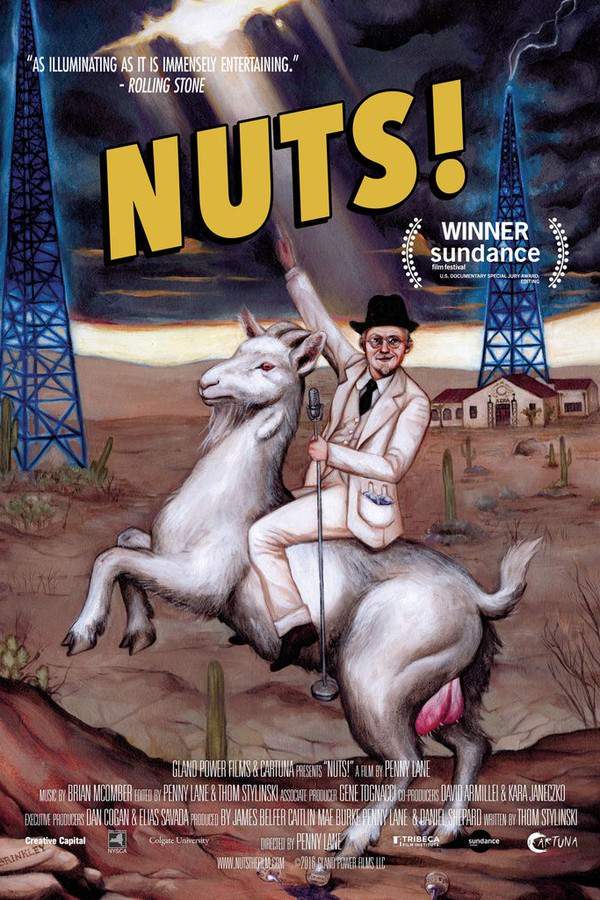
Nuts!, narrated by Gene Tognacci, offers a careful, unflinching look at the extraordinary life of John R. Brinkley (1885–1942), a Milford, Kansas druggist who reinvented himself as a physician with a sensational medical claim. The documentary follows Brinkley from his early days in small‑town America to his emergence as a nationally known figure, driven by a bold, controversial premise: he proposed a cure for male impotence achieved by implanting goat testicles into the human body. Supported for a time by the glowing testimonials of patients who insisted they were helped, Brinkley’s self‑styled medical career rode a wave of charisma, salesmanship, and media savvy, all while the line between medicine and showmanship blurred.
As Brinkley’s reputation grew, so did his reach and influence, and with them came the rise of a remarkable media empire. He is credited with building what was then the world’s most powerful radio station, KFKB (Kansas Folk Know Better), a station that did more than broadcast sermons or medical claims—it helped popularize country, or “hillbilly,” music and effectively invented a form of the early infomercial, delivered in long, persuasive diatribes about public health. The station’s audacity and Brinkley’s relentless self‑promotion drew the attention of national medical authorities, culminating in the revocation of his medical license by the American Medical Association and its editor, Morris Fishbein. The film presents a nuanced portrait of how a medical career built on audacity could unravel under the weight of professional scrutiny.
When government regulators pressed back against his audio‑driven empire, Brinkley did not retreat. He responded by expanding the reach of his broadcasts beyond the United States, building a second, even more audacious operation: XERA, a so‑called “million‑watt regulation skirting border blaster” located in Mexico. From this border‑blazing outpost, Brinkley continued to broadcast, maintaining a provocative presence that extended his influence and notoriety across borders. The documentary traces how this bold maneuver reflected a larger pattern in his life—the ability to adapt his platform and message to stay in the public eye, even as official institutions challenged his methods.
Brinkley’s public ambitions extended into politics as well. In 1930, he ran for governor of Kansas as a write‑in candidate, a bid that the film suggests might have yielded votes were it not for disqualified ballots—an outcome that cast a shadow over the integrity of the race and underscored the heated, often dubious political terrain surrounding his career. The narrative situates Brinkley at the crossroads of medicine, media, and politics, where power and popularity can translate into real influence, even when the fundamentals of credibility and ethics are called into question.
The documentary devotes attention to the fragility of Brinkley’s fortune. It reveals that his triumphs were increasingly tempered by legal and moral peril: he sued Morris Fishbein for libel in a high‑stakes legal battle that would complicate his legacy, and the film discloses, toward its end, a string of wrongful death lawsuits, questionable academic credentials, and an arrest record that painted a more complicated portrait of the man behind the megaphone. Throughout, Nuts! maintains a balanced lens, presenting Brinkley’s extraordinary achievements alongside the serious, ongoing questions they raise about the boundaries of medical authority, the power of media, and the true costs of fame.
With a calm, documentary voice and a steady accumulation of archival material, the film peels back the layers of a figure who thrived on spectacle and controversy. It does not glorify Brinkley, nor does it reduce him to a mere caricature of a con artist. Instead, it offers a measured exploration of how one person leveraged innovation, rhetoric, and a relentless appetite for attention to reshape public discourse about health, legitimacy, and the limits of professional oversight in a rapidly changing America. The result is a thoughtful, long‑form portrait that stays true to the facts while inviting viewers to reflect on the broader implications of Brinkley’s audacious life.