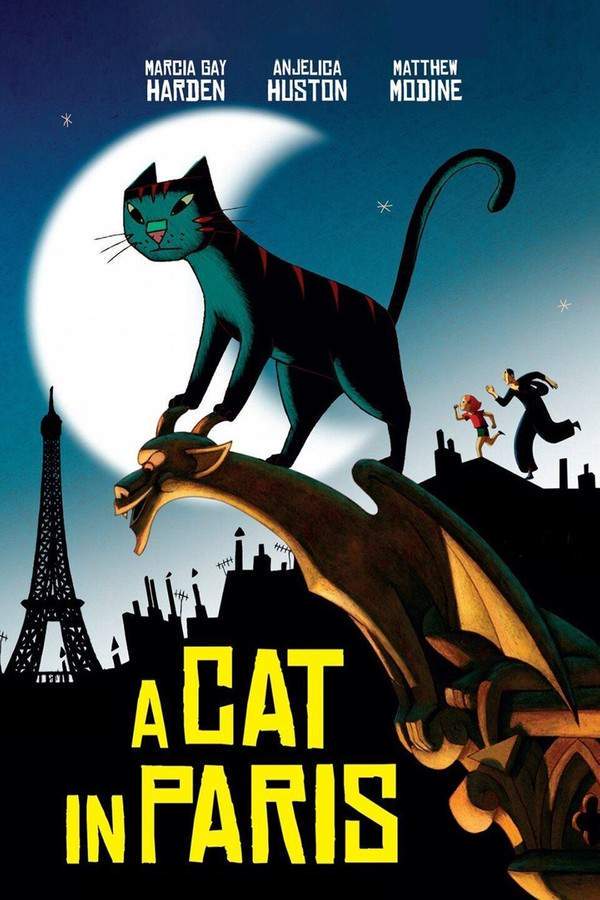
Voiced by Andrea Usher-Jones, James Pidgeon, and Michoue Sylvain.
A spare, dreamlike fable unfolds in a Paris that feels both intimate and uncanny. A police officer, living in squalor and buoyed by a stubborn sense of hunger, becomes fixated on an old lady who tends to a small garden square where pigeons gather. The contrast could not be starker: while he starves, the old woman lavishes the birds with delicate, refined dishes. The tension between need and plenty threads through every frame, turning a simple street scene into a maze of appetite, restraint, and ritual.
The officer’s fixation deepens after a nightmare in which giant, anthropomorphic pigeons disembowel him. When he awakes, the fear lingers, guiding his actions as he tracks the old lady to her apartment. his response to the situation blends menace with a strange, almost ritual practicality: he fashions a giant pigeon costume and quietly invites himself into the old lady’s home. What follows is a chilling cadence of hospitality and coercion. Despite the officer’s rough manners, the old lady remains unfazed and continues to feed him upon each visit, and with every visit his body grows rounder and heavier. The city square outside becomes a recurrent mirror for his transformation, a place where the pigeons—once mere symbols of the old lady’s generosity—seem to reflect his own changing shape.
Throughout the film, tiny details accumulate to suggest a larger commentary on consumption, power, and obsession. Each day the officer passes by a concierge, and one of the old lady’s portraits hints at a younger version of herself surrounded by overweight cats—an image that suggests a meditation on time, desire, and the costs of indulgence. The mood is at once intimate and eerie, blending quiet domesticity with a creeping sense of menace as the boundaries between human appetite and animal hunger blur.
On Christmas Eve, the tone shifts from eerie to almost fable-like in its directness. The officer, now intoxicated, slips into the old lady’s kitchen and discovers her sharpening shears in preparation for preparing a meal for the concierge—who, in a startling twist, appears dressed like a cat. The old lady’s true intention for the pigeons becomes clearer, and the officer’s attempt to escape is thwarted by cunning, persistence, and a stubborn sense of survival. In a frantic chase that climbs toward the top of a cupboard, he struggles to free himself from the pigeon disguise, even exposing his bare foot in a desperate bid for proof of humanity. Yet the proof is not enough to deter the madwoman. The cupboard buckles, and the officer crashes through the window, plummeting to the ground in a fall that mirrors the later, corporeal fate of the pigeons in the square.
The film closes with a striking epilogue: American tourists, startled and frightened, encounter a shirtless officer who has shed his disguise, only to find him thin again and behaving, in a sense, like a pigeon. The image lingers—an image of transformation, vulnerability, and the persistence of hunger—leaving viewers with a haunting reminder of how swiftly appetite can reshape a life and how fragile the line is between nourishment and danger.
- The story unfolds as a surreal, fable-like look at desire, deprivation, and the odd rituals that arise when need collides with ritualized care.
- The repeated motif of pigeons—fed with care, then embodied by the officer’s own changing body—returns to underscore the tension between giving and consuming.
- The old lady’s calm authority contrasts with the officer’s escalating desperation, creating a quiet tension that never fully resolves, inviting interpretation rather than closure.
- The setting—a compact Parisian landscape filled with small rituals, portraits, and a garden square—becomes a stage where the ordinary becomes uncanny and the ordinary acts as a gateway to a deeper, more unsettling truth about appetite and humanity.