Plot Explained Spoilers guaranteed!
Plot Explained

Browse by genre

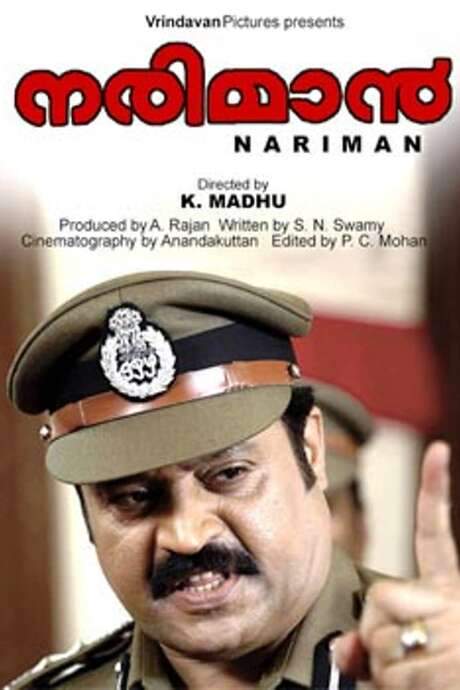
Nariman (2001) movie poster

Plot Summary

Nariman (2001) Plot Summary Explained

Release, runtime and language
2001 · 156 mins · Malayalam
Directed by
K. Madhu
Starring
Siddique, Baburaj, Jagathy Sreekumar, Sadiq, Rajan P Dev, Maniyanpilla Raju

The film portrays an aggressive and belligerent police officer named Nariman who investigates a murder case for which an innocent man is falsely accused.

On this page (6)
  1. 1 Where to watch
  2. 2 What happens: full plot
  3. 3 Plot questions answered
  4. 4 Movie threads
  5. 5 Movies like Nariman
  6. 6 Every angle

Where to watch

Where to Watch Nariman (2001)

Where can you watch Nariman? Stream, rent or buy it in the US, including on Sun Nxt: current JustWatch availability with up-to-date prices.

Streaming availability powered by JustWatch

Full plot summary · contains spoilers

What Happens in Nariman: Full Plot Summary

The whole story of Nariman (2001) explained, from the opening scene to the final frame: every key event, every twist and what it all adds up to. Read it as a quick recap before the sequel, to check a scene you missed, or to finally understand what really happened.

Manu, Vijayakumar, is the man accused in a notorious double murder. During a routine prison transfer, he makes a desperate bid for freedom and is shot by the guards. Although gravely wounded, he survives the volley of bullets that rain down on him. Dr. Giri, N F Varghese, a senior surgeon, takes pity on the injured man and begins to doubt Manu's guilt, sensing there could be more to the story than the official narrative.

Dr. Giri convinces his friend Shekharan, the Chief Minister of Kerala Janardhanan, to reopen the case and hand it to a capable, aggressive police officer, Ashok Nariman Suresh Gopi. Nariman, initially branded as hopeless by legal advisers due to the way the case had been framed, starts to peel back the layers of what happened on the night of the crime. He discovers that the real perpetrators were a tightly knit group led by the shrewd Adv. Padhmanabhan Thampi [Siddique], who worked with his allies Kochunarayanan [Jagathy Sreekumar], a senior police figure represented by SP Philipose [Spadikam George], and the feared Kamal Pasha [Bheeman Raghu]. Nariman lays out how this quartet allegedly executed the murder and how the evidence had been manipulated to seal Manu’s fate.

The case then moves to the Sessions Court, presided over by the Judge [Kozhikode Narayanan Nair], who remains wary of reopening old wounds. The Judge refuses to grant a second hearing, pointing to the prior Supreme Court ruling and the President’s decision on Manu’s fate, a verdict that had already shaped public opinion. Yet Nariman’s work does not end there. He also takes up a new line of inquiry in the Ammini missing case, a case that touches the criminal underworld connected to Kochunarayanan’s illegal liquor network. In this new investigation, the four men—Adv. Thampi, Kochunarayanan, Philipose, and Kamal—are questioned again, with Manu’s defense being contended by Manu’s lawyer Samyuktha Varma.

As the Ammini matter unfolds, Nariman exposes how the earlier murder case may have been built on forged or cherry-picked evidence, crafted to fit a preferred narrative. The revelation shifts the judgment’s momentum and forces the courtroom to confront the possibility that justice had been compromised by powerful interests and clever manipulation. The Judge, though initially stunned, comes to understand that even a revered legal system can be misled when those in power pull the strings.

Ultimately, the Judge grants a second hearing for Manu’s case. In that follow-up, Manu is proved innocent, and the true culprits—Adv. Padhmanabhan Thampi [Siddique], Kochunarayanan [Jagathy Sreekumar], Thomas Philipose [Spadikam George], and Kamal Pasha [Bheeman Raghu]—face the consequences of their actions. The story closes on a note that underscores the fragility of justice when it is tainted by corruption, and the persistence of a determined prosecutor who refuses to abandon a case that could right a dangerous wrong.

Last updated: October 09, 2025 at 15:28

Was this helpful?

Plot questions answered

Nariman Plot Explained: Your Questions Answered

The questions people ask most about Nariman (2001): what happens in the confusing scenes, why the characters do what they do, the twists, hidden details and what the ending means. Each answer contains spoilers.

Q1

Why was Manu falsely accused of the double murder?

Manu was framed because the real culprits needed a scapegoat. Adv. Padhmanabhan Thampi led a conspiracy with Kochunarayanan, SP Philipose, and Kamal Pasha to commit the actual murder. They manipulated evidence and crafted a false narrative to seal Manu's fate, making him appear guilty when he was innocent.

Foreshadowing: Earlier scenes show Manu being transferred as a convicted prisoner, establishing his wrongful conviction.

  • Manu frame-up
  • Adv Thampi conspiracy
  • falsely accused
  • killer real culprits
Q2

How did Manu survive the prison transfer shooting?

During his transfer to another facility, Manu attempted a desperate escape bid. Guards opened fire, raining bullets on him. Despite sustaining severe injuries, he miraculously survived the volley. This event marked a brutal turning point that kept him in custody but also raised questions about his guilt.

Foreshadowing: The opening scene establishes the dangerous conditions of Manu's imprisonment.

  • Manu escape
  • prison shooting survived
  • injured transfer
  • bullets
Q3

Who are the real killers who framed Manu?

The real perpetrators were a tightly knit quartet: Adv. Padhmanabhan Thampi, the mastermind who orchestrated the crime, along with Kochunarayanan (a senior police figure involved in the illegal liquor network), SP Philipose, and the feared Kamal Pasha. Together they executed the murder and manipulated evidence to convict Manu.

Foreshadowing: Nariman's investigation progressively reveals connections between these four individuals.

  • Adv Thampi
  • Kochunarayanan
  • SP Philipose
  • Kamal Pasha
  • real murderers quartet
Q4

What is the Ammini missing case in the film?

The Ammini missing case is a separate investigation connected to the criminal underworld of Kochunarayanan's illegal liquor network. Ammini was an ally within this network who went missing. Nariman uses this case to expose the underlying corruption and eventually reveals Ammini is actually alive, which becomes crucial evidence to prove the frame-up.

Foreshadowing: The timeline shows Nariman shifting to this case after the first hearing stalls.

  • Ammini missing case
  • illegal liquor network
  • conspiracy exposure
Q5

Why did the Judge refuse to reopen Manu's case initially?

The Sessions Court Judge refused a second hearing by citing the prior Supreme Court ruling and the President's decision on Manu's fate. He argued that reopening old wounds could be mere publicity and that the verdict had already shaped public opinion. The judge was wary of challenging higher authorities, even when evidence suggested injustice.

Foreshadowing: The Judge's initial caution reflects the political pressure mentioned early in the investigation.

  • Judge refused hearing
  • Supreme Court ruling
  • President decision
  • second hearing denial
Q6

How does Nariman prove Manu's innocence?

Nariman systematically peels back layers of the case by finding loopholes in the prosecution's narrative. He discovers the evidence was forged and cherry-picked to fit a preferred story. His parallel investigation into the Ammini case provides leverage, and when he reveals Ammini is alive during the courtroom proceeding, it exposes how the four culprits manufactured false evidence to frame Manu.

Foreshadowing: Nariman's early investigation scenes show him gathering evidence and connecting the dots.

  • Nariman investigation
  • evidence manipulation
  • frame-up proof
  • true criminals exposed
Q7

What role does Dr. Giri play in reopening Manu's case?

Dr. Giri, a senior surgeon at the hospital where Manu was treated after being shot, takes pity on the injured man and begins doubting his guilt. Sensing there could be more to the story, he convinces his friend Shekharan, the Chief Minister of Kerala, to reopen the case and assign it to Ashok Nariman, a capable but aggressive police officer. Dr. Giri's mercy initiates the entire investigation.

Foreshadowing: Dr. Giri's decision to help Manu sets the entire plot in motion.

  • Dr Giri
  • Chief Minister Shekharan
  • case reopened
  • mercy character
Q8

Why is Ammini being alive so important to the case?

Ammini being alive becomes the key evidence that exposes the frame-up. During the Ammini case verdict, Nariman reveals she is alive and explains how the four culprits were made out to be guilty through fake evidence and a crafted narrative. Her survival proves the earlier murder case was built on manufactured evidence, forcing the court to confront the manipulation.

Foreshadowing: The Ammini missing case is introduced as potentially exposing corruption.

  • Ammini alive
  • evidence revelation
  • frame-up exposed
  • manufactured evidence
Q9

What happens during the courtroom revelation scene?

As the judge reads the Ammini verdict, Nariman dramatically interrupts to reveal Ammini is alive and to expose the truth behind the frame-up. He explains how the four powerful figures manipulated evidence to create a false narrative. This intervention convinces the Judge that even a revered legal system can be misled when those in power pull the strings, leading him to grant a second hearing for Manu.

Foreshadowing: The buildup to this scene shows the judge initially resistant to new evidence.

  • courtroom revelation
  • second hearing granted
  • Nariman interruption
  • judge convinced
Q10

How does the movie end - is Manu exonerated?

Yes, months after the Judge allows a second hearing, Manu is proved innocent in the retrial. The real culprits, Adv. Thampi, Kochunarayanan, SP Philipose, and Kamal Pasha, face the consequences of their actions. The film closes with Manu exonerated and the conspirators punished, delivering a cathartic resolution that underscores the fragility of justice when tainted by corruption.

Foreshadowing: The earlier courtroom scenes build toward this ultimate vindication.

  • Manu exonerated
  • real culprits punished
  • happy ending
  • justice served movie ending

Movie threads

More Movies Like Nariman, by Mood & Story

Curated lists built around what makes Nariman tick: the same mood, the same kind of story or the same emotional payoff. Each list explains why these movies belong together.

Gritty procedural thrillers against systemic corruption like in Nariman

Determined investigators uncover deep-seated conspiracies in a tense race for justice. If you liked the tense investigation and systemic struggle in Nariman, you'll find similar movies here. These gritty procedural thrillers focus on determined heroes exposing judicial or police corruption, delivering cathartic resolutions after a heavy, suspenseful journey. Discover films with a similar feel of fighting a powerful, manipulative system.

  • tense
  • gripping
  • corrosive
  • determined
  • systemic
  • anxious
  • Tone: tense, determined, corrosive
  • Pacing: fast, driven
Why these movies?

The story pattern: These narratives follow a linear investigative path where a protagonist doggedly pursues the truth against a backdrop of institutional corruption. The conflict escalates as they face powerful antagonists who manipulate the system, leading to tense confrontations and a final, evidence-based unveiling of the truth that provides a sense of justice.

Why they belong together: Movies are grouped here for their shared focus on a high-stakes procedural investigation, a tense and corrosive atmosphere, and the thematic weight of battling systemic injustice. They deliver a specific mix of anxious tension followed by a cathartic, though emotionally heavy, resolution.

Movies about cathartic justice after heavy injustice like Nariman

Emotionally heavy journeys where the wrongly accused are finally exonerated. For viewers who appreciated the emotional payoff in Nariman when the innocent man is cleared. This collection features movies about wrongful accusations and miscarriages of justice. These stories are tense and heavy, but ultimately deliver a satisfying, cathartic resolution that reaffirms justice, similar to the feeling in Nariman.

  • anxious
  • heavy
  • cathartic
  • tense
  • wronged
  • justice
  • Tone: tense, heavy, cathartic
  • Pacing: fast, suspenseful
Why these movies?

The story pattern: The narrative pattern involves establishing a grave injustice against a sympathetic character, creating immediate emotional investment and tension. The story then follows the arduous path to uncover the truth, facing obstacles and powerful opposition, culminating in a dramatic reversal or courtroom scene that clears the accused and delivers emotional catharsis.

Why they belong together: These films are connected by their core emotional arc: they begin with a profound sense of injustice that creates heavy emotional weight, maintain a tense and anxious atmosphere throughout the fight for truth, and resolve with a powerfully cathartic and happy ending that provides emotional release.

If you liked this

Movies Like Nariman

Similar movies to Nariman: the same genre, themes or kind of story. Each one comes with its own plot summary, timeline and ending explained.

Browse all movie summaries

Every angle

Nariman (2001) Explained: Plot, Timeline & Characters

Everything about Nariman in one place: what happens in the plot summary, the timeline in chronological order, the characters and meaning and a spoiler-free summary. What's After the Movie adds the cast, box office and post-credit scenes.

Coming soon on iOS and Android

The Plot Explained Movie Summary App

Plot summaries, endings explained and timelines on your phone. Catch up on any movie in minutes, save your favorites and never miss a twist again.

Be the first to know when we launch. Your email stays private, always.

Learn more about the app