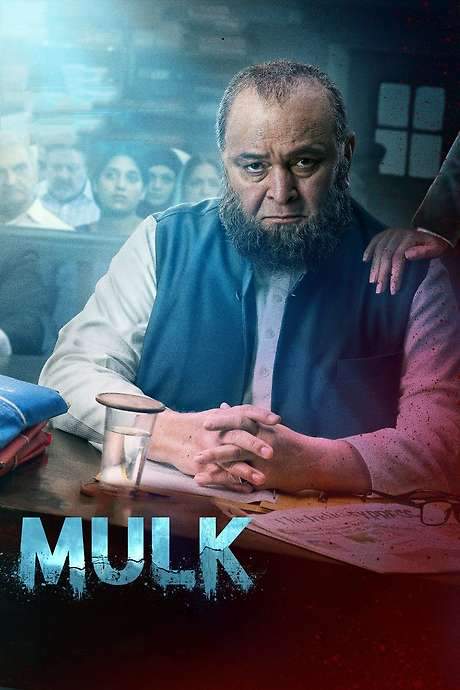
Mulk tells the poignant story of a Muslim joint family navigating their way through the painful aftermath of terrorism in India. At the heart of this narrative is Murad Ali Mohammed, portrayed by Rishi Kapoor, a lawyer who leads a harmonious life with his family in a vibrant and diverse neighborhood of Varanasi. His day typically starts with a Namaz at the local mosque, followed by lighthearted discussions over tea at a stall run by a close Hindu friend. Murad's family includes his supportive wife Tabassum (Neena Gupta), his brother Bilaal (Manoj Pahwa), who operates a mobile phone shop, and his niece Aayat (Eshita Singh, credited as Vartika Singh), and nephew Shahid (Prateik Babbar). Moreover, Murad's son Aftab (Indraneil Sengupta) is married to Aarti (Taapsee Pannu), who is also a lawyer but has distanced herself from the family.
The unfolding of the tale coincides with Murad's 65th birthday, a day marked by family joy as Aarti arrives for a visit. They enjoy a delightful evening with their loved ones and neighbors. However, the celebration takes a dark turn when it is revealed that Shahid has connected with a terrorist group led by the notorious Mehfooz Alam (Sumit Kaul). Shahid, under pressure from Mehfooz, embarks on a mission to orchestrate a bomb blast. Following Murad's birthday festivities, Shahid departs for Allahabad and executes the deadly attack, resulting in numerous casualties.
The investigation into this tragedy falls into the hands of SSP Danish Javed (Rajat Kapoor), who rigorously pursues everyone linked to the incident. He eventually corners Shahid, leading to a fatal confrontation. Shortly after, law enforcement descends upon Murad's home, where they conduct invasive searches and interrogations, disrupting their lives and reputation almost instantaneously. As news of the bombing spreads, the family's world is flipped upside down, garnering public scrutiny and suspicion.
In the midst of this turmoil, Bilaal finds himself in custody while his brother Murad fights for their familial honor. Aarti bravely steps in as his defense attorney, determined to exonerate her family. The investigation continues, with Danish's relentless questioning of Bilaal yielding no important insights even after 17 grueling hours. As their neighborhood turns hostile, family members face unthinkable hostility, which escalates to the point where stones are hurled at their home, and messages of hate appear on their walls. Amid this chaos, some extremists approach Murad, trying to convince him of his nephew Shahid's misguided act of Jihad, yet Murad firmly rejects this dangerous rhetoric.
The legal battles unfold, and the public prosecutor Santosh Anand (Ashutosh Rana) portrays Shahid's actions as a reflection of a broader issue, asserting that Muslims are inherently linked to terrorism. He presents evidence alleging that Shahid's actions had the family's implicit support, and argues for Murad to be removed as Bilaal's counsel. As allegations mount, the courtroom drama intensifies, leading to heartbreaking developments. In a shocking turn of events, Bilaal suffers a heart attack while being transferred for medical attention.
Left in desperate circumstances, it falls to Aarti to advocate for Murad and their family. She compellingly argues in court that there is no substantial evidence linking the family to Shahid’s crimes, emphasizing that he acted alone. Shahid was the only tech-savvy individual in the house, and his supposed connections to terrorists were through deceit, all while the family's reputation crumbles around them. With each passing moment, the emotional toll on Murad's family increases, stemming from unjust generalizations leading to social ostracization.
Ultimately, Aarti's argument resonates with the court, demonstrating that the accusations against Murad and his family are circumstantial. Judge Harish Madhok (Kumud Mishra) dismisses the case, emphasizing that societal prejudices must be tackled collectively, irrespective of religion. The movie closes on a powerful note, reinforcing the essential message that we must nurture a vision of community over division, transforming our mindset from "Us and Them" into "We."