Year: 2024
Runtime: 100 mins
Language: English
Director: Madeleine Hetherton-Miau
For the first eighteen years of her life, Maria Anna "Nannerl" Mozart enjoyed equal recognition alongside her famous brother, Wolfgang. The siblings performed together for royalty and captivated audiences across Europe. However, at sixteen, Nannerl was abruptly forced into retirement simply because of her gender. This film explores the circumstances surrounding her forced retirement and investigates the compelling theory that she continued to compose music in secret, despite the societal limitations imposed upon her.
Warning: spoilers below!
Haven’t seen Mozart’s Sister yet? This summary contains major spoilers. Bookmark the page, watch the movie, and come back for the full breakdown. If you're ready, scroll on and relive the story!
Trace every key event in Mozart’s Sister (2024) with our detailed, chronological timeline. Perfect for unpacking nonlinear stories, spotting hidden connections, and understanding how each scene builds toward the film’s climax. Whether you're revisiting or decoding for the first time, this timeline gives you the full picture.
Last updated: February 06, 2026 at 10:54
Find frequently asked questions about the Mozart’s Sister (2024) timeline, including chronological order, nonlinear jumps, cause-and-effect links, and scene sequence clarifications. This timeline FAQ helps explain when key events happen, how moments connect, and why the story unfolds in that specific order.
Nannerl was forced into retirement at sixteen because of her gender. In the 18th century, women were not allowed to pursue careers as composers or professional musicians. Her father Leopold Mozart insisted she only perform as part of a brother-sister act with Wolfgang, forbidding her from composing or playing the violin, despite her exceptional talent.
Princess Louise of France was a 13-year-old royal being raised at Fontevraud Abbey with two of her sisters. She formed a close friendship with Nannerl during the Mozart family's enforced stay, sharing music and secret conversations. Louise later warned Nannerl against pursuing romance with the Dauphin and ultimately entered a convent, withdrawing from court life.
The Dauphin of France, recently widowed, developed a genuine romantic interest in Nannerl and her music. However, he was bound by dynastic obligations and became engaged to Maria Josepha of Saxony. The engagement was a political marriage that ended any possibility of romance with Nannerl, demonstrating the power of royal duty over personal feelings.
Leopold Mozart forbade Nannerl from composing music and playing the violin because of the societal constraints of the era. He believed a woman's place was not as a composer or solo performer. He allowed her to perform only as part of the sibling act with Wolfgang, prioritizing family income and social propriety over Nannerl's individual artistic ambitions.
The Mozart family stopped at Fontevraud Abbey because their carriage axle cracked during their grand tour of Europe. This mechanical failure forced them to seek shelter in the abbey, where they stayed among monks and nuns while continuing to perform for their keep. It was during this unexpected stay that Nannerl befriended Princess Louise.
In the strange final encounter at Versailles, Nannerl came face-to-face with the Dauphin and his new wife Maria Josepha of Saxony. The cold, formal atmosphere underscored the harsh realities of court life and the limitations placed on women. This meeting forced Nannerl to confront what might have been had circumstances been different.
The film investigates the compelling historical theory that Nannerl continued composing music in secret despite being forced into public retirement. While the film doesn't provide definitive proof, it leaves the audience with the suggestion that her artistic voice persisted privately, even though her work was never officially recognized during her lifetime.
In a poignant final conversation at Fontevraud Abbey, Nannerl and Princess Louise reflected on how their lives might have been different had they been born male. They discussed the doors that would have opened for them in music and court life, underscoring the film's central theme about gender constraints in 18th-century Europe.
Discover curated groups of movies connected by mood, themes, and story style. Browse collections built around emotion, atmosphere, and narrative focus to easily find films that match what you feel like watching right now.
Stories of brilliant minds silenced by the constraints of their time.If you were moved by the story of Nannerl Mozart in Mozart’s Sister, discover other films about artists, musicians, and thinkers whose talents were overlooked or suppressed. These movies explore gender inequality, historical constraints, and the bittersweet contemplation of unfulfilled potential.
The narrative typically follows a character with exceptional talent who is prevented from achieving recognition due to external forces like gender discrimination, class barriers, or political oppression. The story charts their struggle, compromise, and the ultimate melancholic reflection on what might have been.
These films are grouped by their shared exploration of injustice against creativity. They create a specific melancholic and reflective mood centered on frustration and yearning, offering a thoughtful look at historical or societal barriers to artistic expression.
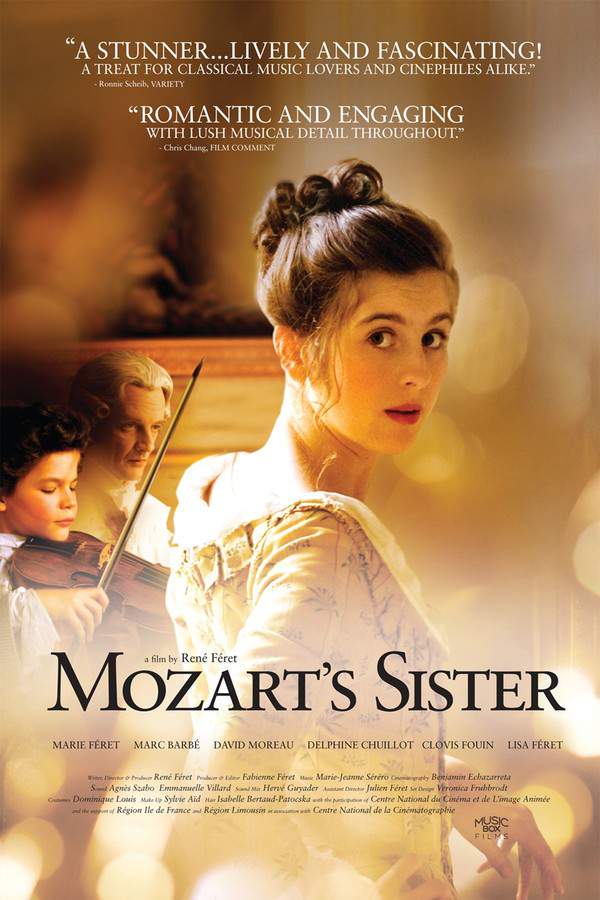
Contemplative stories that blend historical fact with poignant speculation.For viewers who enjoyed the reflective and bittersweet tone of Mozart’s Sister, this collection features historical films that explore alternate possibilities and quiet personal dramas. Find movies with a steady pace, medium emotional weight, and a focus on what could have been.
These stories often follow a linear, straightforward structure centered on a personal journey within a well-documented historical context. The conflict is internal and societal rather than action-oriented, leading to an ending that is contemplative and bittersweet, acknowledging loss while pondering different paths.
They share a specific emotional mix: a steady, reflective pace, a medium level of intensity driven by emotional tension, and a bittersweet conclusion that lingers on the possibilities of an alternate history. The focus is on character and mood over complex plotting.
Don't stop at just watching - explore Mozart’s Sister in full detail. From the complete plot summary and scene-by-scene timeline to character breakdowns, thematic analysis, and a deep dive into the ending - every page helps you truly understand what Mozart’s Sister is all about. Plus, discover what's next after the movie.
Read a complete plot summary of Mozart’s Sister, including all key story points, character arcs, and turning points. This in-depth recap is ideal for understanding the narrative structure or reviewing what happened in the movie.
Discover the characters, locations, and core themes that shape Mozart’s Sister. Get insights into symbolic elements, setting significance, and deeper narrative meaning - ideal for thematic analysis and movie breakdowns.