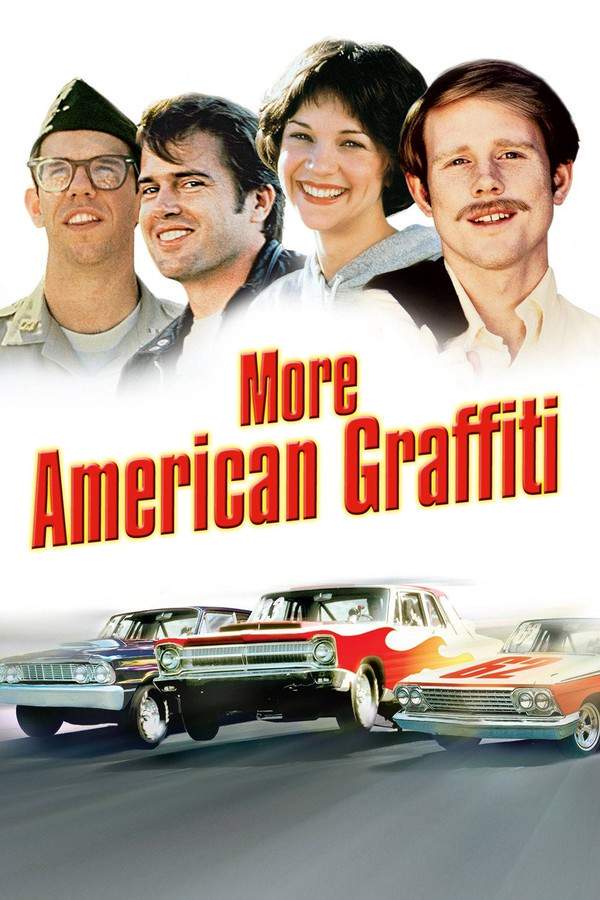
Year: 1979
Runtime: 110 min
Language: English
Director: Bill L. Norton
Budget: $3M
Steve Bolander and his friends are now young adults grappling with the challenges of the early 1960s. Steve's marriage to Laurie faces unexpected strains, while John Milner seeks excitement through drag racing. As they navigate love and personal growth, the shadow of the Vietnam War looms large, impacting their futures and the changing cultural landscape. The film explores themes of identity and the bittersweet passage of time, revisiting familiar characters in a new era.
Get a spoiler-free look at More American Graffiti (1979) with a clear plot overview that covers the setting, main characters, and story premise—without revealing key twists or the ending. Perfect for deciding if this film is your next watch.
In the restless summer of the early 1960s, the familiar streets of Modesto pulse with a new kind of energy, as the world beyond their borders swells with music, protest, and the uneasy promise of change. The film opens a door onto a landscape where classic cruisers still glide beneath neon signs, yet the air is charged with the scent of draft cards, vinyl records, and a restless desire to break free from yesterday’s expectations. The tone balances nostalgic warmth with a crisp, almost documentary‑like immediacy, letting viewers feel the texture of a generation standing on the brink of both personal and cultural transformation.
_ Steve Bolander _ returns home to a marriage that feels both familiar and fragile, his once‑steady path now intersecting with the shifting tides of his wife Laurie’s aspirations and the broader societal pressures of the era. Their relationship becomes a quiet lens through which the film examines the challenges of growing up while trying to keep the promise of youthful freedom alive. Across town, John Milner is drawn to the roar of engines and the thrill of late‑night drag races, seeking excitement that mirrors the restless heartbeat of a nation racing toward an uncertain future. Their friendships and rivalries are sketched with a gentle humor that hints at deeper anxieties, allowing the audience to sense the undercurrents of ambition, love, and fear without spelling them out.
The backdrop is a vivid collage of countercultural hotspots: the swirling colors of Haight‑Ashbury, college campuses buzzing with peace demonstrations, and the early stirrings of a women’s liberation movement that whispers through every conversation. Cinematic styles shift subtly from bright, sun‑lit tableaux to grainy, handheld impressions, echoing the fragmented yet interconnected reality of the time. This visual tapestry invites viewers to feel the era’s contradictions—hope tangled with dread, freedom shadowed by looming conflict—while keeping the focus firmly on the characters’ inner journeys.
Through its evocative atmosphere and richly drawn protagonists, the story promises a meditation on identity, the bittersweet passage of time, and the ways ordinary lives become entwined with the sweeping currents of history, leaving audiences eager to see how these young adults will navigate the coming years.
Last Updated: August 10, 2025 at 14:13
Discover curated groups of movies connected by mood, themes, and story style. Browse collections built around emotion, atmosphere, and narrative focus to easily find films that match what you feel like watching right now.
Films that weave together multiple lives to capture the spirit of a changing era.If you enjoyed the interconnected character arcs and historical backdrop of More American Graffiti, explore more movies like it. This collection features ensemble dramas and comedies that capture the spirit of a generation facing social change, with similar bittersweet tones and complex narrative structures.
These stories typically follow a group of characters—often friends or a community—across several years or key moments. The narrative structure is often fragmented or episodic, using time jumps or parallel storylines to highlight contrasts between youthful idealism and adult realities, ultimately reflecting on the passage of time and the costs of progress.
Movies are grouped here for their shared focus on generational identity, their use of a multi-character ensemble to explore a central theme (like war or social change), and their emotionally resonant, bittersweet tone that balances nostalgia with the harsh realities of growing up.
Stories where personal rebellion clashes with the grim realities of war and society.For viewers who liked the blend of chaotic energy, political themes, and war backdrop in More American Graffiti. Discover similar movies about the 1960s counterculture, Vietnam War era, and stories of personal freedom clashing with societal expectations.
Narratives in this thread often follow young adults navigating a world in flux. Characters might be drawn into political activism, drug culture, or artistic scenes while the looming threat of the draft or other institutional forces creates constant tension. The journey is one of disillusionment and maturity, as personal growth is forged in a climate of chaos and anxiety.
These films share a specific historical setting or vibe defined by counterculture ideals, a palpable sense of social and political anxiety, and a narrative that pits individual desire for freedom against larger, often oppressive, systems. The tone is gritty yet energetic, capturing the chaotic spirit of the era.
Don't stop at just watching — explore More American Graffiti in full detail. From the complete plot summary and scene-by-scene timeline to character breakdowns, thematic analysis, and a deep dive into the ending — every page helps you truly understand what More American Graffiti is all about. Plus, discover what's next after the movie.
Read a complete plot summary of More American Graffiti, including all key story points, character arcs, and turning points. This in-depth recap is ideal for understanding the narrative structure or reviewing what happened in the movie.
Track the full timeline of More American Graffiti with every major event arranged chronologically. Perfect for decoding non-linear storytelling, flashbacks, or parallel narratives with a clear scene-by-scene breakdown.
Discover the characters, locations, and core themes that shape More American Graffiti. Get insights into symbolic elements, setting significance, and deeper narrative meaning — ideal for thematic analysis and movie breakdowns.
Visit What's After the Movie to explore more about More American Graffiti: box office results, cast and crew info, production details, post-credit scenes, and external links — all in one place for movie fans and researchers.