Plot Explained Spoilers guaranteed!
Plot Explained

Browse by genre

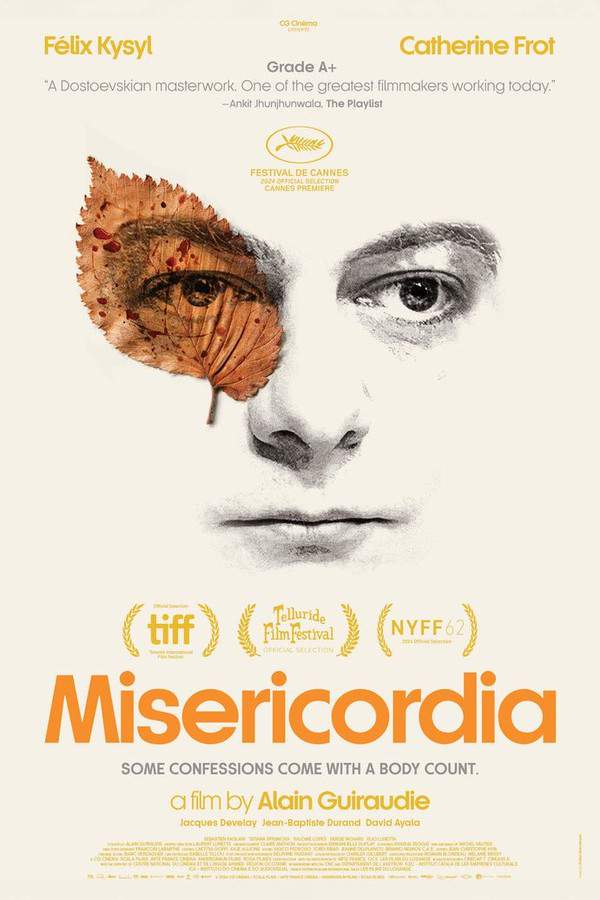
Misericordia (2025) movie poster

Ending Explained

Misericordia (2025) Ending Explained – Final Scene & Meaning

Release, runtime and language
2025 · 1 h 42 m · French
Echo score 78
Directed by
Alain Guiraudie
Starring
Félix Kysyl, Catherine Frot, Jean-Baptiste Durand, Serge Richard, Jacques Develay, David Ayala

Following the funeral of his former boss, Jérémie decides to stay with the baker’s widow, Martine, in his hometown. What begins as a short visit quickly becomes unsettling as a mysterious disappearance, a threatening neighbor, and a priest with peculiar intentions disrupt the quiet village and lead Jérémie down an unexpected path.

On this page (6)
  1. 1 What happens at the end
  2. 2 Final events in order
  3. 3 Ending questions answered
  4. 4 Movie threads
  5. 5 Movies like Misericordia
  6. 6 Every angle

Ending explained · contains spoilers

What Happens at the End of Misericordia?

How Misericordia (2025) ends, what the final scene means, which earlier moments set it up and how to read the ending if the film leaves it open. The full ending explained, with every spoiler.

Jeremie returns to his rural hometown for Jean‑Pierre’s funeral and is immediately caught in a web of unspoken desires. The dead baker’s widow, Martine, clings to him, while his old friend‑turned‑rival, Vincent, broods over the preferential treatment Jeremie received from his parents. As tensions mount—Vincent’s jealousy, Walter’s furtive attraction, and the village’s simmering fascination with Jeremie—the two men clash in the mushroom‑filled woods. In a sudden, unpremeditated burst, Jeremie strikes Vincent, bludgeoning him to death, a moment that feels as accidental as a stray spark in a dry forest.

Panicked, Jeremie buries the body where the murder occurred and constructs a clumsy alibi: he claims a night‑time injury from a fight and later spins a story of a drunken car ride with Vincent that never happened. The local constable, a lone woman, begins to suspect him, yet the investigation stalls. Priest Philippe—who is quietly infatuated with Jeremie—steps in, hinting at a night together and later offering to move the corpse to the cemetery. Their nocturnal escapade is interrupted when the constable breaks in on the priest’s house only to find Philippe and Jeremie in a compromising, half‑pretended tableau, which diverts any further proof.

Haunted by guilt, Jeremie drives to a cliff’s edge, ready to end his torment, but Philippe pulls him back, his devotion bordering on worship. The film ends with Jeremie pressed between Martine’s jealousy and the priest’s affection, the corpse still hidden, and the police powerless to secure a confession. No definitive punishment arrives; instead, the story lingers in a limbo of desire and denial, leaving the audience to wonder whether mercy—or mere oblivion—will ever reach the killer.

Last updated: October 13, 2025 at 19:17

Was this helpful?

The last 4 events

How Misericordia Ends: The Final Events in Order

The last events of Misericordia (2025) in chronological order, the run-up to the ending explained above. The complete timeline has all 15 events, scene by scene.

Open the full timeline
  1. The alibi scheme advances

    The two officers confront Jérémie in the forest where Vincent's body is buried. Philippe arrives and fabricates an alibi, claiming Jérémie spent the night with him and that they are secretly lovers, complicating the investigation.

    When
    That day
    Where
    Forest near Saint-Martial
  2. Midnight ruse to mislead the police

    That night, a policeman attempts to question Jérémie in his sleep, but Jérémie screams for Martine, causing the officer to flee. The tension between truth and cover-up intensifies as the net tightens.

    When
    That night
    Where
    Martine's house
  3. Exhumation and disposal

    The following night, the policeman returns to Martine's house; Jérémie sneaks to the church, then, with Philippe, digs up Vincent's body and moves it to the local cemetery, where Philippe disposes of it. The cover-up enters a new, darker phase.

    When
    That night
    Where
    Local cemetery
  4. Final quiet moment with Martine

    Returning to Martine's house, she invites Jérémie to sleep by her side in her bed, and he asks to hold her hand, a tender closing note after a web of deceit. The moment hints at a fragile emotional resolution amid the crime.

    When
    That night
    Where
    Martine's house

Ending questions answered

Misericordia Ending: Your Questions Answered

The questions people ask most about the ending of Misericordia (2025): what the final scene means, how the twist works, what happens to each character and how to read the ending. Each answer contains spoilers.

Q1

Why does Jérémie kill Vincent in the woods?

The killing in Misericordia is not planned. It erupts in a sudden, unpremeditated moment after Vincent confronts Jérémie about the preferential treatment he received from Jérémie's parents. The accumulated jealousy, rivalry, and unspoken tensions between the two men finally combust, and Jérémie bludgeons Vincent in what the film presents as an accidental, impulsive act rather than a calculated murder.

Foreshadowing: Vincent's brooding resentment over Jérémie's favored status with his parents is visible from the funeral onward, building toward the violent confrontation.

  • vincent
  • murder
  • woods
  • jealousy
  • impulse
  • confrontation
Q2

Why does Priest Philippe help Jérémie hide the body?

Father Philippe is quietly infatuated with Jérémie and uses the cover-up as leverage to bind him closer. By offering to move the corpse and construct a shared secret, Philippe transforms a criminal act into a coercive arrangement that ensures Jérémie remains entangled with him. His aid is not motivated by mercy or justice but by desire and a need for control disguised as devotion.

Foreshadowing: Philippe's unusual attentiveness toward Jérémie during the funeral and early scenes hints at an attraction that will later become transactional.

  • philippe
  • priest
  • body
  • cover-up
  • infatuation
  • leverage
Q3

Why can't the constable prove Jérémie killed Vincent?

The local constable, working alone, grows suspicious of Jérémie but finds no physical evidence and no confession. Jérémie's fabricated alibi about a drunken car ride with Vincent goes unverified, and when the constable breaks into Philippe's house, she finds the two men in a compromising tableau that deflects the investigation. The film uses this moment to show how desire, shame, and small-town discretion conspire to obstruct the search for truth.

Foreshadowing: The constable's early probing questions establish her suspicion, but her isolation and the village's reluctance to cooperate are hinted at from her first appearance.

  • constable
  • investigation
  • suspicion
  • alibi
  • evidence
Q4

What happens when Jérémie drives to the cliff?

Tormented by guilt, Jérémie drives to a cliff's edge with the apparent intention of killing himself. Father Philippe arrives in time to pull him back, an act framed less as rescue than as possession. The scene marks the point where Jérémie's survival becomes bound to Philippe, confirming that the priest's devotion has effectively trapped him rather than freed him.

Foreshadowing: Jérémie's growing silence, sleeplessness, and dissociative behavior in the days after the burial foreshadow his suicidal collapse.

  • cliff
  • suicide
  • guilt
  • philippe
  • rescue
  • despair
Q5

Does Jérémie ever get caught or confess?

No. By the end of Misericordia, Jérémie has not been arrested and has not confessed. The corpse remains hidden, the constable's investigation has stalled, and the village has chosen silence over accountability. The film deliberately withholds any judicial or moral resolution, leaving Jérémie free on the surface but imprisoned by his secrets.

Foreshadowing: The priest's willingness to interfere with the investigation early on signals that a proper inquiry will never reach its conclusion.

  • caught
  • confess
  • arrest
  • justice
  • impunity
  • ending
Q6

What does the ambiguous ending of Misericordia mean?

The ending refuses to deliver punishment, confession, or redemption, instead leaving Jérémie suspended between Martine's jealousy and Philippe's possessive affection with the body still buried. This limbo is the film's statement: in a village bound by desire, repression, and complicity, mercy never arrives and neither does justice. The audience is left to sit with the uneasy knowledge that the killer walks free, protected by a web of unspoken arrangements.

Foreshadowing: The opening funeral scene already establishes a community more concerned with appearances and hidden feelings than with truth.

  • ambiguous ending
  • meaning
  • mercy
  • justice
  • resolution
  • interpretation
Q7

What does the title Misericordia refer to at the end?

The title, meaning mercy or compassion, is deeply ironic given the film's conclusion. No one in the village extends genuine mercy to Vincent, whose body is treated as a secret to be managed rather than a person to be mourned. The mercy that does exist is transactional, Philippe's 'mercy' is really sexual leverage, so the title becomes a critique of how small communities invoke forgiveness while practicing exploitation.

Foreshadowing: Philippe's early offers of spiritual comfort to Jérémie subtly prefigure how religious language will be weaponized later.

  • title
  • misericordia
  • mercy
  • irony
  • meaning
Q8

Why does Jérémie stay with Martine instead of leaving town?

Jérémie's original plan was a short visit for the funeral, but Martine's clinging affection and his own guilt over Vincent keep him rooted in the village. Staying allows him to maintain the appearance of normalcy that protects his alibi, while also feeding the village's unspoken fascination with him. His presence is less a choice than a slow surrender to the web of obligation, desire, and concealment that the murder has tightened around him.

Foreshadowing: Martine's immediate emotional dependency on Jérémie at the funeral foreshadows how she will become part of his entrapment.

  • martine
  • widow
  • stay
  • obligation
  • guilt
  • entrapment
Q9

What happens to Martine by the end of the film?

Martine never learns the truth about Vincent's death and remains emotionally dependent on Jérémie, whose hand she holds in the final scenes. Her jealousy over Jérémie's closeness to Walter and Philippe simmers unresolved, but the film offers no confrontation or clarity for her. She becomes a symbol of the village's willful ignorance, comforted, unaware, and ultimately used as part of the surface normalcy that shields Jérémie from exposure.

Foreshadowing: Martine's grief at the funeral and her immediate attachment to Jérémie hint that she will seek emotional refuge in him rather than the truth.

  • martine
  • widow
  • ignorance
  • jealousy
  • ending
Q10

What does Father Philippe really want from Jérémie?

Philippe wants possession, not penance. His attraction to Jérémie is expressed through a coercive dynamic in which spiritual authority and criminal complicity become tools of control. By becoming Jérémie's confidant in the cover-up and his rescuer at the cliff, Philippe ensures that Jérémie owes him his survival, and that debt is repaid through intimacy. The film frames Philippe's 'devotion' as worship bordering on predation.

Foreshadowing: Philippe's lingering gaze and unusual solicitude toward Jérémie during the funeral Mass hint at intentions that go beyond pastoral care.

  • philippe
  • desire
  • possession
  • coercion
  • priest
  • power
Q11

Why doesn't Jérémie confess what he did?

Confession would mean exposing not just the murder but the entire network of compromises keeping him alive, Philippe's help, Martine's trust, his fabricated alibis. Jérémie stays silent because speaking would collapse the fragile structure of desire and complicity that shields him, and because Philippe's influence has convinced him that silence is safer than truth. His silence is less about guilt than about survival within the village's unspoken rules.

Foreshadowing: Philippe's early insistence on private conversation and discretion primes Jérémie to treat confession as danger rather than relief.

  • confession
  • silence
  • guilt
  • survival
  • complicity
Q12

Is the ending of Misericordia open or closed?

The ending is deliberately open. Misericordia provides no final revelation, no arrest, and no narrative closure, only the image of Jérémie holding Martine's hand while still bound to Philippe, with Vincent's body underground and the law none the wiser. This openness is the point: the film asks viewers to inhabit the discomfort of a story that refuses to resolve, mirroring the unresolved desires and repressions that drive its world.

Foreshadowing: The film's opening at a funeral signals from the start that death will be processed as social ritual rather than moral reckoning.

  • open ending
  • closure
  • interpretation
  • unresolved
  • final scene

Movie threads

More Movies Like Misericordia, by Mood & Story

Curated lists built around what makes Misericordia tick: the same mood, the same kind of story or the same emotional payoff. Each list explains why these movies belong together.

Movies like Misericordia: small town secrets and suffocating lies

Quiet communities where every polite smile hides a darker truth waiting to surface. If you loved Misericordia, discover more movies like this dark French drama where sleepy villages hide murder, blackmail, and forbidden desire. These claustrophobic crime stories thrive on simmering tension, repressed sexuality, and the slow unraveling of polite facades in tight-knit communities full of watchful neighbors and buried guilt.

  • claustrophobic
  • suffocating
  • small town
  • brooding
  • morally ambiguous
  • secretive
  • Tone: dark, brooding, claustrophobic
  • Pacing: steady, slow building
Why these movies?

The story pattern: A stranger or returning figure arrives in a small, gossipy community carrying a secret, and the story unfolds as that secret gradually infects every relationship around them. Old alliances fracture, hidden romances resurface, and a single transgression sets off a chain of blackmail, suspicion, and moral compromise. By the end, no character is untouched, and the village itself feels complicit in what has happened.

Why they belong together: Films in this thread share a distinctly European, character-driven sensibility where setting is almost a character itself. They prioritize mood and atmosphere over action, use long stretches of quiet dialogue to build dread, and explore how social conformity can mask brutality. The queasiness comes from proximity, from knowing your neighbor too well and not well enough.
Movies like Misericordia: trapped in a moral spiral with no clean exit

Protagonists cornered by their own choices, with nowhere left to turn and no redemption in sight. Looking for movies like Misericordia where murder, blackmail, and sexual coercion leave characters trapped in a tangle of their own making? These dark dramas and character studies explore guilt, repressed desire, and ambiguous endings without easy forgiveness, perfect for fans of morally complex films with heavy emotional weight.

  • guilt
  • morally ambiguous
  • trapped
  • ambiguous ending
  • repressed desire
  • coerced
  • Tone: dark, morally ambiguous, heavy
  • Pacing: steady, pressure driven
Why these movies?

The story pattern: A seemingly minor decision pulls the protagonist into a chain of escalating compromises. Each attempted fix only creates new dependencies, until the character is beholden to figures as compromised as themselves. Religious authority, sexual coercion, and criminal complicity intertwine. The story ends not with resolution but with an uneasy equilibrium, a hand held in a room that still smells of what was done.

Why they belong together: These stories are united by their refusal to offer moral relief. Protagonists are not villains, but they are no longer innocent either, and the films trust the audience to sit with that ambiguity. Pacing rewards patience, and the emotional payoff comes from recognizing the trap rather than from any dramatic release.

If you liked this

Movies Like Misericordia

Similar movies to Misericordia: the same genre, themes or kind of story. Each one comes with its own plot summary, timeline and ending explained.

Browse all movie summaries

Every angle

Misericordia (2025) Explained: Plot, Ending, Timeline & Characters

Everything about Misericordia in one place: what happens in the plot summary, the timeline in chronological order, the characters and meaning, the ending explained and a spoiler-free summary. What's After the Movie adds the cast, box office and post-credit scenes.

Coming soon on iOS and Android

The Plot Explained Movie Summary App

Plot summaries, endings explained and timelines on your phone. Catch up on any movie in minutes, save your favorites and never miss a twist again.

Be the first to know when we launch. Your email stays private, always.

Learn more about the app