Plot Explained Spoilers guaranteed!
Plot Explained

Browse by genre

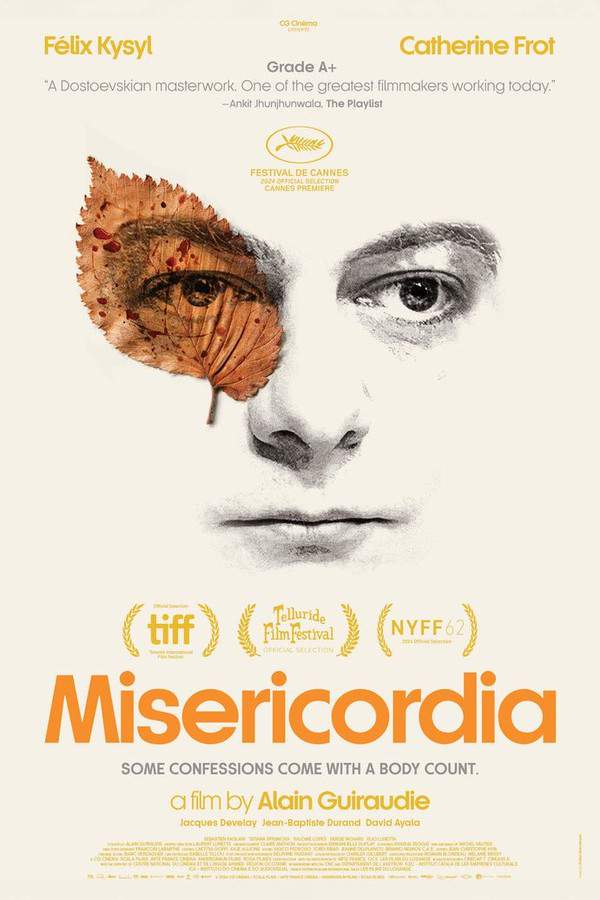
Misericordia (2025) movie poster

Plot Summary

Misericordia (2025) Plot Summary & Ending Explained

Release, runtime and language
2025 · 1 h 42 m · French
Echo score 78
Directed by
Alain Guiraudie
Starring
Félix Kysyl, Catherine Frot, Jean-Baptiste Durand, Serge Richard, Jacques Develay, David Ayala

Following the funeral of his former boss, Jérémie decides to stay with the baker’s widow, Martine, in his hometown. What begins as a short visit quickly becomes unsettling as a mysterious disappearance, a threatening neighbor, and a priest with peculiar intentions disrupt the quiet village and lead Jérémie down an unexpected path.

On this page (6)
  1. 1 What happens: full plot
  2. 2 Plot questions answered
  3. 3 How it ends
  4. 4 Movie threads
  5. 5 Movies like Misericordia
  6. 6 Every angle

Full plot summary · contains spoilers

What Happens in Misericordia: Full Plot Summary

The whole story of Misericordia (2025) explained, from the opening scene to the final frame: every key event, every twist and what it all adds up to. Read it as a quick recap before the sequel, to check a scene you missed, or to finally understand what really happened.

Jérémie Pastor returns from Toulouse to his hometown of Saint-Martial, Aveyron, to attend the funeral of his former boss, a local baker. The widow, Martine Rigal, invites him to spend the night at her house, and the next day he decides to extend his stay, drawn into the rhythms of village life and the familiarity of old faces.

The presence of Jérémie unsettles Martine's brutish son, Vincent Rigal, who resents the intrusion and the memories of his college days. Vincent's resentment grows as Jérémie forms a close bond with Walter Bonchamp, a longtime friend who begins dropping by regularly to chat over drinks.

Tensions rise when Vincent accuses Jérémie of wanting to have sex with his mother. During a confrontation, Vincent overpowers him and orders him to leave town. Later, during a visit to Walter's place, Walter rejects Jérémie's advances and throws him out, even threatening him with a shotgun. One day, Jérémie is walking along a road when Vincent drives him to a nearby forest, where another clash ends with Jérémie striking Vincent with a rock and killing him. He buries the body in the forest and abandons his car in Millau.

The next morning, Martine tells Jérémie that Vincent's wife, Annie, is worried because Vincent did not come home and was late for work. Jérémie claims he had a few drinks at Walter's before spending the night in a barn because of rain, though Walter says Jérémie was not at his place the previous night.

When Vincent's car is found in Millau, Martine and Annie grow suspicious of Jérémie. Jérémie provides a false alibi, saying that after Walter threw him out, Vincent found him on the road and they drove around in Vincent's car before he was dropped off in Millau with orders not to return.

The following day, Jérémie visits Walter, who is certain that Vincent would never leave town with his car. Walter is surprised when Jérémie says his attraction to him is genuine.

In the confessional of the village church, Father Philippe Griseul informs Jérémie that he knows he killed Vincent and offers to conceal the crime in exchange for Jérémie's affection, a request Jérémie does not reciprocate. Returning to Martine's house, Jérémie is questioned by a policeman and a policewoman; Jérémie insists that he and Vincent spent all night driving around and talking, and the officers suspect that Philippe is hiding something.

The following day, the two police officers confront Jérémie in the forest where Vincent's body is buried. He says Vincent beat him up in Millau—a detail not previously disclosed. As the policeman searches for holes, Philippe arrives and creates an alibi by claiming that Jérémie spent the night with him after returning from Millau and that they are secretly lovers.

That night, the officer attempts to question Jérémie in his sleep, and Jérémie screams for Martine, prompting the policeman to flee. The next night, as the officer returns to Martine's house, Jérémie sneaks out and rushes to the church, telling Philippe that Martine gave the policeman a key to her house. Anticipating the officer's next move, Philippe instructs Jérémie to pretend to be in bed with him, which misleads the officer when he arrives.

Later that night, Jérémie and Philippe dig up Vincent's body and move it to the local cemetery, where Philippe disposes of the remains. When Jérémie returns to Martine's house, she invites him to sleep by her side, and he asks to hold her hand, which she allows.
Last updated: August 02, 2026 at 13:01

Was this helpful?

Plot questions answered

Misericordia Plot Explained: Your Questions Answered

The questions people ask most about Misericordia (2025): what happens in the confusing scenes, why the characters do what they do, the twists, hidden details and what the ending means. Each answer contains spoilers.

Q1

Why does Jérémie decide to stay in Saint-Martial after the funeral?

Jérémie was only supposed to attend the funeral of his former boss, the local baker, but Martine Rigal, the baker's widow, invites him to spend the night. The familiarity of the village, the old faces he reconnects with, and the quiet rhythms of rural life draw him into extending what was meant to be a brief visit into an open-ended stay. His decision sets in motion every conflict that follows, as his presence destabilizes the household and the village around him.

Foreshadowing: From the moment he accepts Martine's invitation, the film signals that his return is not a simple act of mourning but a re-entry into unresolved personal history.

  • jeremie
  • saint-martial
  • funeral
  • martine
  • village
  • extended stay
Q2

Why does Vincent resent Jérémie so strongly?

Vincent, Martine's brutish son, resents Jérémie because his presence disrupts the household and stirs up memories of their college days. Jérémie's close bond with Walter, Vincent's best friend, further fuels Vincent's jealousy and sense of being displaced in his own home. The tension is sexual as well as territorial, culminating in Vincent's accusation that Jérémie wants to have sex with his mother.

Foreshadowing: Vincent's hostility is visible from Jérémie's first day back, hinting that the household is already volatile before any confrontation occurs.

  • vincent
  • jeremie
  • resentment
  • martine
  • walter
  • jealousy
Q3

How does Jérémie end up killing Vincent?

After being thrown out by Walter and threatened with a shotgun, Jérémie is walking along a road when Vincent drives up and takes him to a nearby forest. The encounter escalates into a final physical clash, and Jérémie strikes Vincent with a rock, killing him. The killing is not premeditated but emerges from a chain of rejections, confrontations, and Jérémie's growing desperation.

Foreshadowing: The earlier confrontation where Vincent overpowers Jérémie and orders him to leave town establishes that the conflict has nowhere left to escalate except violence.

  • jeremie
  • vincent
  • killing
  • forest
  • rock
  • murder
  • saint-martial
Q4

How does Jérémie try to hide Vincent's body and avoid suspicion?

After the killing, Jérémie buries Vincent's body in the forest and abandons Vincent's car in Millau to break the link between the victim and the location. The next morning he constructs a false alibi, claiming he drank at Walter's and slept in a barn because of rain. When the car is found in Millau, he expands the lie, saying Vincent picked him up and they drove around before dropping him off. Each new detail is added to patch the holes the previous lie created.

Foreshadowing: Walter's refusal to confirm Jérémie's alibi plants the first crack in the cover-up that will widen with every passing day.

  • jeremie
  • vincent
  • body
  • millau
  • alibi
  • forest
  • cover-up
Q5

How does Father Philippe know that Jérémie killed Vincent?

In the village church confessional, Father Philippe directly tells Jérémie that he knows about the murder, though the film does not spell out exactly how he learned it. Given his role as a confessor and his deep knowledge of the village, he likely pieced it together through confession, observation, or information passed along by parishioners. His certainty is what allows him to make his disturbing proposition.

  • father philippe
  • priest
  • confessional
  • murder
  • jeremie
  • vincent
Q6

What does Father Philippe want in exchange for hiding the murder?

Father Philippe offers to conceal Jérémie's crime in exchange for Jérémie's affection, a coercive and clearly improper request. Jérémie does not reciprocate, but Philippe continues to use his knowledge of the killing as leverage. The bargain transforms the priest from a moral authority into a complicit partner in the cover-up, with sexual favors as the price of silence.

  • father philippe
  • bargain
  • concealment
  • affection
  • priest
  • jeremie
Q7

Why does Walter reject Jérémie and threaten him with a shotgun?

Walter, Jérémie's longtime friend, rejects Jérémie's sexual advances during a visit and angrily throws him out, even brandishing a shotgun to drive him away. The rejection intensifies Jérémie's isolation at the exact moment he most needs an ally, and it removes Walter as a credible source who could back his alibi. Walter's later surprise at hearing that Jérémie's attraction was genuine hints that their friendship had always carried an undercurrent Jérémie misread.

  • walter
  • jeremie
  • rejection
  • shotgun
  • advances
  • friendship
Q8

Why does Father Philippe create a false alibi for Jérémie in the forest?

When the two police officers confront Jérémie in the forest where Vincent's body is buried, Philippe arrives and claims that Jérémie spent the night with him after returning from Millau and that they are secretly lovers. The alibi is designed to give Jérémie a witness and a reason to be in the area that does not involve the murder, but it also deepens Philippe's hold over Jérémie by tying the cover-up to their supposed affair.

  • father philippe
  • alibi
  • forest
  • police
  • jeremie
  • lovers
Q9

Why does the policeman try to question Jérémie while he is sleeping?

Frustrated by Jérémie's evasive answers and Philippe's interference, the policeman attempts a covert interrogation by approaching Jérémie in his sleep at Martine's house. The tactic backfires when Jérémie screams for Martine, causing the officer to flee. The scene underscores how thin the official investigation is and how the village's small, tangled relationships are doing more to expose the truth than the police themselves.

  • policeman
  • jeremie
  • midnight
  • martine
  • interrogation
  • house
Q10

Why do Jérémie and Philippe move the body to the cemetery?

With the police closing in and the forest burial site at risk of being discovered, Philippe instructs Jérémie to sneak out and help him exhume the body. They relocate Vincent's remains to the local cemetery, where Philippe handles the final disposal under the cover of his role as a clergyman. The exhumation marks the point at which Jérémie is no longer just hiding a crime but is fully entangled in Philippe's scheme.

  • jeremie
  • philippe
  • body
  • cemetery
  • exhumation
  • vincent
Q11

Why does Jérémie warn Philippe that the policeman has a key to Martine's house?

Jérémie learns that Martine has given the policeman a key to her house, which would allow the officer to enter unannounced and continue pressing him. Anticipating this, Jérémie sneaks out to the church to alert Philippe, who devises the ruse of having Jérémie pretend to be in bed with him. The warning shows that Jérémie is now actively cooperating with Philippe's manipulation rather than resisting it.

  • jeremie
  • philippe
  • policeman
  • martine
  • key
  • church
Q12

What does the final scene with Martine and Jérémie mean?

After the body has been moved, Jérémie returns to Martine's house, where she invites him to sleep by her side and allows him to hold her hand. The tender moment suggests an emotional bond forming between the two, but it is shadowed by the deception still binding Jérémie to Philippe and the guilt of Vincent's death. The film leaves this connection deliberately ambiguous, offering no clean resolution and emphasizing that warmth and crime now coexist in the same household.

  • jeremie
  • martine
  • final scene
  • hand
  • ending
  • ambiguous
Q13

What role does repressed sexuality play in the story?

Repressed desire drives several of the film's central conflicts: Jérémie's unacknowledged attraction to Walter, Walter's conflicted response, the priest's coercive proposition, and Vincent's accusation that Jérémie wants his mother. The tension between what characters feel and what they are willing to admit fuels the lying, the violence, and the moral compromises that follow. The story treats these desires as forces that distort every relationship in the village.

  • repressed sexuality
  • desire
  • jeremie
  • walter
  • philippe
  • vincent
  • theme
Q14

How does Jérémie's alibi keep changing?

Jérémie begins with a simple story: he drank at Walter's and slept in a barn because of rain. When Vincent's car turns up in Millau, he adds that Vincent picked him up on the road, they drove around talking, and Vincent dropped him off in Millau with orders to leave. During the police inquiry, he further claims he and Vincent spent the entire night driving and talking. Each revision is designed to cover the gaps left by the previous one, but the growing complexity makes the story easier to dismantle.

Foreshadowing: Walter's refusal to confirm the first version of the alibi signals that the lies will not hold for long.

  • jeremie
  • alibi
  • lies
  • vincent
  • walter
  • millau
  • police
Q15

How does Vincent's disappearance first come to light?

The morning after the killing, Martine tells Jérémie that Annie, Vincent's wife, is worried because Vincent did not come home and was late for work. This casual mention of a missed shift is what first puts pressure on Jérémie to produce an explanation, triggering the chain of lies that defines the rest of the film. The discovery of Vincent's abandoned car in Millau then escalates the suspicion into open investigation.

  • vincent
  • annie
  • disappearance
  • martine
  • millau
  • missing

Ending explained

What Happens at the End of Misericordia?

How Misericordia (2025) ends, in short: the final scene, the last twist and what it means for the characters. The full ending explained, with every spoiler, lives on its own page.

Read the full ending explained

Jeremie returns to his rural hometown for Jean‑Pierre’s funeral and is immediately caught in a web of unspoken desires. The dead baker’s widow, Martine, clings to him, while his old friend‑turned‑rival, Vincent, broods over the preferential treatment Jeremie received from his parents. As tensions mount—Vincent’s jealousy, Walter’s furtive attraction, and the village’s simmering fascination with Jeremie—the two men clash in the mushroom‑filled woods. In a sudden, unpremeditated burst, Jeremie strikes Vincent, bludgeoning him to death, a moment that feels as accidental as a stray spark in a dry forest.

Panicked, Jeremie buries the body where the murder occurred and constructs a clumsy alibi: he claims a night‑time injury from a fight and later spins a story of a drunken car ride with Vincent that never happened. The local constable, a lone woman, begins to suspect him, yet the investigation stalls. Priest Philippe—who is quietly infatuated with Jeremie—steps in, hinting at a night together and later offering to move the corpse to the cemetery. Their nocturnal escapade is interrupted when the constable breaks in on the priest’s house only to find Philippe and Jeremie in a compromising, half‑pretended tableau, which diverts any further proof.

Continue reading the ending (1 more paragraphs)

Haunted by guilt, Jeremie drives to a cliff’s edge, ready to end his torment, but Philippe pulls him back, his devotion bordering on worship. The film ends with Jeremie pressed between Martine’s jealousy and the priest’s affection, the corpse still hidden, and the police powerless to secure a confession. No definitive punishment arrives; instead, the story lingers in a limbo of desire and denial, leaving the audience to wonder whether mercy—or mere oblivion—will ever reach the killer.

Misericordia ending explained in full

Movie threads

More Movies Like Misericordia, by Mood & Story

Curated lists built around what makes Misericordia tick: the same mood, the same kind of story or the same emotional payoff. Each list explains why these movies belong together.

Movies like Misericordia: small town secrets and suffocating lies

Quiet communities where every polite smile hides a darker truth waiting to surface. If you loved Misericordia, discover more movies like this dark French drama where sleepy villages hide murder, blackmail, and forbidden desire. These claustrophobic crime stories thrive on simmering tension, repressed sexuality, and the slow unraveling of polite facades in tight-knit communities full of watchful neighbors and buried guilt.

  • claustrophobic
  • suffocating
  • small town
  • brooding
  • morally ambiguous
  • secretive
  • Tone: dark, brooding, claustrophobic
  • Pacing: steady, slow building
Why these movies?

The story pattern: A stranger or returning figure arrives in a small, gossipy community carrying a secret, and the story unfolds as that secret gradually infects every relationship around them. Old alliances fracture, hidden romances resurface, and a single transgression sets off a chain of blackmail, suspicion, and moral compromise. By the end, no character is untouched, and the village itself feels complicit in what has happened.

Why they belong together: Films in this thread share a distinctly European, character-driven sensibility where setting is almost a character itself. They prioritize mood and atmosphere over action, use long stretches of quiet dialogue to build dread, and explore how social conformity can mask brutality. The queasiness comes from proximity, from knowing your neighbor too well and not well enough.

Movies like Misericordia: trapped in a moral spiral with no clean exit

Protagonists cornered by their own choices, with nowhere left to turn and no redemption in sight. Looking for movies like Misericordia where murder, blackmail, and sexual coercion leave characters trapped in a tangle of their own making? These dark dramas and character studies explore guilt, repressed desire, and ambiguous endings without easy forgiveness, perfect for fans of morally complex films with heavy emotional weight.

  • guilt
  • morally ambiguous
  • trapped
  • ambiguous ending
  • repressed desire
  • coerced
  • Tone: dark, morally ambiguous, heavy
  • Pacing: steady, pressure driven
Why these movies?

The story pattern: A seemingly minor decision pulls the protagonist into a chain of escalating compromises. Each attempted fix only creates new dependencies, until the character is beholden to figures as compromised as themselves. Religious authority, sexual coercion, and criminal complicity intertwine. The story ends not with resolution but with an uneasy equilibrium, a hand held in a room that still smells of what was done.

Why they belong together: These stories are united by their refusal to offer moral relief. Protagonists are not villains, but they are no longer innocent either, and the films trust the audience to sit with that ambiguity. Pacing rewards patience, and the emotional payoff comes from recognizing the trap rather than from any dramatic release.

If you liked this

Movies Like Misericordia

Similar movies to Misericordia: the same genre, themes or kind of story. Each one comes with its own plot summary, timeline and ending explained.

Browse all movie summaries

Every angle

Misericordia (2025) Explained: Plot, Ending, Timeline & Characters

Everything about Misericordia in one place: what happens in the plot summary, the timeline in chronological order, the characters and meaning, the ending explained and a spoiler-free summary. What's After the Movie adds the cast, box office and post-credit scenes.

Coming soon on iOS and Android

The Plot Explained Movie Summary App

Plot summaries, endings explained and timelines on your phone. Catch up on any movie in minutes, save your favorites and never miss a twist again.

Be the first to know when we launch. Your email stays private, always.

Learn more about the app