Plot Explained Spoilers guaranteed!
Plot Explained

Browse by genre

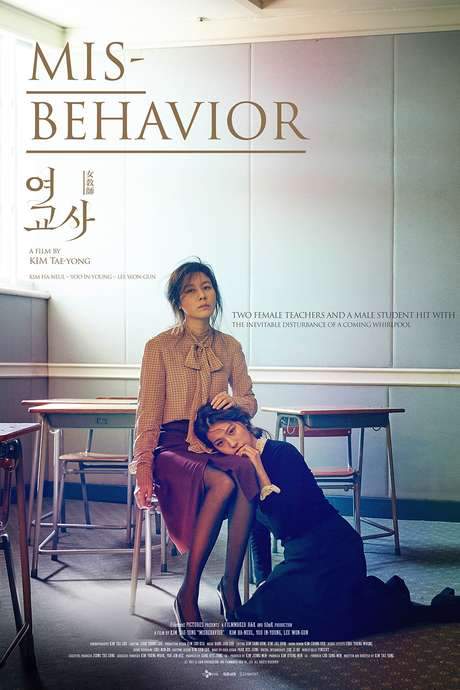
Misbehavior (2016) movie poster

Plot Summary

Misbehavior (2016) Plot Summary Explained

Release, runtime and language
2016 · 96 mins · Korean
Loading streaming availability…
Directed by
Kim Tae-yong
Starring
Lee Ki-woo, Gi Ju-bong, Lee Hee-jun, Oh Na-ra, Jeong Seok-yong, Lee Kyung-young

Hyo-joo, a substitute teacher at a boys’ high school, experiences deep embarrassment after witnessing Hae-yeong in a compromising situation with another student. The incident sparks a series of unsettling events and reveals hidden truths, leading to unforeseen consequences for everyone involved. The fallout from this encounter forces Hyo-joo and others to confront difficult realities and navigate complex relationships.

On this page (5)
  1. 1 Where to watch
  2. 2 What happens: full plot
  3. 3 Plot questions answered
  4. 4 Movie threads
  5. 5 Every angle
Loading streaming availability…

Full plot summary · contains spoilers

What Happens in Misbehavior: Full Plot Summary

The whole story of Misbehavior (2016) explained, from the opening scene to the final frame: every key event, every twist and what it all adds up to. Read it as a quick recap before the sequel, to check a scene you missed, or to finally understand what really happened.

Park Hyo-joo [Kim Ha-neul] is a part-time chemistry teacher who steps in as the homeroom teacher after a colleague goes on maternity leave, only to find herself navigating a dangerous dynamic with Cha Hae-young [Yoo In-young], a newly tenured instructor whose wealth and influential connections give her undeniable power in the school. At home, Park Hyo-joo wrestles with a deadbeat boyfriend who gaslights her, a relationship that frays her nerves and pushes her toward breaking points.

When Park Hyo-joo discovers Cha Hae-young in an intimate encounter with a student, Shin Jae-ha [Lee Won-keun], the tension explodes. The next morning, Park Hyo-joo uses the threat of exposure to demand that Cha Hae-young end the affair with Shin Jae-ha. Yet the power play doesn’t end there. To keep Shin Jae-ha close and under her influence, Park Hyo-joo enrolls him in ballet classes, preparing him for a big competition, and in a moment of loneliness she seeks comfort in an illicit, complicated relationship with him.

Shin Jae-ha ultimately earns a podium place, taking 2nd in the competition, a success that sours as he reveals a bitter truth: Cha Hae-young orchestrated their liaison to bend Park Hyo-joo to her will. The school’s board does not renew Park Hyo-joo’s contract, and she pleads with Cha Hae-young to negotiate with her father, the Lee Kyung-young who chairs the board, in a bid to hold onto her position.

In a pivotal hotel room scene, Cha Hae-young confesses that the romance with Shin Jae-ha was never about love. Enraged and feeling betrayed, Park Hyo-joo murders Cha Hae-young by pouring boiling water over her face. She phones Shin Jae-ha to come to the room, and they have a final, desperate moment together, but he declares that his heart belongs to Cha Hae-young, not Park Hyo-joo. The revelation shatters him, especially as he discovers Cha Hae-young’s lifeless body.

The film closes with a stark, unsettling image: Park Hyo-joo sitting at school as the police arrive, a quiet, haunted end that leaves the audience with questions about desire, power, and consequence.
Last updated: February 24, 2026 at 14:19

Was this helpful?

Plot questions answered

Misbehavior Plot Explained: Your Questions Answered

The questions people ask most about Misbehavior (2016): what happens in the confusing scenes, why the characters do what they do, the twists, hidden details and what the ending means. Each answer contains spoilers.

Q1

Why does Park Hyo-joo start a relationship with Shin Jae-ha after catching him with Cha Hae-young?

After discovering Cha Hae-young's affair with Shin Jae-ha, Park Hyo-joo initially uses the information to blackmail Cha into ending the relationship. However, feeling lonely and emotionally vulnerable due to her deteriorating relationship with her gaslighting boyfriend, Park seeks comfort in Shin Jae-ha. She enrolls him in ballet classes to keep him close, and their inappropriate relationship develops as a way for her to assert control and find emotional validation outside her troubled home life.

Foreshadowing: Park's strained home life and desire for control were established early, showing her need for dominance in at least one aspect of her life.

  • park hyo-joo
  • shin jae-ha
  • affair
  • manipulation
  • loneliness
Q2

What was Cha Hae-young's real motive for the affair with Shin Jae-ha?

Cha Hae-young's affair with Shin Jae-ha was not about love or genuine affection. In the hotel confession, Cha reveals she was simply "fooling around" with Shin and never loved him. The entire liaison was orchestrated by Cha as a manipulation tactic to gain leverage over Park Hyo-joo. By creating a situation where Park discovered the affair, Cha positioned herself to control and potentially blackmail Park, using the scandal as a tool to bend her to her will.

Foreshadowing: Cha Hae-young's calm, calculating reaction when threatened hinted at her manipulative nature rather than genuine fear of exposure.

  • cha hae-young
  • manipulation
  • leverage
  • scandal
  • power play
Q3

Why does Park Hyo-joo murder Cha Hae-young?

Park Hyo-joo murders Cha Hae-young after learning that the entire affair was a calculated scheme designed to manipulate her. In the hotel room, Cha casually confesses that she never loved Shin Jae-ha and was merely using him to control Park. Feeling completely betrayed and enraged, having sacrificed her job, dignity, and emotions for a relationship built on lies, Park snaps and pours boiling water over Cha's face in a brutal act of revenge.

Foreshadowing: The revelation that Cha orchestrated the affair to gain leverage over Park was the breaking point after Park's contract was not renewed and her emotional investment was revealed as meaningless.

  • murder
  • revenge
  • betrayal
  • boiling water
  • hotel room
Q4

Why isn't Park Hyo-joo's contract renewed at the school?

Park Hyo-joo's contract is not renewed after the school year ends. While the administration cites performance reasons and the scandal surrounding the love triangle, the real reason stems from Cha Hae-young's influence through her father, who chairs the school board. The scandal involving a teacher-student relationship, regardless of Park's involvement, provides the board with sufficient grounds to dismiss her, and Cha's family connections ensure the decision favors maintaining the school's reputation.

Foreshadowing: Cha Hae-young's powerful family connections were established when she earned tenure, showing she had the influence to affect Park's career.

  • contract
  • dismissal
  • school board
  • scandal
  • tenure
Q5

What does Shin Jae-ha reveal about the manipulation?

After winning second place in the ballet competition, Shin Jae-ha reveals to Park Hyo-joo that their entire relationship was designed to give Cha Hae-young leverage over her. The affair was never about genuine feelings, it was a setup orchestrated by Cha to manipulate and control Park. Park realizes she was merely a pawn in Cha's power play, having invested emotionally in a relationship that was fabricated from the start.

Foreshadowing: Cha's calm demeanor when threatened and her subsequent agreement to negotiate with Park hinted at a deeper scheme rather than genuine remorse.

  • shin jae-ha
  • revelation
  • pawn
  • scheme
  • competition
Q6

Why does Shin Jae-ha choose Cha Hae-young over Park Hyo-joo?

Despite Park Hyo-joo's investment in their relationship, supporting his ballet training and developing an emotional connection, Shin Jae-ha ultimately declares that his heart belongs to Cha Hae-young. Even after learning Cha never loved him and was using him, Shin's feelings remained directed toward her. This devastating revelation shatters Park completely, as she realizes her sacrifice meant nothing to either Cha or Shin.

Foreshadowing: The power dynamic between the three characters suggested Shin was more drawn to Cha's influence and status than to Park's genuine affection.

  • love triangle
  • shin jae-ha
  • rejection
  • emotional betrayal
Q7

What is the significance of the ballet competition in the story?

The ballet competition serves as a turning point that temporarily validates Park Hyo-joo's scheme while simultaneously setting up her downfall. Shin Jae-ha wins second place, which appears to be a success for Park's plan to keep him close and under her influence. However, it is during this moment of apparent triumph that Shin reveals the truth about the manipulation, turning the victory into the catalyst for Park's desperation and eventual violent act.

Foreshadowing: Park's enrollment of Shin in ballet classes was driven by her need for control and proximity, making the competition's outcome directly tied to her emotional stakes.

  • ballet competition
  • second place
  • dance
  • victory
  • turning point
Q8

How does the power imbalance between Park Hyo-joo and Cha Hae-young drive the conflict?

The power imbalance between the two teachers is central to the film's conflict. Cha Hae-young, newly tenured with wealthy and influential family connections, holds significant power within the school. Park Hyo-joo, a part-time chemistry teacher with no tenure or connections, is professionally vulnerable. When Park discovers Cha's affair, she briefly gains leverage through blackmail, but Cha ultimately uses her family's influence to have Park's contract non-renewed, demonstrating how institutional power ultimately prevails over moral leverage.

Foreshadowing: The rivalry established early in the film between the two teachers highlighted their unequal standing from the beginning.

  • power dynamics
  • tenure
  • influence
  • school board
  • rivalry
Q9

What happens in the hotel room scene between Park Hyo-joo and Cha Hae-young?

In the pivotal hotel room scene, Cha Hae-young confesses to Park Hyo-joo that she was never in love with Shin Jae-ha and was merely using him to manipulate Park. This revelation, combined with Park's professional downfall and emotional investment in the relationship, triggers Park to commit murder by pouring boiling water over Cha's face. Park then calls Shin to the room, where they have one final encounter before he discovers Cha's body.

Foreshadowing: The negotiation between Park and Cha, where Cha agreed to talk to her father, built tension toward this explosive confrontation.

  • hotel
  • confession
  • murder
  • boiling water
  • confrontation
Q10

What happens at the end of the movie?

The film ends with Park Hyo-joo sitting in the school cafeteria when police arrive to arrest her for Cha Hae-young's murder. Shin Jae-ha, after discovering Cha's lifeless body, is devastated by the consequences of the manipulations he was caught up in. The closing image shows Park calmly facing arrest, leaving her fate in the hands of authorities while the audience is left with the aftermath of the destructive love triangle.

Foreshadowing: The hotel room scene's violent climax and Shin's discovery of the body directly lead to Park's arrest.

  • ending
  • arrest
  • police
  • school
  • consequence
Q11

How does Park Hyo-joo's relationship with her boyfriend affect her behavior?

Park Hyo-joo's relationship with her deadbeat boyfriend, who gaslights her, contributes significantly to her psychological deterioration. The emotional abuse at home leaves her feeling powerless and insecure, driving her to seek control and validation elsewhere. This vulnerability makes her more susceptible to the complex manipulation with Cha Hae-young and Shin Jae-ha, as she desperately clings to any situation where she feels powerful or desired.

Foreshadowing: The early establishment of her troubled home life explains her need for control and her subsequent inappropriate attachment to Shin.

  • boyfriend
  • gaslighting
  • emotional abuse
  • vulnerability
  • control

Movie threads

More Movies Like Misbehavior, by Mood & Story

Curated lists built around what makes Misbehavior tick: the same mood, the same kind of story or the same emotional payoff. Each list explains why these movies belong together.

Thrillers about psychological power struggles like Misbehavior

Claustrophobic stories where manipulation and control lead to ruin. If you enjoyed the toxic dynamics and psychological manipulation in Misbehavior, you'll find more movies like it here. This list features intense dramas and thrillers where unstable power imbalances spiral into betrayal and ruin.

  • manipulative
  • tense
  • unsettling
  • claustrophobic
  • cynical
  • anxious
  • Tone: dark, tense, unsettling
  • Pacing: steady, building tension
Why these movies?

The story pattern: These narratives follow characters trapped in an escalating battle for dominance, often beginning with a hidden secret or act of blackmail. The plot steadily builds tension as manipulations backfire and control slips, leading to a climax of violence or irreversible moral collapse.

Why they belong together: Movies in this thread share a core focus on the corrupting nature of power, featuring morally ambiguous characters, heavy emotional weight, and a dark, tense atmosphere that builds to a bleak conclusion.

Dark character studies of moral collapse like Misbehavior

Stories of ordinary people spiraling into violence and corruption. Fans of Misbehavior's bleak story of a teacher's downfall will appreciate these similar movies. This collection focuses on character-driven dramas where poor choices and hidden desires lead to a violent, irreversible conclusion.

  • bleak
  • tense
  • lonely
  • unsettling
  • moral corruption
  • descent
  • Tone: dark, bleak, cynical
  • Pacing: steady, character-driven
Why these movies?

The story pattern: The narrative pattern follows a protagonist whose life is upended by a secret or a moment of weakness. As they attempt to control the fallout, their actions become increasingly desperate and unethical, leading to a chain of events that destroys their life and those around them.

Why they belong together: These films are grouped by their shared focus on a tragic character arc, a steady pacing that builds dread, a heavy emotional weight, and an ultimately hopeless conclusion that leaves no room for redemption.

Every angle

Misbehavior (2016) Explained: Plot, Timeline & Characters

Everything about Misbehavior in one place: what happens in the plot summary, the timeline in chronological order, the characters and meaning and a spoiler-free summary. What's After the Movie adds the cast, box office and post-credit scenes.

Coming soon on iOS and Android

The Plot Explained Movie Summary App

Plot summaries, endings explained and timelines on your phone. Catch up on any movie in minutes, save your favorites and never miss a twist again.

Be the first to know when we launch. Your email stays private, always.

Learn more about the app