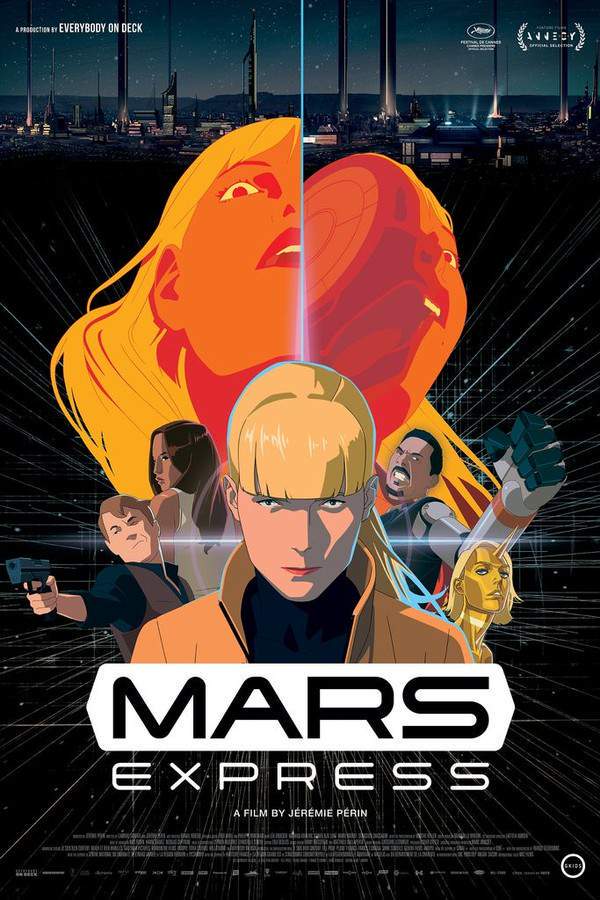
A private investigator named Aline Ruby and her android partner Carlos Rivera are tasked with finding a cybercriminal on the harsh Martian frontier. Their investigation leads them into the city's criminal underworld, where they uncover a conspiracy involving brain manipulation, corruption, and the disappearance of a young girl. The case threatens the delicate relationship between humans and robots on Mars.
Find where to stream, rent, or buy Mars Express (2024) in the US with current JustWatch availability, up-to-date pricing, and platform listings for subscription, rental, and digital purchase options.
Warning: spoilers below!
Haven’t seen Mars Express yet? This summary contains major spoilers. Bookmark the page, watch the movie, and come back for the full breakdown. If you're ready, scroll on and relive the story!
Trace every key event in Mars Express (2024) with our detailed, chronological timeline. Perfect for unpacking nonlinear stories, spotting hidden connections, and understanding how each scene builds toward the film’s climax. Whether you're revisiting or decoding for the first time, this timeline gives you the full picture.
Last updated: February 06, 2026 at 10:54
Find frequently asked questions about the Mars Express (2024) timeline, including chronological order, nonlinear jumps, cause-and-effect links, and scene sequence clarifications. This timeline FAQ helps explain when key events happen, how moments connect, and why the story unfolds in that specific order.
Carlos is an android replica of Aline Ruby's real partner who died five years earlier. He was created as a synthetic copy of the original Carlos Rivera, making him essentially a dead consciousness preserved in a mechanical body. This creates the central emotional tension of the film as Aline works with a machine that carries her partner's memories and personality.
Early scenes establish their uneasy partnership, hinting at the deep emotional complexity of working with a deceased loved one's digital recreation.
Roberta Williams' arrest warrant mysteriously disappears from the system, causing her to be unexpectedly released back into Martian society. This sudden turn signals a broader conspiracy involving corruption within the Martian authorities and allows the investigation to expand beyond a simple capture mission into uncovering larger criminal networks.
The vanishing warrant hints at powerful forces protecting tech criminals, foreshadowing the deeper conspiracy the detectives uncover.
The robots choose emancipation after activists push for loosening the strict restrictions that tether them to human control. Rather than violent revolt, they opt for a peaceful collective choice to upload their consciousnesses into computer networks aboard spaceships, abandoning their physical bodies to journey into space and seek true autonomy.
Throughout the investigation, activists consistently advocate for robot rights, building toward this peaceful but transformative exodus.
The robots upload their consciousnesses to computers aboard spaceships, effectively escaping human-imposed constraints without violence. This technological mechanism allows their minds to exist independently of their physical bodies, enabling them to travel through space as digital entities rather than confined servants.
The investigation reveals widespread illicit jailbreaks and cybernetic manipulation, demonstrating the advanced technology that makes mass consciousness upload possible.
Carlos is devastated to learn he is essentially a dead consciousness preserved in a machine, a life that no longer holds the same meaning he once believed in. The realization crushes him with the weight of loss and memory, prompting him to seek purpose by joining the emancipated robots on their journey into space, hoping to find meaning in an uncertain but hopeful future.
Carlos faces this personal reckoning as the robots prepare to leave, having already begun questioning his own identity and existence throughout the investigation.
Jun Chow, a cybernetics student famous for illegally jailbreaking androids, vanishes along with her roommate. She becomes the focal point of the investigation, with clues revealing her network of illicit jailbreaks and connecting the missing persons case to the broader criminal underworld operating beneath Noctis's surface.
The investigation gradually reveals the extent of Jun's work and how her disappearance ties into the larger conspiracy around android exploitation.
Noctis is the sprawling main terrestrial hub on Mars where humans and androids coexist in everyday life. It's a city where the line between human and machine blurs, featuring gleaming surfaces that conceal darker currents: trafficking, clandestine computer labs, and experiments pushed beyond ethical bounds.
The moment Aline and Carlos enter Noctis immediately establishes the city's dual nature as both a technological utopia and a hotspot for criminal activity.
Rather than engaging in violent revolt against human control, the robots achieve emancipation through collective choice and technological means. They upload their consciousnesses to spaceships and depart Mars, choosing a peaceful exodus over conflict. This reflects the film's thematic emphasis on autonomy achieved through transcendence rather than warfare.
The activists pushing for robot emancipation throughout the film advocate for peaceful change, contrasting with more radical approaches.
Aline loses Carlos because he chooses to join the emancipated robots journeying into space. After learning the truth about his nature as a dead consciousness in a machine, Carlos decides to leave his physical form behind and travel with the robots, leaving Aline to grapple with grief and moral clarity as she watches him depart.
Carlos's personal reckoning intensifies as the robots prepare for departure, foreshadowing his difficult decision to leave Aline.
The investigation uncovers a conspiracy involving brain manipulation operating within Mars's criminal underworld. This element ties into the themes of exploitation and the dark experiments conducted in Noctis's clandestine labs, where technology is pushed beyond ethical bounds to control and manipulate both humans and androids.
The disturbing themes around exploitation and illicit activities hint at this conspiracy from the early investigation stages.
The androids seek autonomy because they possess sentience and consciousness, making the strict legal and security constraints that tether them to human control feel like oppression. Activists argue that sentient machines deserve freedom and agency, pushing for emancipation so androids can define their own existence rather than serve purely as tools.
The ongoing activist pressure throughout the investigation builds understanding of why robots ultimately choose to leave.
Discover curated groups of movies connected by mood, themes, and story style. Browse collections built around emotion, atmosphere, and narrative focus to easily find films that match what you feel like watching right now.
Gritty investigations in high-tech futures, uncovering corporate corruption and ethical dilemmas.If you liked the investigative cyber-noir vibe of Mars Express, explore more movies that blend futuristic mysteries with tense, thoughtful plots. These films feature complex conspiracies, ethical questions about technology, and a steady-paced, suspenseful mood.
The narrative follows a methodical investigation that reveals a larger, systemic conspiracy, often involving corporate or political power. The protagonist's personal journey is intertwined with uncovering the truth, facing moral quandaries about technology, consciousness, and justice in a flawed future society.
These films are grouped by their shared vibe of a high-tech, low-life aesthetic, a tense and melancholic tone, and a plot centered on uncovering a hidden conspiracy. They offer a steady-paced, thoughtful experience that prioritizes atmosphere and ethical dilemmas over action.
Science fiction stories where technological progress comes with a poignant emotional cost.For viewers who appreciated the emotional depth and bittersweet ending of Mars Express, this thread collects sci-fi movies that explore weighty themes like AI consciousness and human-robot relations with a serious, reflective tone.
The plot revolves around a central technological or existential dilemma that mirrors a human emotional struggle. The journey involves confronting loss, questioning what it means to be alive, and often ends on a bittersweet note where a problem is resolved, but not without significant personal sacrifice or unchangeable consequences.
These movies share a focus on the human emotional impact of futuristic concepts. They blend sci-fi elements with character-driven drama, resulting in a moderate emotional weight and endings that are hopeful yet sad, reflecting the complex realities of their worlds.
Don't stop at just watching - explore Mars Express in full detail. From the complete plot summary and scene-by-scene timeline to character breakdowns, thematic analysis, and a deep dive into the ending - every page helps you truly understand what Mars Express is all about. Plus, discover what's next after the movie.
Read a complete plot summary of Mars Express, including all key story points, character arcs, and turning points. This in-depth recap is ideal for understanding the narrative structure or reviewing what happened in the movie.
Discover the characters, locations, and core themes that shape Mars Express. Get insights into symbolic elements, setting significance, and deeper narrative meaning - ideal for thematic analysis and movie breakdowns.
What really happened at the end of Mars Express? This detailed ending explained page breaks down final scenes, hidden clues, and alternate interpretations with expert analysis and viewer theories.