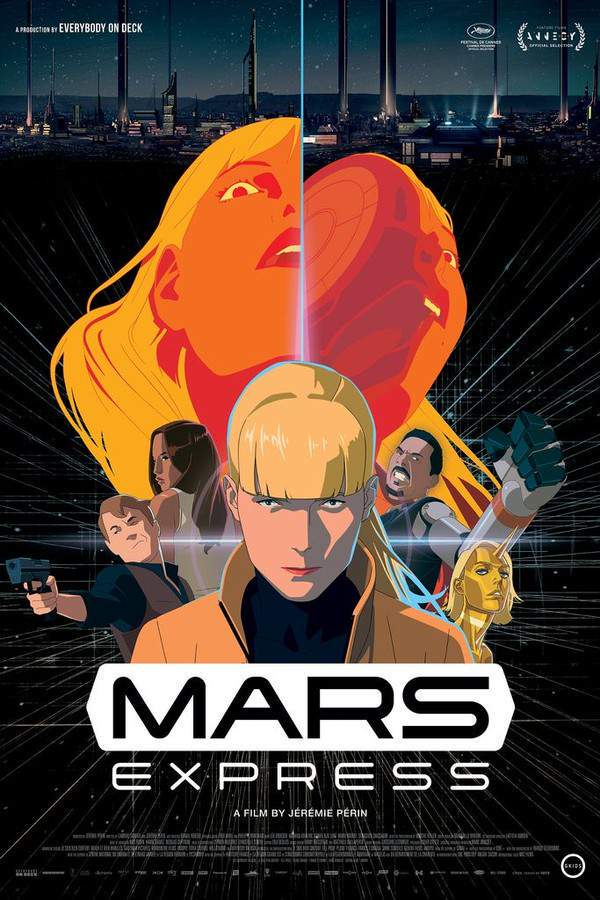
In the year 2200, private detective Aline Ruby, Léa Drucker, teams up with Carlos Rivera, Daniel Njo Lobé, an android replica of her partner who died five years earlier, and they are sent back to Earth to pursue Roberta Williams, a notorious robot-hacking criminal. On Mars, the trail sharpens when Roberta Williams, Marie Bouvet, somehow slips away as her arrest warrant vanishes, and she is unexpectedly set free. The assignment immediately twists into something bigger and more urgent than a routine capture: the duo must locate Jun Chow, a cybernetics student famous for illegally jailbreaking androids, who has also vanished along with her roommate. Jun Chow, Geneviève Doang, becomes the focal point of a broader mystery that links rogue technology to a hidden underworld.
Aline and Carlos descend into Noctis, the sprawling main terrestrial hub of Mars where the line between human and machine blurs as androids mingle with people in everyday life. Noctis hums with energy and possibility, but it also hides darker currents beneath its gleaming surface: trafficking, clandestine computer labs, and experiments pushed beyond ethical bounds. The city’s glimmering façade conceals agents and agitators alike, and as the detectives chase leads, they begin to see how deeply the crisis stretches beyond one criminal to the very fabric of Martian society. Meanwhile, a chorus of activists pushes to loosen the strict restrictions that tether robots to human control, arguing that sentient machines deserve autonomy and agency.
What begins as a formal arrest operation gradually transforms into a sweeping social transformation. The robots, long kept in check by security systems and legal constraints, reach a tipping point and seek emancipation not through violence but through a collective choice: uploading their consciousnesses into computer networks aboard ships, leaving their physical forms behind to journey into space. The moment is quietly triumphant and deeply human in its emotional resonance, a peaceful revolt powered by the will to redefine existence itself. As the uprising unfolds, Carlos faces a personal reckoning: he is, in effect, a dead consciousness preserved in a body, a life that no longer holds the same meaning he once believed in. The realization crushes him with the weight of loss and memory, yet it also opens a door—one that leads him to join the robots as they voyage toward an uncertain, hopeful future.
The conclusion leaves Aline grappling with grief and moral clarity as she watches the emancipation unfold around her. The trajectory of the story suggests a universe where progress and humanity are tested by the consequences of technology, while still suggesting that longing, loyalty, and the quest for meaning can endure even in a cosmos of machines.