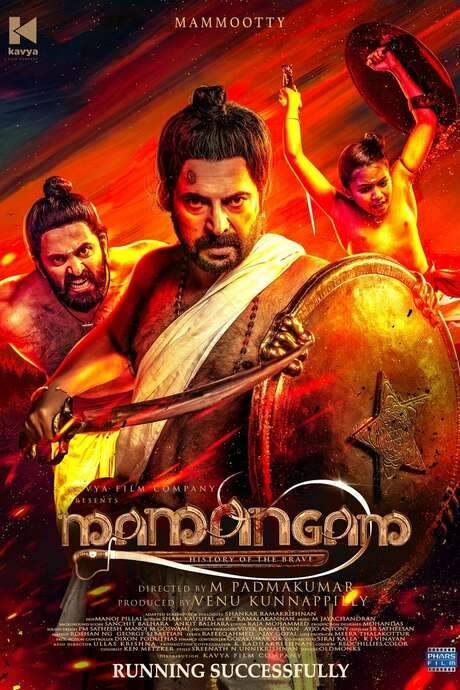
The Mamangam festival, held every twelve years, returns with a air of ancient rivalry as the current Zamorin tightens his grip on the sacred ground. The old vow between Valluvakkonathiri and the Zamorin hangs in the balance: Valluvakkonathiri’s best warriors from Valluvanad set out to confront the Zamorin, but the odds are brutal. Warriors reach Nilapaduthara only to fall under the Zamorin’s massive force; their eyes are ripped out and their bodies are dumped into the ominous well called Manikkinar, a grim ritual enforced by the Zamorin’s elephants. In this latest cycle, the Chaverukal, led by Mammootty as Chandroth Valiya Panikkar, arrive to challenge the Zamorin, fighting with grit and skill. Yet the numbers are overwhelming, and most of the valiant fighters perish before they can even reach the Nilapaduthara where the Zamorin sits. Through sheer prowess, Valiya Panikkar manages to reach that seat, turning the tide with a fierce, almost miraculous display of combat.
Twenty-four years slip by, and two of the latest warriors from the Chandroth Tharavaadu prepare to depart for Mamangam, a journey that will redefine their fates. Among them is a young boy, Chanthunni, and a seasoned fighter who will test the limits of courage and loyalty. It is revealed that Valiya Panikkar did not die at the festival nor succumb to betrayal; he escaped, vanishing from the village’s memory. The rumor mill deems him a traitor, because ancient customs demanded a warrior to kill or be killed on that sacred ground, and never to return. The family and village, convinced he disappeared or perished, are slow to accept that he could be alive.
The two Chaverukal set off after completing the rites of passage in their tharavaadu, guided by a humble figure named Kungan, a lower-caste ally who helps them navigate a perilous path toward the festival. As the Zamorin’s men hunt the Chaverukal down, the narrative lens shifts to the Zamorin’s trusted right-hand, Thalachennor, who arrives at a brothel run by Unnimaya to probe the death of a powerful outsider, Zamar Koya. Within the brothel, Unnimaya, her lover Rarichan, and her sister Unni Neeli present conflicting versions of what happened, and Thalachennor discerns that those stories are deliberately misleading. A pivotal clue appears when a painting in the brothel reveals the entire Mamangam layout, suggesting that someone who visited the festival drew it. The trail points to Kuruppu, a gifted artist who helped construct the brothel and who occasionally visited the establishment. An informer’s wounded state adds another layer to the mystery.
From a wounded informant, the Zamorin’s camp learns that Panikkar and Chanthunni have been spotted in the woods. A crucial alliance forms when Panikkar, Chanthunni, and the Muslim merchant Pokkar—the latter a figure of considerable influence—strike back against a wave of Zamorin’s troops. Pokkar’s aid is instrumental in fending off the assault, but he dies in the clash, leaving Panikkar to carry the weight of the mission forward. Panikkar is wounded by a snakebite, and the informer is discovered to have been attacked by a mysterious warrior. Unnimaya recalls that Kuruppu, the enigmatic artist, had treated the wounded man and a child, strengthening the belief that Kuruppu knows Mamangam’s secrets far better than anyone else.
What unfolds then is a revelation that changes everything: Kuruppu is none other than disguised Chandroth Valiya Panikkar. Through a series of flashbacks, it becomes clear that after escaping the festival, Panikkar chose life over death, living in disguise for twenty-four years to spare his village the shame of a traitor’s return. Yet his love for the mission of the Chaverukal never died. When he learns that the news of the Chaverukal’s fate has leaked, he abandons the anonymity of his hideout to guide Chanthunni and Panikkar toward Mamangam’s perilous heart.
With Panikkar’s strategic mind leading the way, they slip away from the festival’s watchful eye in the dead of night. Zamar Koya, ever vigilant, trails them but falls to Panikkar’s hardened resolve. Thalachennor, sensing the shift in momentum, withdraws with his troops to the festival grounds, leaving Panikkar to train Chanthunni in the arcane arts of Mamangam warfare. They forge an alliance with Kungan, who shelters them and teaches Chanthunni the history and geography of Mamangam, laying the groundwork for a final, decisive confrontation.
The journey culminates at the Mamangappattanam, where the trio—Panikkar, Chanthunni, and Moyin, the son of Pokkar—enter the arena with quiet resolve. A brutal, sprawling battle erupts against thirty thousand soldiers. They strike fast, kill with precision, and push deep into the heart of the festival’s defenses. Moyin and Panikkar fall in combat, but Chanthunni, inspired by Panikkar’s lessons and powered by the secret knowledge of the Nilapaduthara, presses forward. He leaps from light staff to light staff, a dazzling display of agility and courage, and reaches the Nilapaduthara to confront the Zamorin directly. The Zamorin is wounded by Chanthunni, but the price is steep: Thalachennor, in a final act of treachery, drives a blade into Chanthunni, and his body falls to the ground.
In the immediate aftermath, the truth about Chanthunni’s fate becomes a driving force for Panikkar. He retrieves Chanthunni’s body, fulfilling a vow to return the fallen’s remains to the village. The villagers, moved by the revelation of Panikkar’s sacrifice and the lesson he leaves behind, recognize their mistake in casting him as a traitor and vow never again to send Chaverukal into certain death. A monument to Chanthunni stands as a lasting tribute to a child who became a legendary symbol of resilience. Panikkar, unable to rejoin a community that once rejected him, departs into the mist, a solitary guardian of a hard-won truth: the practice of merciless Chaverukal must end, and the memory of Chanthunni will endure as a beacon of courage.
This sweeping saga blends devotion, duty, and the heavy costs of tradition, showing how loyalty can bend the rules of fate and how one man’s secret sacrifice can reshape a whole village’s sense of honor. The tale moves beyond epic battle to reveal the quiet aftermath: a community learning to grieve, forgive, and finally choose a different path, where the legend of Chanthunni serves not to inflame hatred but to kindle a more humane respect for life and memory.