Plot Explained Spoilers guaranteed!
Plot Explained

Browse by genre

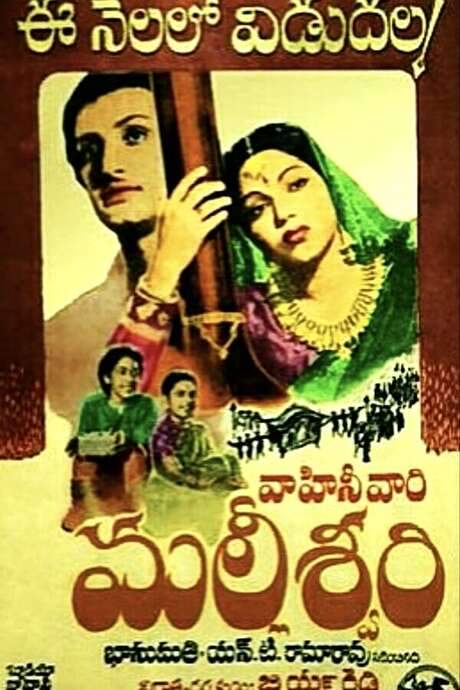
Malliswari (1951) movie poster

Plot Summary

Malliswari (1951) Plot Summary Explained

Release, runtime and language
1951 · 175 mins · Telugu
Loading streaming availability…
Directed by
B.N. Reddi
Starring
N.T. Rama Rao, Bhanumathi, Rushyendramani, T.G. Kamaladevi, Srivastava

During the Vijayanagara Empire, the ‘Rani Vasam’ system sends women to the royal palace as residents, forbidding any contact with men under pain of death. Malleswari (Bhanumathi) is sent by her parents for wealth, though she loves sculptor Nagaraju (N.T. Rama Rao). Caught meeting her, he is sentenced to death, but Emperor Krishnadevaraya pardons him and allows Malleswari to go with him.

On this page (6)
  1. 1 Where to watch
  2. 2 What happens: full plot
  3. 3 Plot questions answered
  4. 4 Movie threads
  5. 5 Movies like Malliswari
  6. 6 Every angle
Loading streaming availability…

Full plot summary · contains spoilers

What Happens in Malliswari: Full Plot Summary

The whole story of Malliswari (1951) explained, from the opening scene to the final frame: every key event, every twist and what it all adds up to. Read it as a quick recap before the sequel, to check a scene you missed, or to finally understand what really happened.

During the reign of the Vijayanagara Empire, Rani Vasam was a long-standing tradition described as a boon for young women. Under this system, breaking news of a palanquin arriving at a family’s doorstep could seal a future for a daughter as the official resident of the royal palace. Large sums in gold and jewellery were offered to parents in exchange for their consent, but once chosen, these women were isolated from contact with men and required permission for visits. Breach of the rule carried a severe penalty, including execution.

Nagaraju N.T. Rama Rao and Malliswari Bhanumathi of Veerapuram are cross-cousins who grew up as close friends, sharing joys and troubles from childhood. The bond between them irks Malliswari’s mother, Nagamma, who views Nagaraju and his family with resentment rooted in class differences. Nagamma’s disapproval is echoed by the village round, as Narappa—Malliswari’s father and village head—stands as a quiet observer, while Hanumanthappa, Malliswari’s uncle, wields influence as a minister in Krishnadevaraya’s court. The young duo’s friendship becomes a point of tension within the family, especially as Nagamma pushes for Malliswari’s future within the palace walls, which would sever their kinship.

One day, a chance visit to a nearby village leads Nagaraju and Malliswari to shelter in a mandapa during a rainstorm. In the same sheltered space, Krishnadevaraya and Allasani Peddana, along with a contingent of soldiers, discover Malliswari’s striking talent as both a singer and dancer. Unaware of each other’s royal identities, Nagaraju and Malliswari exchange thoughts, and Nagaraju seizes the moment to suggest Malliswari be recommended to Krishnadevaraya for the fabled Rani Vasam. Malliswari views this as a prank, while Nagamma presses for her daughter’s removal to the palace, and Narappa quietly hopes for Malliswari’s marriage to Nagaraju.

Driven by a growing sense of duty and aspiration, Nagaraju decides to leave Veerapuram to earn wealth and win Nagamma’s approval for marriage to Malliswari. His path takes him to Vijayanagara, where he trains as a sculptor and eventually finds success. Yet the reunion with Malliswari remains on hold, for Krishnadevaraya and Tirumaladevi appoint Malliswari as the official resident of the palace, granting her the status of Rani Vasam. This turn of events throws Malliswari into a life of opulence and danger, while Nagamma’s cravings for wealth and status push her to increase the pressure on Malliswari. As Malliswari is drawn deeper into palace life, Nagaraju returns, only to be confronted with the consequences of these political moves and the aching ache of separation.

The narrative thickens as Nagamma aggressively pushes Malliswari toward the palace, and Nagaraju, upon discovering what has happened, sinks into depression. Govindamma, Nagaraju’s mother, begins to falter under the weight of his withdrawal into a life of retreat, haunted by memories of Malliswari. A group of sculptors eventually invites Nagaraju to accompany them back to Vijayanagara to construct a special mandapa for dancers, and he agrees. It is there, at last, that he encounters Malliswari again.

However, their romance faces another obstacle: Malliswari’s maid, Jalaja, fears the severe punishment for any breach of the Rani Vasam rules. Jalaja secretly arranges a midnight meeting for the lovers on the banks of the Tungabhadra river, hoping to safeguard them by arranging a private moment away from prying eyes. The lovers’ path once again crosses the center of power when Krishnadevaraya and his ministers attend the newly built dance hall, and they learn that Nagaraju is among the commissioned sculptors.

That night, Malliswari wishes to meet Nagaraju but is delayed because the palace plans a formal performance of Usha Parinayam, with Krishnadevaraya and Tirumaladevi in attendance. Nagaraju, waiting near the Tungabhadra, slips into the palace and is pursued by soldiers, while Malliswari spots him from afar and calls out his name. To save Malliswari from a death sentence under Rani Vasam, Nagaraju pretends not to recognize her, but the pair soon find themselves jailed for violating the palace’s strict rules.

In the tension that follows, Jalaja reveals the lovers’ true story to Tirumaladevi, and she admits that Malliswari once refused any help and chose to face death with Nagaraju rather than bow to the palace’s demands. The next morning, as the nooses are prepared, the lovers confront Krishnadevaraya. A passionate confrontation ensues in which Nagaraju blames the king for orchestrating Malliswari’s forced entry into Rani Vasam, while Krishnadevaraya defends his actions and champions the lovers’ bond. Ultimately, the emperor forgives both Nagaraju and Malliswari, and their union is celebrated in a grand royal ceremony within the palace, marking a hopeful end to a tale woven from tradition, loyalty, and the enduring pull of true love.
Last updated: October 09, 2025 at 10:43

Was this helpful?

Plot questions answered

Malliswari Plot Explained: Your Questions Answered

The questions people ask most about Malliswari (1951): what happens in the confusing scenes, why the characters do what they do, the twists, hidden details and what the ending means. Each answer contains spoilers.

Q1

Why did Nagaraju recommend Malliswari for Rani Vasam if he loved her?

When Nagaraju suggests Malliswari for Rani Vasam during the rainstorm shelter, he believes it's an opportunity to give her a prestigious life. At that moment, he doesn't know she loves him back, he thinks she might prefer the palace's wealth and status. He also hopes earning royal favor could help him later secure permission to marry her. His intention is to help her, not understanding the consequences of the system that would separate them forever.

Foreshadowing: Earlier, Malliswari treats his Rani Vasam suggestion as a prank, hinting she values their bond over palace life.

  • nagaraju
  • malliswari
  • rani vasam
  • recommendation
  • love
  • intention
Q2

What is Rani Vasam in the Vijayanagara Empire?

Rani Vasam was a tradition where young women were selected to become official residents of the royal palace. Families received gold and jewellery in exchange for their daughters, but once chosen, the women were forbidden from any contact with men. Violation carried severe punishment, including execution. It was presented as a 'boon' but effectively trapped women in isolation.

Foreshadowing: The story establishes early that breaking the Rani Vasam rules means death, setting up the central conflict.

  • rani vasam
  • tradition
  • vijayanagara
  • palace
  • execution
Q3

Why does Nagamma push Malliswari to go to the palace despite her relationship with Nagaraju?

Nagamma views Nagaraju's family as socially inferior due to class differences. Sheresents that Malliswari and Nagaraju grew close as childhood friends and sees the palace as a way to secure wealth and status for her daughter, and for herself. Nagamma actively works to separate them, hoping the palace life will end any connection to Nagaraju's family.

Foreshadowing: Nagamma's open insults toward Nagaraju and Govindamma during family arguments establish her class-based resentment early.

  • nagamma
  • malliswari
  • palace
  • class
  • difference
  • motivation
Q4

Why does Nagaraju leave Veerapuram to become a sculptor?

After Nagamma insults his family and insists on Malliswari entering Rani Vasam, Nagaraju decides to leave Veerapuram to earn wealth and improve his status. He hopes that returning as a successful, wealthy man will win Nagamma's approval to marry Malliswari. His motivation is to prove himself worthy through financial success before seeking her hand in marriage.

Foreshadowing: Nagamma's harsh words about his family directly trigger his decision to leave.

  • nagaraju
  • sculptor
  • veerapuram
  • wealth
  • approval
  • marriage
Q5

Why does Nagaraju pretend not to recognize Malliswari when they are caught?

When Nagaraju is caught sneaking in the palace, Malliswari calls out his name, which would instantly doom them both to execution for violating Rani Vasam rules. To protect her from the death sentence, Nagaraju pretends not to know her, hoping his denial might save Malliswari from the harshest punishment. His selfless act is meant to shield her even at the cost of his own life.

Foreshadowing: The story establishes that Rani Vasam violations carry execution, making this desperate act necessary.

  • nagaraju
  • malliswari
  • pretend
  • recognition
  • execution
  • protection
Q6

What leads to Nagaraju and Malliswari's arrest?

Nagaraju enters the palace at night hoping to meet Malliswari at the Tungabhadra river meeting point. Soldiers pursue him through the palace corridors. Malliswari spots him and calls out his name, alerting the guards. Their interaction constitutes direct contact forbidden by Rani Vasam, leading to their arrest and imprisonment for violating the sacred palace rules.

Foreshadowing: Jalaja's secret midnight meeting arrangement at Tungabhadra sets up the dangerous encounter.

  • arrest
  • palace
  • rani vasam
  • violation
  • meeting
  • soldiers
Q7

What does Jalaja do to help the lovers?

Jalaja, Malliswari's maid, learns of their secret relationship and fears the deadly consequences if they're caught. She arranges a midnight meeting at the Tungabhadra riverbank, hoping to give them a private moment away from palace surveillance. Later, when the lovers face execution, Jalaja reveals their full love story to Tirumaladevi, explaining how Malliswari once chose to die with Nagaraju rather than betray their bond.

Foreshadowing: Jalaja's fear of Rani Vasam punishment drives her to help while also worrying about discovery.

  • jalaja
  • maid
  • secret meeting
  • tungabhadra
  • tirumaladevi
  • revelation
Q8

Why does Krishnadevaraya forgive Nagaraju and Malliswari?

During the confrontation, Krishnadevaraya acknowledges his own role in the tragedy, he accepted Malliswari into Rani Vasam after Nagaraju himself recommended her for the position. The emperor realizes the lovers' bond is genuine and that the rigid tradition has caused unnecessary suffering. Touched by their devotion and recognizing his own complicity, he pardons them and grants permission for their marriage.

Foreshadowing: The king admits that Nagaraju originally suggested Malliswari for Rani Vasam, taking responsibility for the chain of events.

  • krishnadevaraya
  • forgiveness
  • execution
  • marriage
  • tradition
  • responsibility
Q9

Does Malliswari really choose death over betraying Nagaraju?

Yes. Jalaja reveals to Tirumaladevi that Malliswari had previously refused any help that would require betraying her love for Nagaraju. She chose to face death rather than abandon him or deny their relationship. This demonstration of unwavering loyalty impresses Tirumaladevi and becomes key evidence that convinces the royal court of the genuine love between the couple.

Foreshadowing: The revelation confirms Malliswari's character, she values love over survival.

  • malliswari
  • death
  • choice
  • loyalty
  • jalaja
  • tirumaladevi
Q10

What does Nagaraju blame Krishnadevaraya for during the confrontation?

In the morning confrontation before execution, Nagaraju directly accuses Krishnadevaraya of orchestrating the entire tragedy. He argues that the king took Malliswari from him by accepting her into Rani Vasam, separating two people who loved each other. Nagaraju holds the king responsible for the forced palace system that destroyed their lives, even though he originally suggested Malliswari for the position without knowing the consequences.

Foreshadowing: The confrontation reveals how Nagaraju's own well-intentioned suggestion backfired catastrophically.

  • nagaraju
  • krishnadevaraya
  • blame
  • accusation
  • confrontation
  • responsibility

Movie threads

More Movies Like Malliswari, by Mood & Story

Curated lists built around what makes Malliswari tick: the same mood, the same kind of story or the same emotional payoff. Each list explains why these movies belong together.

Forbidden historical romances like Malliswari

Epic romances where love must overcome strict societal rules and oppressive customs. If you enjoyed the high-stakes romance of Malliswari, you'll find similar stories here. This collection features movies about forbidden love set against grand historical backdrops, where characters must challenge oppressive traditions and face great risks for their relationship, ultimately ending on a hopeful note.

  • romantic
  • dramatic
  • tense
  • hopeful
  • grand
  • tradition-bound
  • Tone: hopeful, dramatic, tense
  • Pacing: steady, traditional
Why these movies?

The story pattern: The narrative follows a linear path where two lovers are separated by an inflexible societal or political system. Their love is tested through periods of enforced separation and the threat of severe punishment. The conflict is typically resolved through a benevolent external intervention or a final act of defiance that allows love to conquer tradition.

Why they belong together: These films are grouped together because they share a core theme of romantic struggle against powerful institutions. They balance dramatic tension with a fundamentally hopeful tone, creating an emotionally engaging experience centered on the enduring power of love in the face of adversity.

Movies about hopeful endurance like Malliswari

Character-driven stories where resilience and hope triumph over systemic injustice. For viewers who appreciated the resilient spirit in Malliswari, this section highlights similar films. Discover movies where characters face significant oppression or separation but maintain hope, leading to uplifting conclusions that reward their endurance and faith.

  • hopeful
  • dramatic
  • tense
  • enduring
  • romantic
  • melancholic
  • Tone: hopeful, dramatic
  • Pacing: steady, character-driven
Why these movies?

The story pattern: The emotional journey is defined by a central character or couple facing a prolonged trial. The external pressure—be it societal, familial, or political—creates a consistent dramatic tension. However, the narrative arc is ultimately uplifting, with the characters' steadfast hope and resilience being validated by a positive resolution that feels earned.

Why they belong together: These movies are united by their specific emotional mix: they present serious challenges and create genuine tension, yet they are fundamentally uplifting. The combination of dramatic stakes with a hopeful, steady pacing and a happy ending creates a satisfying and emotionally resonant experience.

If you liked this

Movies Like Malliswari

Similar movies to Malliswari: the same genre, themes or kind of story. Each one comes with its own plot summary, timeline and ending explained.

Browse all movie summaries

Every angle

Malliswari (1951) Explained: Plot, Timeline & Characters

Everything about Malliswari in one place: what happens in the plot summary, the timeline in chronological order, the characters and meaning and a spoiler-free summary. What's After the Movie adds the cast, box office and post-credit scenes.

Coming soon on iOS and Android

The Plot Explained Movie Summary App

Plot summaries, endings explained and timelines on your phone. Catch up on any movie in minutes, save your favorites and never miss a twist again.

Be the first to know when we launch. Your email stays private, always.

Learn more about the app