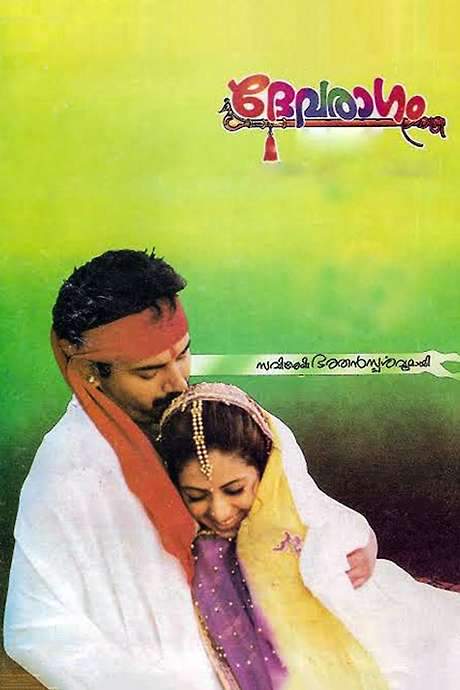
The story begins with a young child climbing into a bullock cart, eagerly insisting that he accompany the vehicle on its journey to pick up the Shavundi, the funeral rites performer who resides among the cremation grounds. The Shavundi is a figure often associated with fear and superstition—covered in ash and grime, sleeping in a grove infested with bats, and accompanied by ominous background music that underscores his eerie presence. As the child and the Shavundi converse during the ride, the scene shifts into a flashback that introduces us to Lakshmi, whose life story forms the core of this narrative.
Lakshmi's world turns upside down with the arrival of Vishnu, portrayed by Arvind Swamy, the priest's son and a priest-in-training in their village. His presence ignites a spark in Lakshmi, played by Sridevi(/actor/sridevi), who is immediately captivated by the young man. Driven by her newfound feelings, Lakshmi makes earnest efforts to forge a relationship with Vishnu. Their interactions are filled with innocent teasing and playful clashes, but gradually, their affection deepens into love.
However, their romance faces societal constraints. Vishnu, bound by his vows as a brahmachari, cannot marry legally, and the circumstances seem unfavourable for their union. Recognizing the gravity of their situation, Lakshmi seeks guidance from an astrologer, who predicts a challenging future for the lovers but offers hope through a sacred path. He advises them to visit a particular temple, promising that all their sins will be absolved and that they will begin anew in a different life if they undertake this pilgrimage. Seizing this chance, Lakshmi and Vishnu marry secretly, their vows made away from prying eyes, and they share their first intimate moments as husband and wife knowing that their bond is genuine and deep.
Complications are soon to follow. Lakshmi's aunt visits her and arranges her marriage to her cousin Parthasarathy, played by Rajiv Krishna. When Lakshmi confesses her love to her father, the situation intensifies; her father, desperate and emotionally overwhelmed, threatens self-harm and demands that Vishnu assist in formalizing her marriage, circumventing societal norms. As Vishnu's father is ill, he is compelled to perform the marriage rituals for Lakshmi and her new husband, unaware of her previous secret marriage to Vishnu. Witnessing her husband participate in the rites for a woman he secretly married causes Lakshmi immense heartbreak, but she feels powerless to stop the proceedings.
After the wedding, Lakshmi's husband learns about her love for Vishnu, but he reassures her that he bears no rancor. As time passes, Lakshmi becomes pregnant, and troubled by her conscience, she pleads for her husband's forgiveness, promising to reveal the truth later. Her husband confesses his impotence, requesting her to keep her pregnancy secret, fearing social disgrace and shame if the truth emerges.
Devastated, Vishnu leaves his home and begins a spiritual quest, frequenting various temples in hopes of finding peace. During his pilgrimage, Vishnu visits a mentor, an old student of his father, who now serves as a prominent priest. This mentor expresses interest in marrying his daughter Kokila, a popular advertisement actress, who also harbors feelings for Vishnu. Still haunted by his love for Lakshmi, Vishnu declines the proposal. Instead, he performs a puja for Kokila's unborn child at her father’s instruction, a ritual he agrees to despite his inner turmoil. When Vishnu sees a kolam (traditional rangoli) outside Kokila’s house—a symbol that brings to mind Lakshmi—his heart aches deeply. Upon entering, he recognizes Lakshmi herself, and in a moment of grief, he performs the mangalyapuja (marriage rite) for his own son without realizing who the child truly is.
His anguish deepens when he returns to his father, yelling out his story of love and loss. The old priest, furious and disappointed, curses Vishnu, condemning him to become a Shavundi, a figure seen as sinful and cursed, unfit for any sacred duties. The curse signifies Vishnu’s internal torment and guilt, and overwhelmed, he leaves in despair, embodying the shame and pain of his circumstances.
Fast forward to the present, the narrative reveals a tragic twist—Lakshmi’s husband has reportedly died, and Vishnu, now in the role of a Shavundi, is performing the funeral rites. Witnessing this, Lakshmi’s fury erupts as she confronts the truth: her son is alive—her husband is Vishnu, the man who once blessed her during those sacred ceremonies. She reveals that Vishnu, in his role as a priest and in his act of performing the ritual, unknowingly performed the mangalyapuja for their son—a gesture that binds him forever to her family. The revelation shocks everyone present, exposing the deep intertwining of their lives and the tragic misunderstandings that have plagued them.
Faced with the reality of his past actions and the weight of societal and personal guilt, Vishnu refuses to remain a Shavundi any longer. He chooses to reject his cursed role and, with a heavy heart, decides to take Lakshmi and her child away from the oppressive society to lead a life of peace and happiness. The film ends on this note of hope amid tragedy, emphasizing themes of love, sacrifice, and redemption in the face of societal prejudices and personal destiny.
---
Let me know if you'd like any additional adjustments!