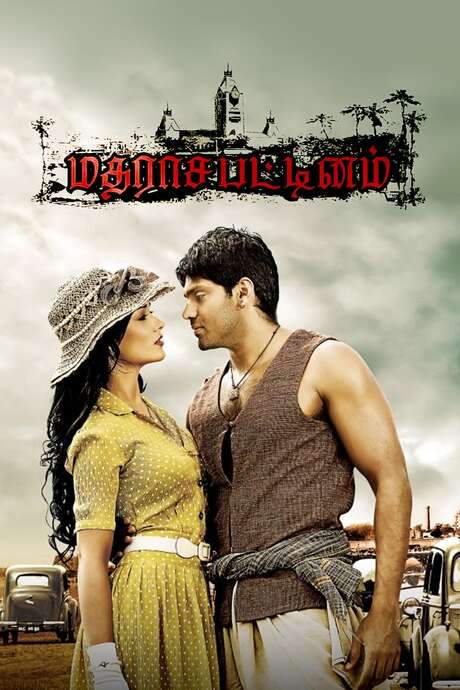
Madrasapattinam
Year: 2010
Runtime: 159 mins
Language: Tamil
Director: A. L. Vijay
Amy, the wife of an English governor stationed in Madras, falls in love with Parithi, a local villager. They attempt to elope, but are captured and Amy is forced to return to London. Decades later, she returns to Madras, determined to find Parithi and discover what became of their love.
Warning: spoilers below!
Haven’t seen Madrasapattinam yet? This summary contains major spoilers. Bookmark the page, watch the movie, and come back for the full breakdown. If you're ready, scroll on and relive the story!
Timeline – Madrasapattinam (2010)
Trace every key event in Madrasapattinam (2010) with our detailed, chronological timeline. Perfect for unpacking nonlinear stories, spotting hidden connections, and understanding how each scene builds toward the film’s climax. Whether you're revisiting or decoding for the first time, this timeline gives you the full picture.
Last updated: October 01, 2025 at 10:24
Madrasapattinam (2010) Timeline Questions Answered – Chronology FAQ
Find frequently asked questions about the Madrasapattinam (2010) timeline, including chronological order, nonlinear jumps, cause-and-effect links, and scene sequence clarifications. This timeline FAQ helps explain when key events happen, how moments connect, and why the story unfolds in that specific order.
Why did the clock show the wrong time in Madras Central Railway Station?
The clock in the Clock Room showed four o'clock when it was actually five o'clock. This timing mix-up caused Amy and Parithi to miss their chance to escape together on Independence Day 1947. The malfunction foiled their plan to elope, leading to their forced separation.
Earlier scenes show the couple planning their escape around the clock, hinting at time being their enemy.
Why was Amy forced to return to England?
As the daughter of the Madras Presidency Governor, Amy was under pressure to leave India as British rule ended. Her relationship with Parithi, a local dhobi, was unacceptable to her family and the colonial authorities. On 15 August 1947, when India gained independence, Amy was compelled to return to England, separating her from Parithi.
The escalating tensions with white officials throughout the film set up this forced departure.
What is the Thali necklace and why does Amy want to return it?
The Thali is a sacred thread necklace that signifies marriage and belonging in South Indian culture. It tied Parithi's mother to India and represented the bond between Amy and Parithi. Amy wanted to return it because she believed no one else could rightfully claim it, she was its rightful owner, and it symbolized their love and her connection to India.
The Thali is first shown as Parithi demonstrates its cultural significance to Amy.
How did Parithi die and when?
Parithi died approximately twelve years before the present-day timeline of the film. When elderly Amy arrives in Chennai searching for him, she learns from a taxi driver that Parithi has already passed away. She visits his tomb to honor his memory and fulfill her lifelong promise.
The present-day search is framed as a race against time, as Amy herself is near death.
Why does Amy return to Madras after decades?
Amy returns to Chennai on her deathbed in London, driven by an urgent need to return the Thali necklace to Parithi. With only a faded photograph to guide her, she embarks on this final quest alongside her granddaughter Catherine. Her motivation is to restore the legacy of their bond and ensure the necklace returns to its rightful place.
The film opens with Amy near death, establishing her urgency to complete this mission.
Who is Parithi and what does he do?
Parithi is a dhobi (laundry worker) in Madras who becomes a local hero by resisting British plans to build a golf course at the dhobikhana, their community washing area. He is portrayed as a courageous and dignified man who fights for his people's home and dignity under colonial rule.
Parithi's introduction establishes his role as a rebel and community leader.
Who is Nambi in the movie?
Nambi is the witty and loyal translator who assists Parithi and Amy throughout their relationship. He serves as a bridge between the British officials and the local villagers, providing comic relief while also supporting the couple amid the political turmoil of the era.
Nambi is introduced early as Parithi's companion, foreshadowing his supportive role.
What happened on 15 August 1947 in the movie?
On 15 August 1947, India gained independence from British rule. This is the day Amy and Parithi planned to escape together. However, the clock malfunction and the political upheaval forced Amy to leave India, separating the lovers forever. The date marks both liberation and personal loss.
The film builds tension toward this date as the couple's final opportunity to be together.
Why is Amy called Duraiamma?
Duraiamma is an affectionate Tamil term meaning "lady" or "mistress" that Parithi uses to call Amy. It represents the intimate, culturally blended nature of their relationship and becomes the name Amy is known by throughout the film, symbolizing her acceptance into local life.
Parithi first uses this term when introducing Amy to Madras culture.
Why do Amy and Parithi hide in the Clock Room?
Amy and Parithi hide in the Clock Room atop Madras Central Railway Station while trying to escape together on Independence Day. An Indian police officer offers them protection, but the clock's malfunction becomes their undoing. The location represents their final hope and the cruel timing that separates them.
The Clock Room is introduced as a place of shelter earlier in the film.

Explore Movie Threads
Discover curated groups of movies connected by mood, themes, and story style. Browse collections built around emotion, atmosphere, and narrative focus to easily find films that match what you feel like watching right now.
Historical forbidden romance movies like Madrasapattinam
Epic love stories that bloom amidst cultural divides and political turmoil.Discover movies like Madrasapattinam that feature intense romantic stories set against a historical backdrop. If you enjoyed the tale of love across cultural divides in colonial India, you'll find similar epic romances in this collection.
Désirée
1954

Every Time We Say Goodbye
1986

Passion Flower
1930

Hearts in Bondage
1936

The Sleeping Dictionary
2003

Salt on Our Skin
1992

The Love Letter
1998

The Valley of Decision
1945

All I Desire
1953

Cyrano de Bergerac
1990

Déjà Vu
1997

One True Love
2000

A Lost Lady
1934

The World
2005

Green Dolphin Street
1947
Narrative Summary
The narrative typically follows lovers from different worlds whose relationship is forbidden by the societal structures of their time. Their journey is as much about navigating external pressures—war, class, or colonialism—as it is about their internal passion, often leading to sacrifice and a legacy defined by memory.
Why These Movies?
Movies in this thread share a core focus on romance tested by historical circumstances, blending deep emotional connection with a vivid sense of time and place. They create a specific emotional mix of yearning, grandeur, and bittersweet consequence.
Movies about searching for a lost love like Madrasapattinam
Stories driven by a decades-long search to reclaim a connection from the past.If you liked the elderly Amy's search for Parithi in Madrasapattinam, explore these movies about characters on a lifelong quest to find a lost love. These stories capture the bittersweet hope and melancholic yearning of searching for a past connection.

Tracing Her Shadow
2021
Lacuna
2012

A Lot Like Love
2005

And Now My Love
1974

Eternal Sunshine of the Spotless Mind
2004

For Love of the Game
1999

We All Loved Each Other So Much
1974

My Blue Summer
2022
Green Dolphin Street
1947

Rock Odyssey
1987

Secrets
1933

Love Aaj Kal
2009

Three Thousand Years of Longing
2022

The Apartment
1996

How Stella Got Her Groove Back
1998
Narrative Summary
These narratives often use a dual timeline, juxtaposing the intensity of the original romance with the slower, more reflective present-day search. The journey is as much about self-discovery and coming to terms with the past as it is about the literal finding of the person, with the ending providing poignant closure rather than simple reunion.
Why These Movies?
They are united by a specific emotional arc: the initial burst of romance, the ache of long separation, and the hopeful, sometimes desperate, perseverance of the search. The pacing is often variable, blending past passion with present contemplation.
Unlock the Full Story of Madrasapattinam
Don't stop at just watching - explore Madrasapattinam in full detail. From the complete plot summary and scene-by-scene timeline to character breakdowns, thematic analysis, and a deep dive into the ending - every page helps you truly understand what Madrasapattinam is all about. Plus, discover what's next after the movie.
Madrasapattinam Summary
Read a complete plot summary of Madrasapattinam, including all key story points, character arcs, and turning points. This in-depth recap is ideal for understanding the narrative structure or reviewing what happened in the movie.

Characters, Settings & Themes in Madrasapattinam
Discover the characters, locations, and core themes that shape Madrasapattinam. Get insights into symbolic elements, setting significance, and deeper narrative meaning - ideal for thematic analysis and movie breakdowns.


