Year: 1996
Runtime: 160 mins
Language: Hindi
Director: Gulzar
A realistic, hard-hitting portrayal of terrorism and youth in the Punjab after the 1984 riots.
Warning: spoilers below!
Haven’t seen Maachis yet? This summary contains major spoilers. Bookmark the page, watch the movie, and come back for the full breakdown. If you're ready, scroll on and relive the story!
Read the complete plot breakdown of Maachis (1996), including all key story events, major twists, and the ending explained in detail. Discover what really happened—and what it all means.
Set in Punjab during the late 1980s, a perilous era shaped by the fallout of Operation Blue Star, the assassination of Indira Gandhi, and the 1984 Sikh massacre, this story unfolds largely through a series of stark flashbacks that peel back the layers of fear, loyalty, and vengeance that grip a community pushed to the edge.
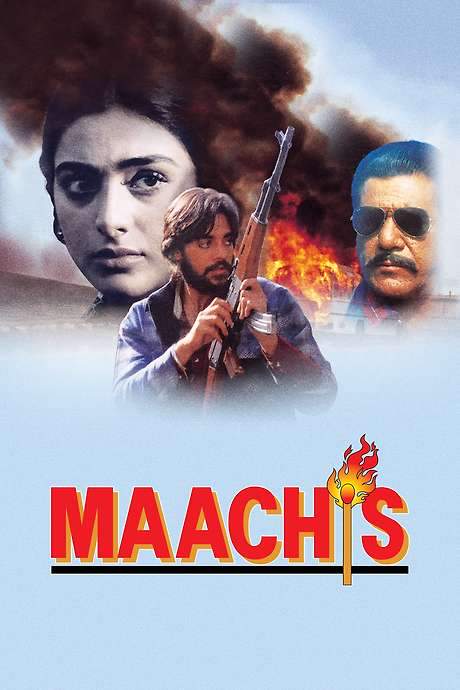
Jaswant Singh Randhawa, Raj Zutshi and his sister Veerendar “Veeran,” Tabu live a quiet life with their aging mother, Biji, Navnindra Behl, in a rural village. The family’s once-peaceful routine is upended when the local authorities—Assistant Commissioner Khurana, a stern and unyielding presence, and Inspector Vohra, a relentless figure—arrive in search of Jimmy, accused of trying to shoot a member of Parliament. In a moment of misdirection, Jaswant’s prank leads the police to his puppy, Jimmy, which enrages Khurana and Vohra. Jaswant is detained, and Kripal, his friend and Veeran’s fiancé, begins a frantic search that spans several police stations, only to find him badly beaten upon his return after fifteen days. The brutal brutality of the police leaves a mark on Kripal’s trust in the system and on his view of justice.
Kripal’s anger births a dangerous reckoning. Frustrated by the lack of legal recourse, he seeks help through channels he hopes will deliver accountability. When that path fails, he follows a more dangerous lead to Jeetay, who is connected to militant circles. This search leads him to a highway dhaba where he meets Sanatan, a militant figure who has already carried out a bombing. Kripal pleads for aid, and Sanatan, though wary, agrees to help him navigate the network of militants in a truck packed with explosives.
At the militant hideout, Kripal lays out the reality of his predicament. The Commander, a hardened veteran of the struggle, reveals a painful truth: he killed Jeetay because Jeetay had become a police informant. The Commander refuses to promise Kripal safe passage, insisting that if Kripal wants justice, he must take decisive action on his own by targeting Khurana. Kripal’s resolve hardens as he earns the trust of the group, and Sanatan emphasizes a crucial point: their fight is not about nationalism or religion in abstract terms, but about defending civil rights and resisting a system that harms ordinary people.
Sanatan, who survived the Partition of 1947 and lost much of his family in the 1984 riots, shares his belief that the ruling class manipulates society by pitting communities against each other for political gain. With that worldview guiding him, Kripal trains with the militants. After a year of preparation, Kripal executes Khurana in a crowded marketplace, an act that shatters the sense of safety for everyone around him. The revelation of Khurana’s death devastates Jaswant and Veeran when Kripal returns to bid them farewell before going into hiding.
The road ahead is bleak. The militants, now aware that Kripal is a high-profile target, urge him to disappear, while the group continues to plan new operations, including a mission involving a missile specialist who turns out to be Veeran herself. The ring’s dynamics become personal: Kripal and Veeran quietly marry in secret, only to discover that Veeran carries a cyanide pill, a preventive measure kept by the group in case of capture.
As Kripal and Veeran navigate the blurred lines between loyalty and betrayal, the hunt intensifies. Kripal attempts to surveil Inspector Vohra ahead of a planned strike on Kedar Nath, but he is captured before the mission can proceed. Sanatan, convinced of Kripal’s betrayal, orders Veeran under house arrest and commands Wazir to kill her. Veeran escapes and kills Wazir in the process, while Jaimal Singh leads the subsequent strike on the MP’s convoy. Jaimal dies on the bridge, but Sanatan succeeds in destroying Kedar Nath’s car with a missile.
The pursuit then shifts: Veeran, now deeply embedded in the group, hunts Sanatan herself. A final, brutal confrontation in the woods ends with Veeran killing Sanatan. In a quiet, almost intimate moment earlier, Veeran had slipped Kripal a cyanide pill during a clandestine visit to his prison cell; the film closes on a stark note as Kripal dies in his cell, the cyanide taking its toll, while Veeran sits in the back of a moving pickup, blood streaming from her nose, having swallowed the pill herself.
This is a meditation on how cycles of violence consume not only those who pull the triggers but also the ordinary lives around them, turning acts of defense into acts of reckoning. The narrative leaves the audience with a measured, sorrowful view of a era when trust between citizens and the institutions meant to protect them was strained to a breaking point. In the end, the story lingers on the cost of resistance and the personal toll carried by those who choose to resist a corrupted system.
Last Updated: October 07, 2025 at 09:28
Discover curated groups of movies connected by mood, themes, and story style. Browse collections built around emotion, atmosphere, and narrative focus to easily find films that match what you feel like watching right now.
Stories where injustice turns ordinary lives into paths of violent resistance.If you liked the grim portrayal of radicalization in Maachis, explore more movies like it. This thread features similar stories of political injustice, personal tragedy, and the descent into violent resistance, often with a heavy emotional weight and bleak resolution.
The narrative typically follows a protagonist who experiences a profound personal or political injustice, which shatters their world and forces them towards extremist measures. The journey is one of moral compromise, showing the transformation from an innocent individual to a hardened militant, often culminating in a tragic conclusion that underscores the futility of the cycle.
Movies are grouped here for their shared bleak tone, high emotional intensity, and focus on the theme of political radicalization. They resonate through their unflinching look at how systems of power breed violence and the devastating personal cost of fighting back.
Films where the quest for revenge consumes everything, leaving only sorrow.For viewers who appreciated the sorrowful exploration of revenge in Maachis, this collection highlights similar movies. Discover other films where a personal quest for justice spirals into a hopeless cycle of violence, characterized by a grim mood and profound emotional impact.
The plot follows a character motivated by a severe personal loss or wrong, embarking on a path of retaliation. However, the narrative structure emphasizes the escalating costs and moral decay, rather than a triumphant outcome. The journey is a downward spiral, often ending with the protagonist's own destruction or a Pyrrhic victory that feels like a loss.
These films share a cohesive vibe defined by a grim and sorrowful mood, high tension, and a bleak perspective on revenge. They are united by their heavy emotional weight and the thematic exploration of how vengeance begets more violence, leading to an inescapable tragedy.
Don't stop at just watching — explore Maachis in full detail. From the complete plot summary and scene-by-scene timeline to character breakdowns, thematic analysis, and a deep dive into the ending — every page helps you truly understand what Maachis is all about. Plus, discover what's next after the movie.
Track the full timeline of Maachis with every major event arranged chronologically. Perfect for decoding non-linear storytelling, flashbacks, or parallel narratives with a clear scene-by-scene breakdown.
Discover the characters, locations, and core themes that shape Maachis. Get insights into symbolic elements, setting significance, and deeper narrative meaning — ideal for thematic analysis and movie breakdowns.
Get a quick, spoiler-free overview of Maachis that covers the main plot points and key details without revealing any major twists or spoilers. Perfect for those who want to know what to expect before diving in.
Visit What's After the Movie to explore more about Maachis: box office results, cast and crew info, production details, post-credit scenes, and external links — all in one place for movie fans and researchers.
Discover movies like Maachis that share similar genres, themes, and storytelling elements. Whether you’re drawn to the atmosphere, character arcs, or plot structure, these curated recommendations will help you explore more films you’ll love.
Maachis (1996) Scene-by-Scene Movie Timeline
Maachis (1996) Movie Characters, Themes & Settings
Maachis (1996) Spoiler-Free Summary & Key Flow
Movies Like Maachis – Similar Titles You’ll Enjoy
Mission Kashmir (2000) Movie Recap & Themes
Tumko Na Bhool Paayenge (2002) Full Summary & Key Details
Maqbool (2003) Movie Recap & Themes
Mala leche (2004) Full Summary & Key Details
Chandni Bar (2001) Plot Summary & Ending Explained
Qayamat: City Under Threat (2003) Movie Recap & Themes
Aan: Men at Work (2004) Movie Recap & Themes
Saugandh (1991) Full Summary & Key Details
Mujrim (1989) Story Summary & Characters
Nishchaiy (1992) Plot Summary & Ending Explained
Mausam (1975) Story Summary & Characters
Deshdrohi (2008) Story Summary & Characters
Kachche Dhaage (1999) Movie Recap & Themes
Maanthrikam (1995) Story Summary & Characters
Mohra (1994) Complete Plot Breakdown