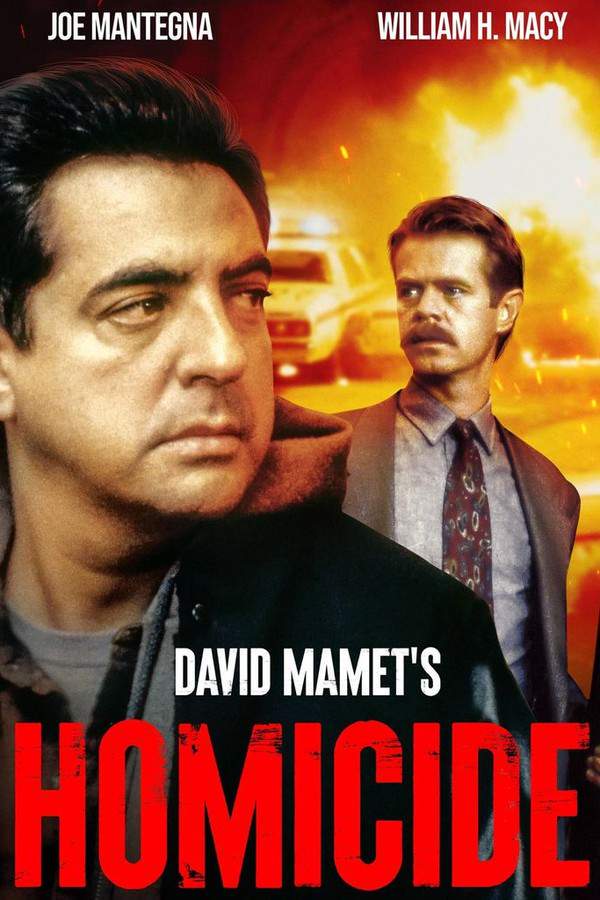
Bobby Gold, [William H. Macy], is a homicide detective on the trail of Robert Randolph, a dangerous drug dealer and cop-killer who sits on the FBI’s Ten Most Wanted List. While chasing an accomplice of Randolph, Gold and his partner, Tim Sullivan, [Joe Mantegna], stumble upon a brutal street crime: the elderly Jewish owner of a neighborhood candy store has been shot dead, and rumors of a fortune hidden in her basement swirl around the case. The son, a prominent doctor, leverages his influence to have Gold reassigned to the investigation, hoping that Gold’s own Jewish heritage will give him a deeper understanding of the family’s tragedy. Yet Gold remains professionally irritated by the distraction from a far bigger, higher-profile case, even as the case quietly begins to tug at his sense of identity and belonging.
What starts as routine police work soon broadens into something larger as late-night conversations with members of the local Jewish community provoke Gold to rethink himself and his loyalties. Through these interactions, he confronts feelings of inadequacy and a nagging sense of not fully fitting into the world he polices. A careful examination of the store owner’s background reveals a past connected to a Zionist organization operating within the city, and Gold’s curiosity shifts toward understanding a community that seems both emboldened and endangered by hidden forces.
Gold learns that the elderly woman once helped arm a Jewish liberation group, a unit dedicated to protecting its people from threats within the city. When he is asked to help steal a list of group members from police evidence to shield the organization, Gold refuses, and the group leaders rebuff him for denying his faith. In a bid to keep the group safe, he reluctantly seeks help from a Jewish woman within the circle, who directs him to a toy shop turned secret stronghold—an alarming repository of Nazi propaganda that confirms the group’s worst fears about antisemitism and danger.
Enraged, Gold lashes out and detonates a bomb the woman had given him, destroying the toy shop and the stronghold. This act deepens the rift between him and his colleagues, as the group then presses him to retrieve the confidential list from police archives. When Gold refuses again, they respond by presenting him with photographs of his actions at the toy shop, effectively blackmailing him into cooperation.
The case against Randolph intensifies, and a crucial raid unfolds with Gold running late after his confrontation with the Jewish group. In the chaos, Sullivan is fatally shot in Gold’s arms, a loss that amplifies Gold’s fury and sense of responsibility. Overcome with rage, he blurts out a racial slur before charging into the building to catch up with Randolph. In the ensuing pursuit, Gold loses his weapon and finds a heavy chain to use as a weapon, finally closing in on Randolph as he tries to escape through a basement exit.
Randolph shoots Gold and taunts him as he clears a metal grate blocking his escape. In a moment of grim calculation, Gold reveals a personal truth—that Randolph’s mother was the one who betrayed him to the authorities—before the antagonist fatally wounds Gold with a final shot to the arm. A fake passport, arranged by Gold’s mother, is produced as a desperate safeguard, but the moment is interrupted when a police officer off screen shoots Randolph in the chest, ending his flight.
Back at the precinct, Gold returns to a reception of mixed, uneasy responses from his fellow officers, who seem distant in the wake of Sullivan’s death and the fallout from Gold’s actions. He is informed that he is now “off homicide.” The investigation closes with a troubling revelation: the old woman’s supposed fortune was not the motive after all, and she was killed by two Black kids aiming to take the reward, a detail that further complicates Gold’s sense of justice and his place within a community that now questions whether he can truly belong.